

In this lecture on the Yoga Vasistha, Sri Swami Jyotirmayananda takes up Upashama Prakarana, Section 30, and unfolds the story of Hiranyakashipu and Prahlada. He is careful to note at the outset that this is not the Bhagavata Purana’s telling. It is an allegory, and every character in it lives inside you right now.
The Allegory Behind the Story
Swamiji opens with a caution that shapes the entire lecture: these are allegorical stories. Hiranyakashipu is not a demon who lived once, long ago. Hiranya means gold, and gold in scripture stands for the base of greed, the same greed that once sent a golden deer running through the Ramayana to distract Sita. Read this way, Hiranyakashipu is a name for a very familiar force: the demoniac, lower self that can come to dominate a person who lets a negative quality grow, unshaken, day after day.
Hiranyakashipu: The Anatomy of Ignorance
Hiranyakashipu rules three worlds, and Swamiji is explicit about what those three worlds are. They are thought, word, and action, the plane of understanding, the plane of speaking, and the plane of practical reality. Ignorance does not stay confined to the mind. It moves through everything you think, everything you say, and everything you do, until it dominates all three.
Prahlada: The Seed of Devotion
Against this, the story sets Prahlada. Even before his birth, while still in the womb, his mother received teaching on bhakti and jnana from the sage Narada. Prahlada is born already a devotee, and no torment his father devises can shake that devotion, not even Holika, his aunt, who was immune to fire and still could not survive the very fire meant to destroy him. Swamiji traces the English word “holy” straight back to her name. Prahlada is the counter-movement to Hiranyakashipu, what Swamiji calls the healthy devotional movement that answers ignorance, seated in the same three worlds, thought, word, and action.
Narasimha: Where Self-Effort Meets Grace
The turning point of the story is Narasimha, Vishnu’s incarnation as half lion, half man. Swamiji gives this a precise inner meaning. Nara is the human, the self-effort, purushartha, that a person brings on their own. Simha, the lion, is grace. Narasimha arises only when the two blend. Self-effort alone stays merely human. Grace alone has nothing to work through. When sadhana commences and self-effort meets grace, the strength that rises is lion strength, and it is this combined force, arms of samadhi, nails of viveka, that tears down Hiranyakashipu and gathers Prahlada, devotion, into its arms.
The Power Hidden in a Single Mantra
Swamiji then turns to the mantra Om Namo Narayanaya and takes it apart letter by letter. Om itself he calls the mother of all mantras, the sound in which the throat opens and the lips close, pointing beyond both to the transcendental. Na is the negation of the mind’s impurities. Ra is the awakening of spiritual potentiality. Ya is the ascending steps of wisdom that lead, finally, to the heart. Every mantra carries this same seed of namo, the assertion that nothing belongs to me, the negation of the ego that makes real devotion possible in the first place.
The Seven Stages of Wisdom
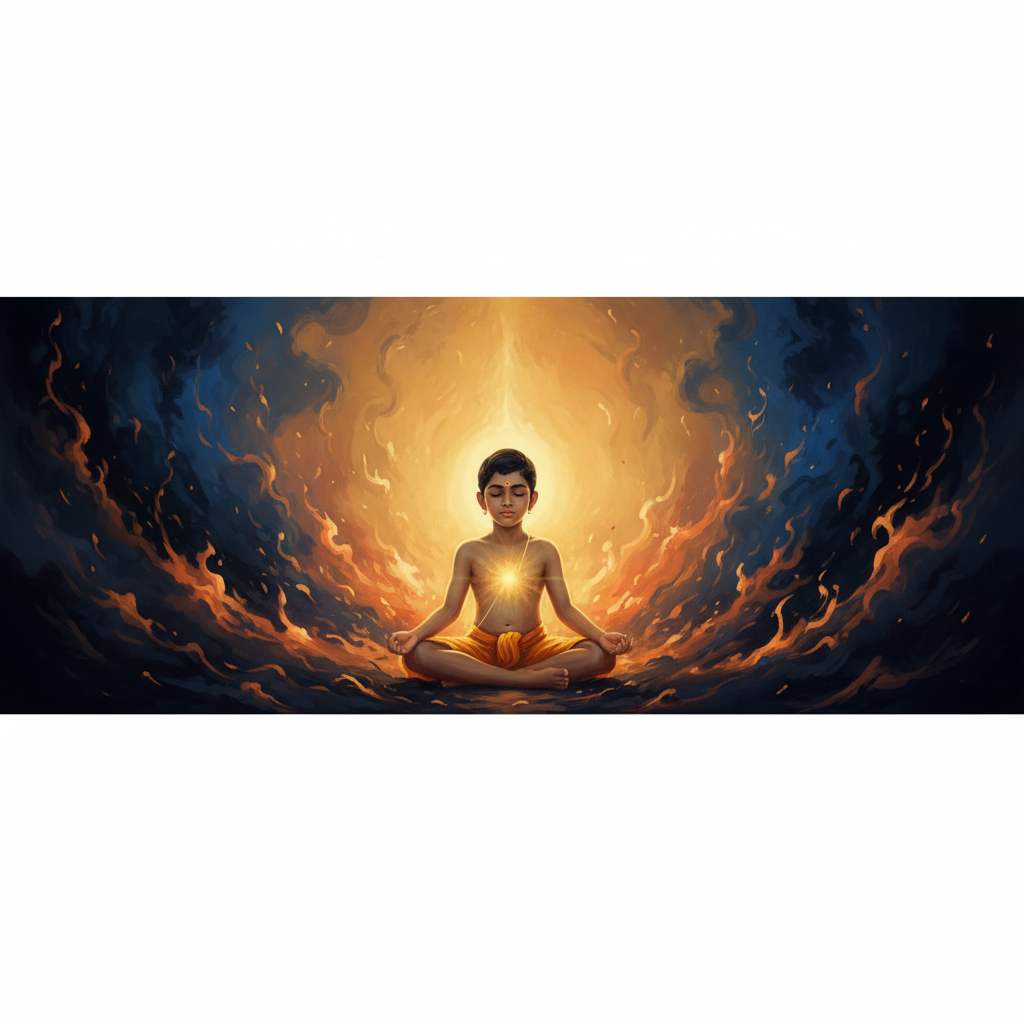
From the mantra, Swamiji moves into the Sapta Bhumika, the seven stages of wisdom that the Yoga Vasistha itself lays out, and touches all seven in this lecture. Shubheccha is the initial aspiration, a real hunger for something more than perspiration and outer effort. Vicharana is sustained inquiry, the mind turning to ask “Who am I.” Tanumanasi is the thinning of desire, where old cravings for anger, hate, and greed begin to lose their weight. Sattvapatti is the clarity that follows, described through the image of clouds that no longer block the sun but begin to display its glory. Asamsakti is the freedom of the liberated, where the mind, like the sky, welcomes every cloud, positive or negative, without being touched by any of them. Padartha Bhavana is the stage after that, illustrated through deep sleep: the world falls away just as it does when you sleep, except here the falling away is permanent understanding, not temporary absence. What returns is not the old world but the recognition that it was always Brahman, echoed in the line Swamiji quotes, “Siyaram mayi sab jaga jani,” Rama and Sita seen pervading the whole world. The seventh stage he leaves almost entirely unspoken, true to its nature: beyond description, beyond even the “revelation” of the fourth stage, a silence he does not try to fill with words.
Ahamgraha Upasana: Becoming What You Worship
The lecture closes on the highest form of devotion Swamiji describes, Ahamgraha Upasana. Ordinary worship keeps the deity separate from the worshipper. This higher form dissolves that distance entirely. Prahlada does not simply praise Vishnu from outside. He declares, “I am the all-pervading Self. I am Vishnu, the destroyer of the forces of darkness.” Swamiji is clear that this is not arrogance. It is the natural end point of real bhakti, because bhakti is love for truth, and the deepest truth devotion can uncover is that the one you have been worshipping and the one doing the worshipping were never two.
Scholar’s Corner
The Hiranyakashipu-Prahlada narrative appears across Puranic literature, most famously in the Bhagavata Purana and the Vishnu Purana, though Swamiji notes explicitly that this lecture follows the Yoga Vasistha’s own telling in the Upashama Prakarana rather than those accounts. The Sapta Bhumika framework belongs to the Yoga Vasistha itself, a sevenfold map of the ascent from aspiration to liberation. The Ashtakshara mantra, Om Namo Narayanaya, is one of Vaishnavism’s central mantras, and the threefold classification of its recitation, vocal (Vaikhari), whispered (Upanshu), and mental (Manasika), is a standard part of Indian mantra science.
Glossary
Upashama Prakarana – the section of the Yoga Vasistha dealing with the quieting of the mind. Hiranyakashipu – in this allegory, ignorance dominating thought, word, and action. Prahlada – the seed of devotion that survives and ultimately overcomes ignorance. Narasimha – Vishnu’s half-lion incarnation, the union of self-effort and grace. Purushartha – self-effort, one’s own spiritual exertion. Sapta Bhumika – the seven stages of wisdom described in the Yoga Vasistha. Padartha Bhavana – the sixth stage of wisdom, recognizing every object of the world as Brahman itself. Ahamgraha Upasana – the highest form of meditation, in which the worshipper realizes identity with the deity. Bhakti – devotion, understood here as love for truth.
Watch the Full Lecture
The complete lecture is available on the Yoga Research Foundation YouTube channel.
This study guide is drawn from the archived teachings of Sri Swami Jyotirmayananda.