

The human experience is often defined by a profound lack of mental control. We wake up with the intention to be peaceful, yet immediately find ourselves governed by stress, reactive emotions, and lingering fears. The mind, rather than serving as an instrument for our liberation, becomes a tyrannical master. Sri Swami Jyotirmayananda, a direct disciple of Swami Sivananda, provides the authoritative scriptural cure for this modern symptom by expounding on Patanjali’s Raja Yoga Sutras. By understanding the nature of our thought waves, we step into our rightful position as the master of the mind.
The Mind as an Instrument (00:00:01)
The ideal state of the human condition is not one where the mind ceases to function, but rather one where the mental process is entirely under your command. The mind is merely an instrument. It is akin to an umbrella: you open it and use it when it rains, and when you return home, you fold it and put it away.
However, most individuals walk through life with the umbrella perpetually open, unable to detach from the relentless stream of thoughts. Understanding that your true self—the Spirit, the Absolute—is distant and distinct from these thought waves is the foundational step toward spiritual realization. You are the screen upon which the cinema of life is projected; you are not the changing pictures.
The Five Vrittis (00:04:19)
To gain control, one must first identify what is being controlled. Patanjali classifies all mental modifications into five distinct categories of thought waves, known as vrittis. These are: Pramana (Right Knowledge), Viparyaya (Wrong Knowledge), Vikalpa (Imagination), Nidra (Sleep), and Smriti (Memory).
Every experience you possess, from childhood to your present state, is constituted by these five factors. They operate constantly, generating either Sattvic (harmonious), Rajasic (agitated), or Tamasic (dull) effects within your consciousness.
Right Knowledge and Imagination (00:08:21)
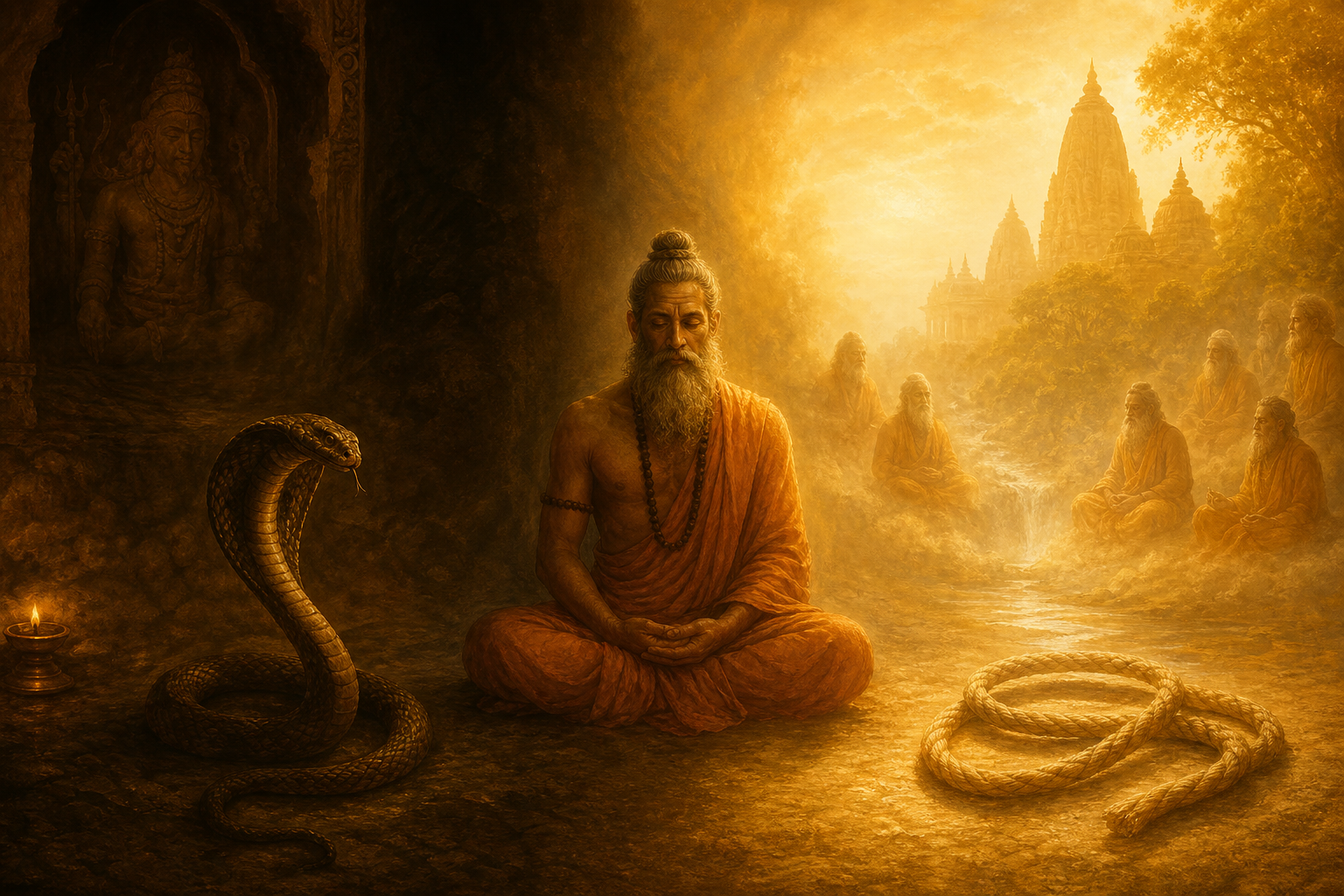
Pramana, or right knowledge, is achieved through direct perception, logical inference, and authentic scriptural testimony (Agama). Seeing a rope accurately as a rope in a well-lit room is right knowledge.
Conversely, Viparyaya is wrong knowledge—the classic Vedantic illustration of seeing a snake in the dim light where only a rope exists. The mind molds itself to an illusion, triggering real psychological and physiological fear based on a complete falsehood.
Vikalpa takes this a step further into sheer imagination. It is a thought wave based merely on verbal knowledge, devoid of any physical reality. In the modern era, populations are heavily fed by Vikalpa through media and societal chatter, leaving the mind soaked in erroneous assumptions that breed deep-seated anxieties.
The Illusion of Sleep and Memory (00:13:57)
Nidra (sleep) is not the absence of thought, but rather a specific vritti that sustains the perception of nothingness. Just as a film projector rapid-fires black frames to create the illusion of a dark screen, the mind exerts effort to create the perception of sleep. It is the thought wave of absence.
Smriti (memory) is the recollection of objects and experiences previously stored in the mind. A healthy memory recalls an experience exactly as it was, without distortion. Defective memory, heavily influenced by egoism and attachment, selectively remembers only the pleasant or the painful, further distorting your present reality.
Abhyasa: The Power of Unbroken Practice (00:32:42)
How do we tame these five thought waves? The first method prescribed by Patanjali is Abhyasa—the repeated, persistent effort to secure the steadiness of the mind.
For practice to become firmly established, it must observe three conditions: it must be done for a long time, it must be continuous without break (Nairantarya), and it must be performed with deep faith and devotion (Shraddha). A jerky, inconsistent practice yields little fruit. Daily, steady application, filled with devotional feeling, slowly transitions the mind from a state of affliction to a state of profound clarity.
Vairagya: True Dispassion and Mastery (00:38:47)
The sister practice to Abhyasa is Vairagya, or dispassion. Vairagya is frequently misunderstood as a forceful, painful tearing away from the things you love. In truth, it is the highest form of mastery.
When you wake up and your mind prevents you from being happy, it is like having an unruly monkey sitting on your head. Vairagya is the realization that it is your monkey. You do not have to remain its slave. By progressively seeing the defects in mundane attachments—recognizing the inherent pain in the cycle of birth, disease, and death—you naturally withdraw your dependence on the external world. You train the mind to serve your highest good, ultimately paving the way to self-realization and absolute peace.
Scholar’s Corner
- Yoga Sutras 1.6: “pramāṇa viparyaya vikalpa nidrā smṛtayaḥ” — The five modifications of the mind are right knowledge, wrong knowledge, imagination, sleep, and memory.
- Yoga Sutras 1.14: “sa tu dīrghakāla-nairantarya-satkārāsevito dṛḍhabhūmiḥ” — Practice becomes firmly grounded when attended to for a long time, without break, and with deep devotion.
- Yoga Sutras 1.15: “dṛṣṭānuśravika-viṣaya-vitṛṣṇasya vaśīkārasaṃjñā vairāgyam” — Dispassion is the mastery of consciousness in one who has ceased to thirst for objects seen or heard about.
Glossary of Sanskrit Terms
- Vrittis: Thought waves or modifications of the mind.
- Pramana: Right knowledge (via perception, inference, or scripture).
- Viparyaya: Wrong knowledge or illusion.
- Vikalpa: Imagination based on verbal delusion.
- Nidra: The thought wave of sleep.
- Smriti: Memory or recollection.
- Abhyasa: Sustained spiritual practice.
- Vairagya: Dispassion; mastery over desires.
- Klesha: Afflictions of the mind, such as ignorance or fear of death.
Watch the Full Lecture
Watch the full lecture on YouTube.
Join the community for daily inspiration.
This study guide is drawn from the archived teachings of Sri Swami Jyotirmayananda.