
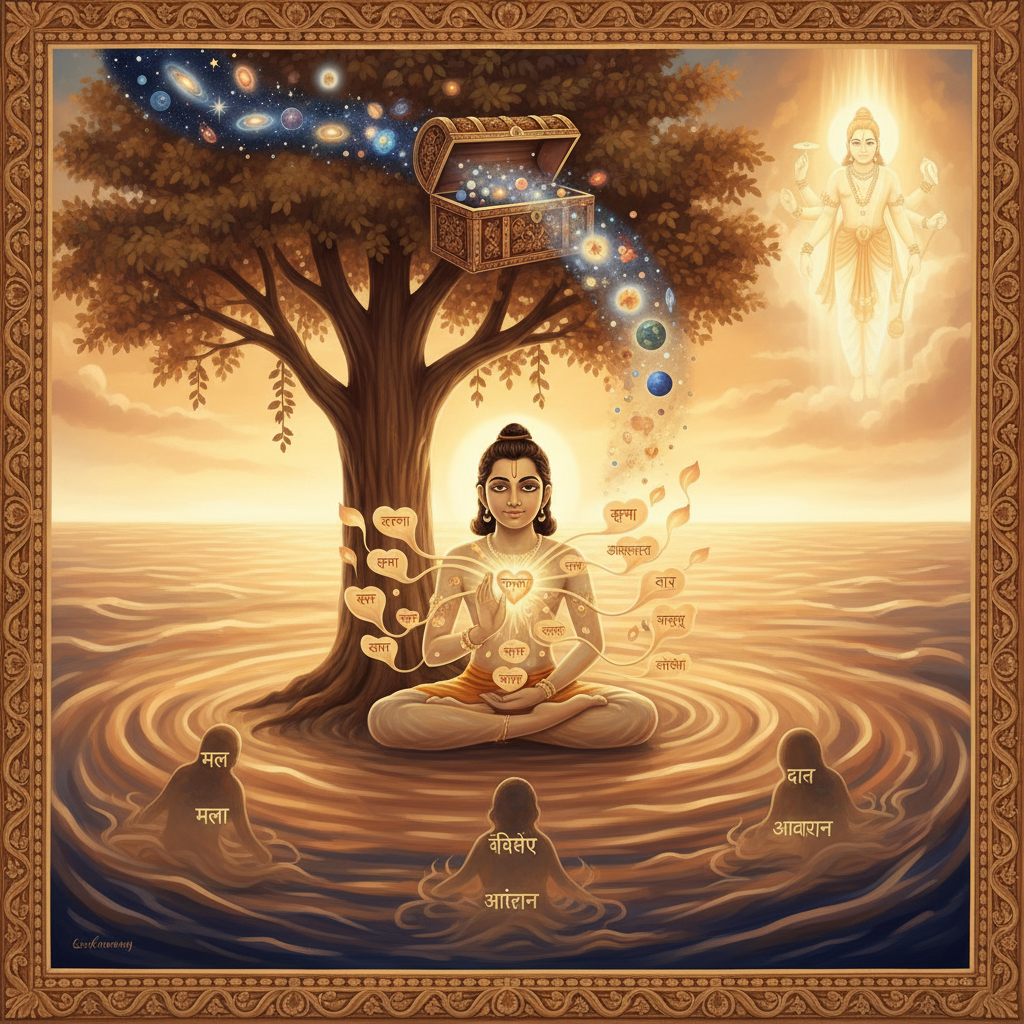
Sri Swami Jyotirmayananda continues the Yoga Vasistha, Upasama Prakarana, Section 35, where Sage Vasishtha tells Rama how Prahlada, through profound reflection (vicara), came practically to the state of enlightenment. Because he arrived there, whatever he practiced along the way is important for every aspirant.
The Enemy Named Ignorance
Prahlada’s first declaration is that he has destroyed the enemy in the form of ignorance, which had robbed him of his discriminative intellect. Swamiji names this as the project before every individual: a soul separated from viveka-buddhi, from sanmati (pure understanding), is the deepest of all separations. You may unite with the whole world and still, without sanmati, be seated in a shaky ship that no other ship can rescue.
To recover that intuitive knowledge, three levels of ignorance must be destroyed — avidya, kama, and karma, described in another vocabulary as mala, vikshepa, and avarana.
Mala, Vikshepa, Avarana
Mala is gross impurity. A personality gripped by anger, hatred, and greed never quite knows how it will act; it lives led by the whims of the mind, which feels easy and natural to the masses but is not the ideal state. Swamiji adds a sharp observation: we try to overpower our own impurity by finding greater impurity in others, and feel relieved by the comparison.
Vikshepa is distraction, fed by the vasanas — subtle impressions in the subconscious we are not even aware of. Distraction is subtle enough to corrupt even a right course. A person looking for satsanga can end up more involved in hopping from ashram to ashram than in actually listening. Swamiji’s memorable image is Ravana, a genuine scholar of the Vedas whose scholarship was interpreted by ten heads, each saying something different, until he concluded, “No one is like me.”
Avarana is the veil of ignorance itself, dwelling at the deepest, unconscious level. As long as avidya remains, the negative vasanas keep receiving nourishment. The whole goal is to free oneself from these three enemies — and the art of handling them, Swamiji says plainly, is the practice of integral yoga and being truly devoted to God.
Ego Is Not Egoism
By the grace of Lord Vishnu, Prahlada says, he recovered his viveka and attained knowledge of the Self. Here Swamiji makes a distinction worth keeping. Without ego you cannot exist even for a moment — it is not the enemy. But when ego stays married to rajas and tamas and never matures into sattva, it becomes a disease called egoism, ahamkara. (Swamiji jokes that you have found the worst car you can ever own: aham-kara.) All the troubles of humanity, he says, rest on ahamkara — it is what shuts out the natural qualities inherent in the soul and blocks the one question, “Who am I?”
The Virtues You Do Not Have to Learn
Those inherent qualities are the atmaguna — and Swamiji lists them with warmth, because they are not achievements but your own nature once impurity clears. Daya, compassion. Shanti, and kshama, a forgiveness so free of self-congratulation that it is like a mother tickled by her child’s antics rather than a superior pardoning an inferior. Anasuya, the absence of jealousy — for everyone runs their own karmic process and has the same resources, so why waste energy hunting faults in others? Shaucha, a spontaneous drive to remove impurity, inner and outer, the way you brush mud off your head without asking anyone’s permission. Anayasa, doing your best effortlessly, the way a tree lets a flower open and waft fragrance while everyone sleeps. Mangala, the auspiciousness a baby lives in, excited by every next moment without needing an astrologer to tell it whether to be happy. Akarpanya, not being miserly — the natural human urge to share whatever you discover with the whole world. And aspriha, living not with craving but with fulfillment.
These, Swamiji says, are the blooms that deck the personality of one who has come to enlightenment.
Nothing Left to Attain
Having gained the boundless treasure of discriminative knowledge — viveka-buddhi, a direct experience, not an intellectual one, that “I am not the body, mind, intellect, or senses” — Prahlada makes the great declaration. Swamiji quotes the Sanskrit of the Yoga Vasistha: all that is to be known, I have known; all that is to be seen, I have seen; all that is to be attained, I have attained; nothing more remains to be accomplished by me.
It is, he says, much more than winning a million-dollar lottery — when a lottery is won a whole country gets excited, yet here the greater truth is that you have won all that you see.
The long-lingering poverty of the soul in bondage — poor not only in circumstance but in understanding, through countless embodiments — has vanished. No more “poor, poor,” but “perfect, perfect.” I now abide in the Supreme Self.
Swamiji unfolds the classic ascent of the “I”: you are not merely the body but, through the mind, the universe; not an individual mind but the cosmic mind; the very reality behind the mind, Ishvara; and finally, all this being maya, “you alone are” — aham brahmasmi. And to the childish worry, “if I become Brahman, what happens to all these people?” — the answer is the ocean. You became the ocean; all people are its waves. From the ocean’s angle, all waves are “I am.”
From Form to the Formless
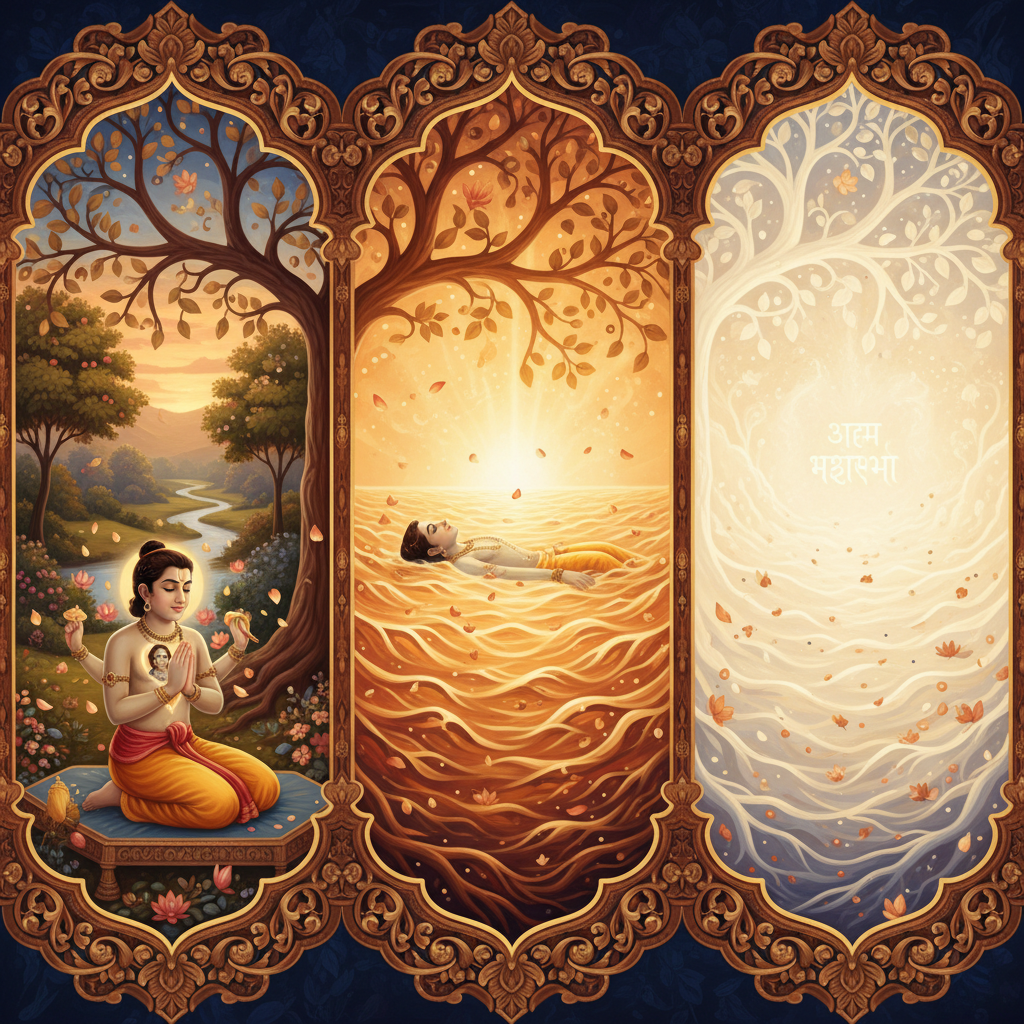
All of this, Prahlada says, was attained by adoring Lord Vishnu. So Swamiji closes on devotion, and its three maturing stages. First, saguna sakara — God with form and quality: Shiva with his matted locks and crescent moon, Rama, Krishna, the Devi, visualized in the lotus of your own heart, and then recognized in the eyes of a smiling child. Second, saguna nirakara — the form recedes and the mind rests on the qualities: God as an ocean of compassion, of kindness, the thousand names describing His glory. Third, nirguna nirakara — form and attribute both fall away; the mind is so overwhelmed by divine awareness that it no longer needs a description, the way you do not describe the sun once the cloud has moved. Every concept of bliss you had, Swamiji says, was only a glowworm’s light next to the ananda that God is.
The proof of devotion is coming closer and closer until there is nothing but God. Then, and only then, is devotion perfect. Prahlada arrives exactly there — “I and Lord Vishnu are one and the same” — able to speak both as an unshakeable devotee, a dasa, an instrument, and from the inner awareness that his very reality is God Himself. That, Swamiji says, is where bhakti and jnana become two aspects of one attainment.
Reflect
What are you still seeking outside yourself, that the Self already contains?
Scholar’s Corner
- Yoga Vasistha, Upasama Prakarana, Section 35: the description of Prahlada’s enlightenment — the three impurities cleared, the atmagunas that bloom, “all that is to be known is known,” and devotion maturing from form to the formless.
- Mala / vikshepa / avarana (also avidya / kama / karma): the three obstacles to be destroyed to recover viveka-buddhi.
- “Jnatam jnatavyam akhilam…“: Prahlada’s declaration that all worth knowing is known, all worth attaining is attained.
Glossary
- Viveka-buddhi
- intuitive discriminative intellect that distinguishes the Self from the not-Self.
- Sanmati
- pure, right understanding arising from the soul.
- Mala, vikshepa, avarana
- gross impurity, distraction, and the veil of ignorance.
- Vasana
- subtle subconscious impression that drives craving and distraction.
- Ahamkara
- egoism — ego fixed in rajas/tamas, distinct from the healthy functional ego.
- Atmaguna
- the innate virtues of the soul (compassion, forgiveness, spontaneity, and the rest).
- Karuna Sagar
- “Ocean of Compassion,” a name for God at the second stage of devotion.
- Saguna sakara / saguna nirakara / nirguna nirakara
- God with form-and-quality, with quality alone, and beyond both.
- Aham Brahmasmi
- “I am Brahman.”
Watch the full lecture at https://youtu.be/F0w8qMSqJJ4
This study guide is drawn from the archived teachings of Sri Swami Jyotirmayananda.