
Orientation
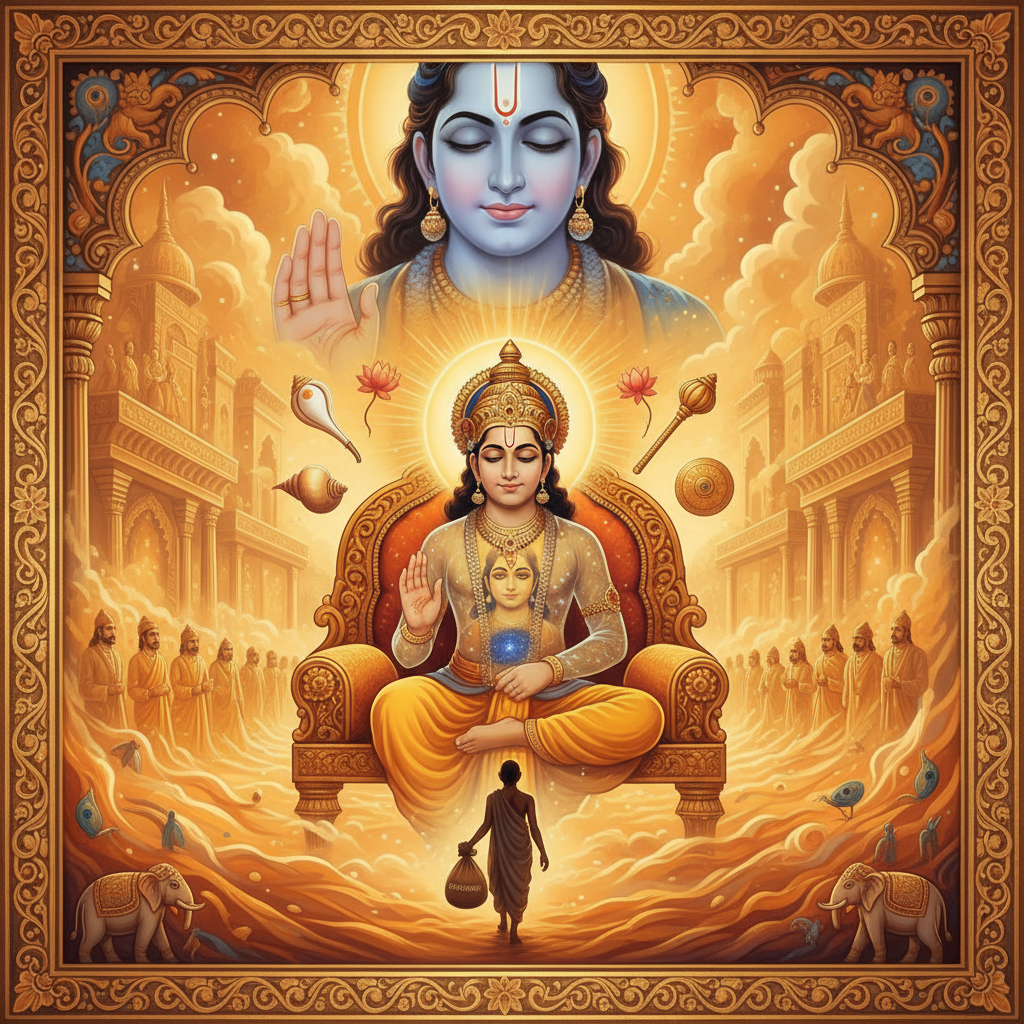
Prahlada, the demon king who became one of the great devotees, has gone into samadhi and not come out. Sage Vasistha has been telling Rama this story for several sections now, and at Section 41 of the Upashama Prakarana it reaches an odd resolution: Lord Vishnu arrives, wakes him, and tells him to go back to work. Rule the kingdom. Finish out your prarabdha karma. Then you will be free of the body too.
Swami Jyotirmayananda spends the first third of this lecture on why devotion is what produced that state, and he does it through a single line of the Bhagavad Gita — upadrasta anumanta ca bharta bhokta maheshvarah — which he treats not as a list of divine attributes but as five stages a devotee actually passes through. At 05:01 God is the one quietly looking over you, the way someone looked after you when you were a baby who did not yet know who he was. By 10:47 the same God is enjoying through your personality, and the ego through which that happens has become transparent enough not to hurt.
The turn in the lecture, and the reason for its title, comes at 35:22. Swamiji has just described the mediocre sannyasi who keeps reminding his disciples how much land he walked away from — and then flatly removes the ground from under him. From the point of view of the enlightened there is nothing to renounce, because the world was never anything other than Brahman. Renunciation as an achievement requires that something real be given up. Nothing was.
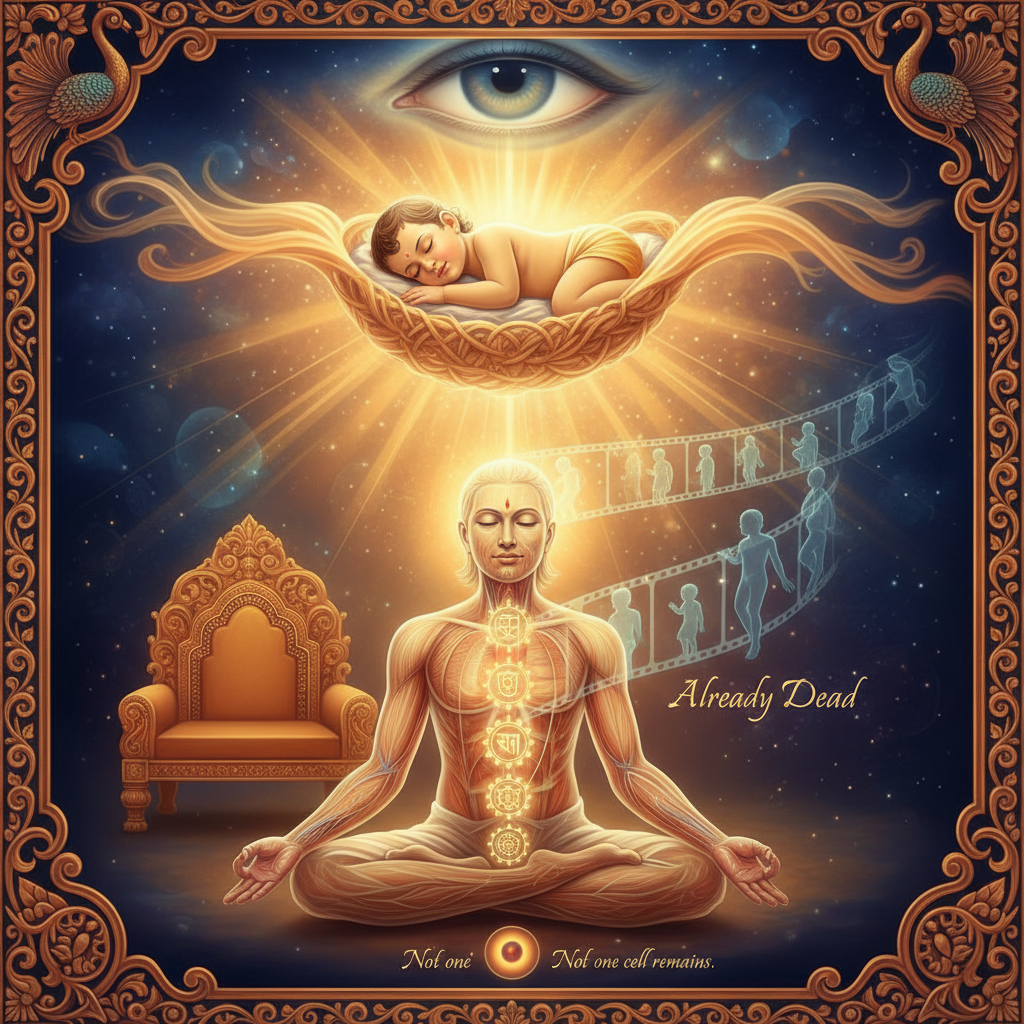
What follows is the harder half. Swamiji takes up the belief that pain belongs to the body and therefore ends when the body does, and says plainly that ending the body does not end the pain, it postpones it into another one — the same karma, a new embodiment, the suffering chloroformed rather than cured. He is equally impatient with the death-anniversary ritual and the birthday blessing “may you live long,” and gives the reason at 30:01: this body has already died many times over, and not one cell from your infancy remains. So which body is the grief for?
Passage index
- 00:00 — The ocean beyond the waves
- 02:06 — Upashama Prakarana, Section 41
- 02:52 — Prahlada asleep in samadhi
- 03:34 — The five names of God in the Gita
- 05:01 — Upadrasta and anumanta: witness and approver
- 09:55 — Bharta and bhokta: support and enjoyer
- 12:35 — Ruling until prarabdha is spent
- 16:59 — When effort becomes spontaneous
- 20:33 — Samadhi with the eyes open
- 23:23 — Existence, awareness, bliss in every object
- 27:59 — Not grief, not delusion, not fear
- 30:01 — The body has already died many times
- 35:22 — For the enlightened, nothing to renounce
- 39:25 — All is pain to the discerning
- 44:15 — Conch, lotus, mace and discus
- 47:03 — Prahlada returns to the throne
The five names the Gita gives to God
The Gita line Swamiji builds on is a description of the Supreme dwelling in this body: witness, permitter, supporter, enjoyer, great lord. Read as theology it is a list. Read as Swamiji reads it, it is a sequence — and the sequence is what a devotee’s inner life actually looks like as it matures, which is why he introduces it immediately after saying that Prahlada’s devotion has come to its climax.
Before devotion, he says, everything rests on your own effort, and the result is exhaustion: perspiration without inspiration. That phrase is worth sitting with, because it names something most sincere practitioners recognise and few admit. You are working hard. Nothing is opening. The work itself has become the obstacle.
Upadrasta: someone is looking over you
The first shift is not an insight but a change of felt company. Where you previously met frustration and emptiness and concluded that no one in the world could help, the same moment now arrives with a sense of being watched over. Swamiji reaches for infancy to make it concrete: you did not know who you were, you could not have looked after yourself, and you were looked after anyway. He extends it to the present with a list of things happening in you right now without your knowledge or consent — your nails, your hair, the blink you did not decide to make. Ninety-nine percent of your personality, he says, is being handled.
He is careful about what this stage is not. It is not yet knowledge. It is a felt protection, an umbrella, God hiding and yet present. That is the whole of the first stage, and he does not inflate it.
Anumanta: the approval you feel as joy
The second stage gives the devotee something he did not have before: feedback. Swamiji describes an internal source of approval that switches on when your sadhana is on the right track — you feel inspired, you feel joyous — and an obstruction that appears when it is not. This is his answer to a question every practitioner eventually asks and rarely gets answered: how would I know if I am going the right way?
His image for it is domestic rather than juridical. God comes like a mother, patting the back: you are doing well. And when you go the wrong way, the same motherly hand can scold, can push you back — and you will not recognise it as love at the time. You thank her later.
Bharta and bhokta: the support, and the one who enjoys
The third stage is unconditioned support. Swamiji offers a simile and then immediately marks it as one, which is characteristic: the sun supports its own reflection. He does not let the analogy overreach.
The fourth is the strange one, and he handles it carefully. It is God who is enjoying through your personality — your personality was never meant for the fulfilment of your ego. He walks through what that requires: ego effacement, the first stage of which is simply that egoism keeps your head heavy. What is left, once the “this is mine” has moved off it, is an ego that has become transparent and does not hurt you. Through that transparent ego you notice that every thought, word and deed occurring in you is His. You look for yourself and find no place for yourself. And then, he says, comes the shocking revelation — and it is the shock, not the sweetness, that tells you devotion has reached its height.
When effort becomes sahaja
Roughly a third of the way in, the lecture stops being about stages and becomes about the texture of an advancing practice. The word Swamiji uses is sahaja: spontaneous, natural, not-forced. He is precise that this does not mean things become easy. It means the struggle stops being purposeless — there is an internal fulfilment inside the effort.
“Waves are there, but the ocean is beyond the waves.” 41:09
His illustration is the sun behind cloud. While it is hidden there is a constant effort among the masses about how to bring light. When the cloud moves away, effort has no role. Nothing was added; something stopped obstructing. He applies it directly to the moral life: early on you are managing your anger, your irritation, your bitterness, and later you find yourself wondering what used to make you bitter. Not because you won the fight. Because the taste changed, and the mind stopped being willing to stoop.
Samadhi with the eyes open
Prahlada tells Vishnu that he has long meditated on him through the internalised flow of the mind, and now beholds him with his physical eyes. Swamiji takes this as the technical point of the section: Prahlada is now in samadhi whether his eyes are closed or open.
He is even-handed about why the early instruction is the opposite. In the first stage you are told not to go after the world — sit in the puja room, withdraw the mind, and follow the chain inward: what guides the senses, the mind; what guides the mind, the intellect; what guides the intellect, the Cosmic Mind; and who, then, am I. That inquiry lands on aham brahmasmi, and Swamiji’s comment is dry — you have realised it, and your eyes are still closed. Some embellishment remains. Externalisation has to stop disturbing the vision, and then it has to start inspiring you as much as internalisation did.
Existence, awareness, bliss in a spoon
The metaphysics arrives late and in domestic clothing. Take any object at all — a spoon, shoes, a human being, a bird. Swamiji identifies three ingredients in it, asti, bhati and priya, mapping to sat, cit and ananda: it exists, it is knowable, it can delight. Names and forms get so highlighted to the human mind that the satchidananda behind them is forgotten. Look at a row of trees and what you are seeing is existence in various expressions.
His image for the second layer is a lake carrying reflections: the reflections have no reality of their own, the lake does. And the practical consequence is the one he wants — your project is not only to discover God within you, but to see that every little detail of the world is nothing but Brahman. Put those two together, he says, and that is maturity. Either one alone is unfinished.
Why the sage does not discard the body
Prahlada is explicit that he retired into samadhi not from grief, not from delusion, not from fear of the world, and that he never intended to discard the body. Swamiji uses this to separate a healthy practice from the one most people begin with — in the early stage, fear and helplessness leave you no choice but to turn to God, and that is fine, but it is not where this ends up.
Then he takes on mortality directly. The body is a residence. You live in a house without worrying about the mortality of the house. This does not license neglect: take care of the body, do all the details, but not from the helpless identity of being it. And the annual rituals of grief around a date of departure he calls, without softening it, ridiculous — because the body being mourned has already been replaced many times over, with not one cell surviving from infancy.
Nothing left to renounce
The passage the head of this lecture comes from is short and it is aimed at religious people. Swamiji describes the early aspirant who builds an identity out of what he gave up, and the mediocre sannyasi who reminds his disciples that he was going to be a very big landowner. The disciples, he notes, feel the greatness of the guru. He does not.
“From the point of view of the enlightened, there is nothing to renounce. For this world is nothing but Brahman.” 35:22
His grounds are not ethical but metaphysical, which is what makes it hard to argue with. Renunciation as a credential requires that the thing renounced was real and was yours. If nothing exists apart from Brahman and nothing belongs to you, then the very “I” doing the accounting is not finally real either — so the ledger of how much I have given up and how much more God wants is a ledger kept in a currency that does not exist. What he offers in its place is unglamorous: have patience, come to satsanga, follow Integral Yoga in daily life.
Pain does not end with the body
This is the section to handle with care, and Swamiji does. The ignorant believe pain belongs to the body, so only the death of the body will end it — and for someone unable to handle psychological suffering, the mind offers a quick suggestion: no body, no pain. He answers it flatly. It does not end the pain. The same karma has to be gone through in another body, nature has to bring about another embodiment, and the suffering has only been chloroformed for a while. The disease has not gone anywhere.
What ends pain, he says, is the intuitional knowledge of the Self dispelling the illusion of body-identification. Nothing shorter works. And he widens the definition of pain until it becomes uncomfortable: sarvam duhkham vivekinah — to the discerning, all is pain. Any situation that is not fulfilling the purpose of your life is a form of pain, no matter how prosperous it looks. However happy you are, if that happiness has not contributed to your movement Godward, it is pain.
The four yogas in Vishnu’s four hands
Prahlada worships Vishnu, who is holding conch, lotus, mace and discus, and Swamiji reads the four objects as the four yogas. The conch is the awakener, jnana yoga. The lotus is devotion, bhakti. The mace is dhyana, meditation that strikes the mind again and again. The discus is karma, self-effort in daily life. His point is structural rather than decorative: the soul becomes aware of the four, and then the reality of the soul appears holding all four. Not one of them alone.
He is also unwilling to look down on the beginning of the path. Prahlada, already enlightened, ends by asking Vishnu to accept his ritual worship — and Swamiji says this is deliberate, so that those not at a high level can begin where they are. Rituals matter for the masses because they draw the mind, again and again, until some become sensitive enough to go deeper. Every step has its own importance. What he warns against is not ritual but stopping there.
Prahlada returns to the throne
Vishnu’s instruction is to rule until prarabdha karma is spent, with a mind free of attachment, fear and anger, and the reason given for the brevity is striking: you are enlightened, therefore you need no more instruction. Then he disappears, and Prahlada goes back to his royal duties with an enlightened mind — like King Janaka, Swamiji adds, who is the standing example of the same thing.
The paradox he leaves it on is that living with the body, for such a person, is what is meant by the bodyless state. Whether with or without a body, one with Brahman. And the next section, he says, takes up the prarabdha of the sages — which is where the lecture stops.
Terms
- upadrasta — the witness; God as the one quietly looking over you
- anumanta — the permitter; the inner approval, or obstruction, that tells you whether your practice is on track
- bharta — the supporter; support that is not conditioned by anything you do
- bhokta — the enjoyer; God experiencing through your personality
- sahaja — spontaneous, natural; effort that has stopped being forced
- samadhi — absorption; here, the state Prahlada holds with his eyes open or closed
- prarabdha karma — the portion of karma already in motion in this life
- videhamukta — one liberated without the body, as distinct from liberation while embodied
- satchidananda — existence, awareness, bliss; the reality behind names and forms
- asti, bhati, priya — that a thing is, is knowable, and can delight
- sarvam duhkham vivekinah — to the discerning, all is pain
For reflection
- Where are you still holding on to something you have already understood is not real?
- Can you name a time an obstruction turned out to be a correction?
- What in your practice has become sahaja, and what is still perspiration without inspiration?
Yoga Vasistha, Upashama Prakarana, Section 41 — Lecture 182, by Sri Swami Jyotirmayananda, the last living direct disciple of Swami Sivananda. The Yoga Research Foundation archive is free.
This study guide is drawn from the archived teachings of Sri Swami Jyotirmayananda.