
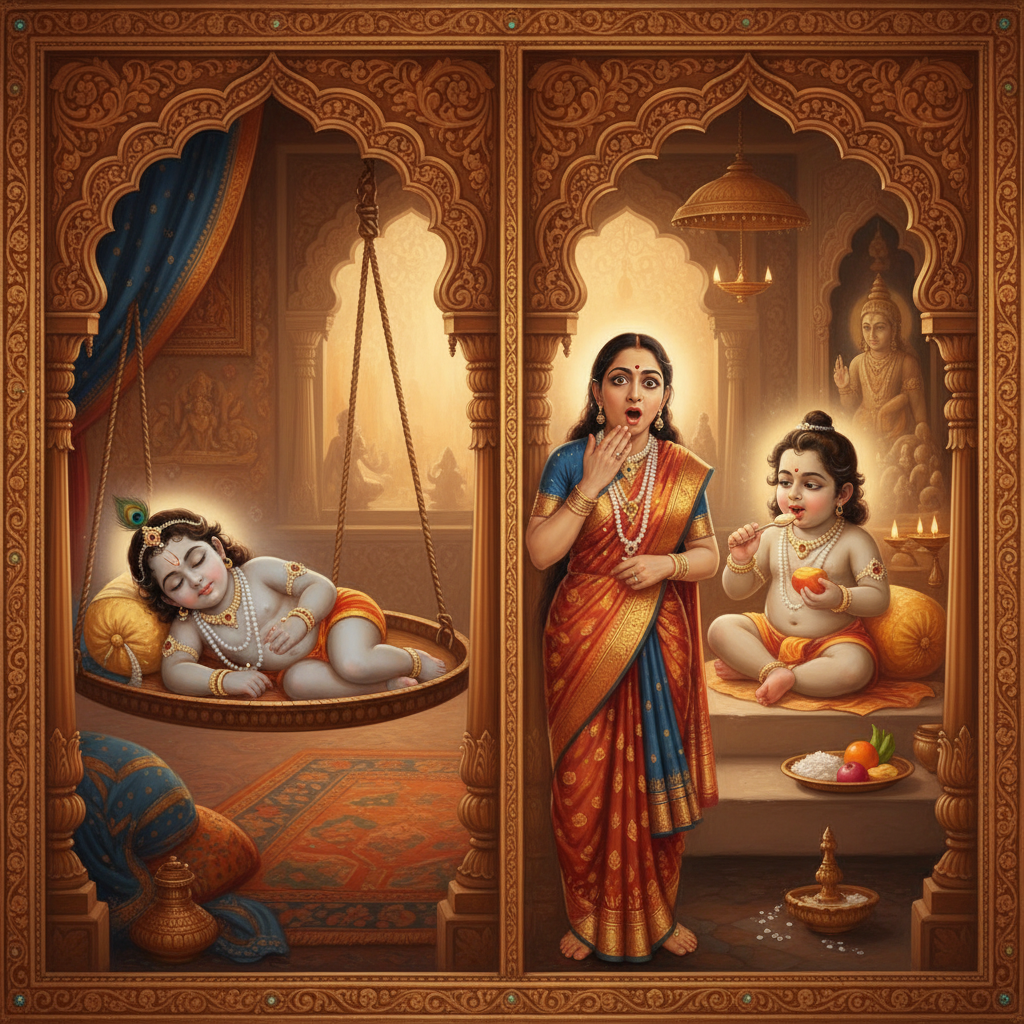
Kausalya has just finished dressing her infant in his ornaments. She lays him down, performs her worship, offers food to the deity, and steps away to the kitchen. When she comes back, Rama is eating the offering. She runs to where she left the child and finds him asleep, exactly as she put him down. She goes back. He is still eating. Her mind, in Tulsidas’s phrase, loses its balance.
Almost every retelling treats this as a marvel — proof of divinity, a wonder to be admired and moved past. In this lecture Swamiji does something else with it. He treats it as a description of a stage, and specifically as a description of the moment a devotee’s practice stops being safe.
The distinction the lecture turns on arrives at 32:51, and it is blunt. Worship conducted inside a shrine, he says, remains in kindergarten. Not false. Not optional — he is explicit that you must do it. But kindergarten. What Kausalya undergoes is what happens when devotion opens a door the worshipper did not know was there: you come out of the temple expecting the ordinary world and find the same God already moving in it. Swamiji names the shock directly, and then names the harder part, which is that until the shock is assimilated the devotion stays where it was.
Around that centre the lecture builds two supports. The first, laid out from 05:04, is a ladder of the tastes of divine love — five relationships a soul can hold toward God, from the quiet pull that asks for nothing to the total self-abandonment of the mystics. The second, from 14:19, is a warning: scriptural learning, meditative practice and acquired powers do not by themselves cut the bondage they are meant to cut. Swamiji’s image for scripture studied without devotion is a coconut nobody could open. You keep the stories and break your teeth.
The lecture closes on the cosmic form, on the physical signs by which genuine feeling announces itself in the body, and on a request from Kausalya that is easy to read past and worth stopping at.
Where things happen
- 00:00 — The best sacred place is here
- 01:39 — Invocation, and Balkanda Doha 199
- 05:04 — The tastes of divine love
- 14:19 — Why scholarship and siddhis do not free you
- 15:40 — Maya dances when his eyebrows move
- 20:48 — The four kripas
- 23:16 — Scripture is a coconut
- 29:28 — The offering eaten, the child asleep
- 32:51 — Worship in the temple is kindergarten
- 35:30 — The cosmic form in every pore
- 44:49 — The signs of sattvika bhava
- 51:49 — Kausalya’s prayer, and the chudakarana
The bala-lila is a stage, not an anecdote
Doha 199 describes Rama as the abode of joy, beyond illusion, transcending mind and speech and the senses — and then shows him crawling on the floor with his three brothers, delighting his parents. Swamiji holds both halves together and refuses to let the second one become merely charming. They are not really children, he says. The childishness is deliberate, and it is offered to a particular kind of devotee.
Siva, telling the Ramayana to Parvati, sets the condition: the privilege of enjoying the bala-lila belongs to whoever has developed intense love for Rama’s feet. Swamiji reads privilege literally. The scenes of Rama’s infancy are not universally accessible entertainment. They open only to a heart already carrying a certain kind of love, and that love is itself the fruit of long righteous action and grace.
The tastes of divine love
Rasa here means the particular flavour a relationship with God carries. Swamiji walks five of them, and the sequence is a ladder, not a menu.
Shanta is the beginning: no attitude attached, no role assumed, simply a profound and quiet drawing toward God.
Dasya is the servant’s love — and Swamiji’s account of it is unexpectedly practical. The privilege of a servant, he says, is that he carries no burden of responsibility. All the world’s problems belong to the Master, who knows how to handle them. This is not passivity; the instruction is to keep performing your duty and exercising your own effort, but as an instrument, without the crushing proprietorship of outcomes.
Vatsalya is parental love, and Swamiji tests it against ordinary experience. A normal parent does not keep a ledger of everything done for the infant so it can be produced later when the child is grown. Love that expects nothing in return is not a spiritual abstraction; you have already met it.
Sakhya is friendship, God close enough that the restriction drops away. When you feel like scolding him, Swamiji says, scold him. Arjuna is the example — frightened by the cosmic form and frank enough to ask the Lord to come back to normal size. What has changed at this stage is not God’s grandeur but the devotee’s distance from it. God is no longer principally awe-inspiring. He is near.
Shringara is the climax, and Swamiji handles the word carefully because it will be misheard. Shringa is the horn, the summit; angara is fire. Shringara is love burning at its peak. In human terms it is described as amorous love, the love in which — as English has it — you fall. Turned toward God, it is the state in which the soul sheds body, prana, mind, intellect and ego, one layer of illusion after another.
Why learning is not liberation
At 14:19 Tulsidas states the case flatly, and Swamiji does not soften it. A person may study extensively, meditate long, and acquire genuine powers, and still not be free of the world process. The maya that deludes ordinary souls has no power over sages — but it has considerable power over the accomplished.
His image for the mechanism is one of the most memorable in the lecture. Maya, which makes all people dance, which drives them up and down through their karmas like rice boiling in a kettle, herself stands and dances before God. He does not even look at her. His eyebrows move — bhrikuti-vilasa — and that is sufficient. Swamiji notes the register carefully: eyebrows moving in joy, not in strain.
The practical consequence is the distinction between preyas and shreyas, the pleasant and the beneficial. Follow the ego’s taste and you tighten maya’s grip; develop the taste for devotion, in which the ego subsides, and you loosen it.
Straightness, and the four kinds of grace
The prerequisite is unglamorous. Manasa, vacha, karmana — thought, word and deed must agree. An aspirant must be straight. Where they do not agree, Swamiji says, you are living in the world like a fox, attaining things by cleverness, collecting satisfactions the ego enjoys and gaining, finally, nothing. Maya outfoxes the fox.
To the straight aspirant, four kinds of grace become available. Ishvara kripa, God’s grace, shows itself as a growing interest in practice. Atma kripa is your own grace — and Swamiji makes it diagnosable: if the interest in sadhana is not there, atma kripa is not there. Guru kripa arranges guidance by authentic people rather than by the countless guides who are themselves deluded. Shastra kripa is the grace of scripture itself, without which reading produces information and no more.
The coconut
Which brings the lecture to its sharpest image. Read the Gita without shastra kripa, Swamiji says, and what you take away is the plot — what happened to Duryodhana, what happened to Karna, why those people gambled. Meanwhile the teachings that actually apply to you sit unread.
Scripture, he says, is a coconut. You have heard about the nourishment inside. You have no means of breaking the shell. So you stay with the stories, and you break your teeth — and each attempt of that kind, he adds, reduces your capacity to absorb the teaching next time.
What the mother is actually doing
Before the riddle, Tulsidas spends several verses on Kausalya simply enjoying her child — taking him into her lap, setting him on his swing, so immersed that she does not know whether it is day or night. Swamiji reads the swing outward. Rama swings through the branches, he says, sending out fragrance through the flowers; for one who has come far enough, through every person, every creature, every object. The verse from the Hindi is ghat ghat mein hai Sai ramta — the Lord moves in every vessel. If you are going in that direction, you are watching your own child on the swing wherever you look.
Then the detail that makes the passage land. Kausalya, lost in love, sings of the child’s doings — and Swamiji stops to point out that every parent does exactly this. Guests arrive and you begin: look what he did, look how he looked. In modern days, he adds drily, you have taken pictures of it, so instead of looking at the baby you are looking at the phone. Here, look, his tongue is coming out.
The joke has a hinge in it. What makes a baby so lovable, he asks. Rama. And what makes you lovable to the baby? Rama. Behind every kind of love, the same one is standing. The domestic scene is not an illustration borrowed to explain a doctrine; the doctrine is a description of what was already happening in the domestic scene.
The offering eaten, the child asleep
Then the episode itself. Kausalya adorns the child, lays him on the swing-like platter, bathes, worships, makes her offering, and goes to the kitchen. She returns and Rama is eating what she offered. She hurries to the child; he is asleep. She goes back; he is eating. Here is Rama, there is Rama. Have I lost my mind?
Swamiji calls it a simple riddle riddled with mystery, and then gives the reading. You develop devotion to God in your temple. You offer the best of what you have. If that devotion opens a higher door, you walk out of the temple — where previously you noticed squirrels and ordinary things — and you see the same God moving. It is, he says, a big shock to the mind.
Kindergarten
And here is the sentence the lecture is built around. Until you assimilate that shock, your devotion remains confined to the temple. It remains in kindergarten.
Swamiji is careful not to let this become contempt for ritual. God worshipped in the temple is a kindergarten experience that you must do. The failure is not in performing it; the failure is in never letting the understanding widen past it — that the entire world is God’s dwelling place, that your own body is a temple, that there is no spot not permeated by God. For one who has come that far, the question of where to find a sacred place resolves: here. And when: now. That, he says, is the foundation of the real temple.
The cosmic form, and what it costs
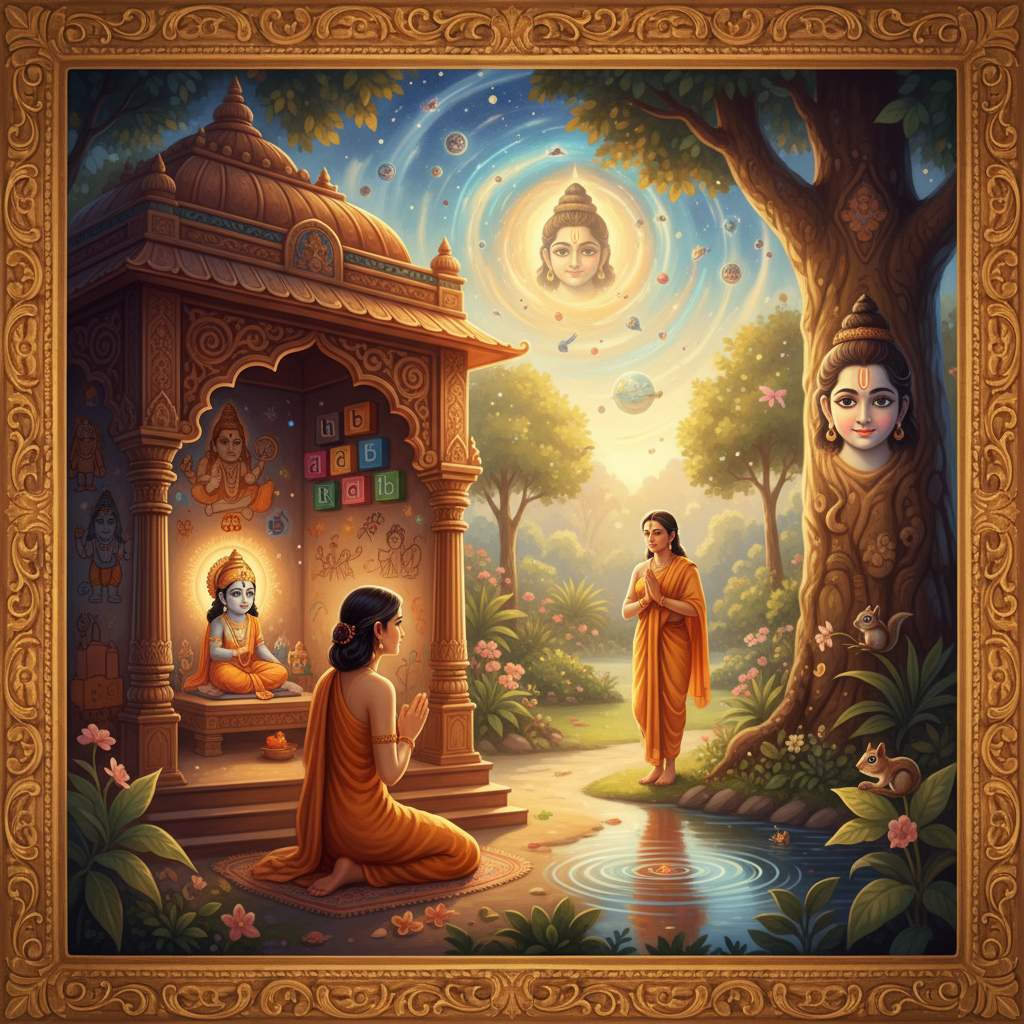
Rama, seeing his mother’s distress, smiles and extends the trick rather than ending it. He shows her the akhanda rupa, the undivided form: in every pore of his body, millions upon millions of universes.
Swamiji lets the imagination stretch and then pulls it back deliberately. He borrows a simile from Yoga Vasistha — the beam of light entering a dark room through a small hole, the countless dust particles scintillating in it. Now treat each particle as an entire universe, with its galaxies and stars and mountains. Even then, he says, you have not described the immensity. And then: do not stretch your mind too much. Let it relax.
The instruction is not anti-intellectual. It is a statement about the relation between bhakti and jnana. Devotion informed by some knowledge of that immensity becomes keener; devotion that has grown profound can hold an immensity that would otherwise break the mind. The two support each other, and a mind pushed at the immensity alone simply exhausts itself.
What follows in the verse is the resolution of the whole thread. Maya — the same maya that makes all souls dance — stands passive before the cosmic form and lets go of her grip. If you have devotion, Swamiji says, you will be led to liberation. Mukti bhakti ki dasi hai: liberation is the maidservant of devotion.
The body tells the truth
Kausalya’s hair stands on end, her body trembles, and no words come. Swamiji uses the moment to catalogue the signs by which sattvika bhava announces itself physically: romancha, the hair rising; ashru, tears that are cool rather than the hot tears of grief; svarabhanga, the voice breaking so that only a few words come; vismaya, astonishment; kampana, the body shaking with joy; and finally ecstasy.
He makes two observations worth keeping. The first is that these effects are profoundly nourishing — he uses the word medically. The second is an explanation of why the great mantras are so short. They emerged from ecstatic states in which speech itself was breaking, which is precisely why they now require volumes of commentary.
Two requests
Kausalya’s next thought is horror at herself: she has treated the Lord of the universe as her baby. Can that be forgiven? Rama consoles her, explains, and asks one thing — that she tell no one.
Swamiji reads the secrecy as instruction rather than mystique. As devotion deepens, the internal movement expands beyond imagination, and that expansion should not disturb practical daily life. His illustration is deadpan and aimed squarely at the reader: someone makes you wait, and you think, do you not know my kundalini has risen? If it has risen, he says, you do not need to talk about it. Knowledge that is real does not arrive in daily life as a claim. It arrives as gentleness — like a flower, wafting fragrance.
Then Kausalya makes her own request, with folded hands: let this vision end. Let me go on loving you as my child. It is the rarest moment in the passage. Offered the vision that the tradition treats as the summit, she asks for the relationship back — and it is granted.
The lecture closes with the brothers growing, and with the chudakarana, the tonsure sacrament. The head is shaved to signify cutting down the vasanas, the subtle desires. A small tuft is left, marking the sahasrara at the crown — respect the top of your head, Swamiji says; from there comes nectar. He notes that a sacrament works like a sugar-coated pill: what you experienced was the sweetness, and everything else was done internally, without your knowing.
Terms Used in This Lesson
- bala-lila — the play of the Lord in childhood; in this lesson a stage of devotional experience rather than an anecdote.
- rasa — the particular flavour a relationship with God carries.
- shanta — the quiet drawing toward God with no role assumed.
- dasya — the servant’s love; duty performed without proprietorship of outcomes.
- vatsalya — parental love, which keeps no ledger of what it has given.
- sakhya — friendship with God, near enough that restriction drops away.
- shringara — love at its summit (shringa, peak; angara, fire), in which the soul sheds body, prana, mind, intellect and ego.
- bhrikuti-vilasa — the play of the eyebrows; maya set dancing by the least movement of the Lord’s brow.
- preyas and shreyas — the pleasant and the beneficial; the ego’s taste against the soul’s good.
- manasa, vacha, karmana — thought, word and deed; their agreement is the straightness an aspirant must have.
- Ishvara kripa, atma kripa, guru kripa, shastra kripa — the four kinds of grace: God’s, your own, the teacher’s, and scripture’s.
- akhanda rupa — the undivided cosmic form, millions of universes in every pore.
- maya — the deluding power that drives souls through their karmas, and that stands passive before the cosmic form.
- sattvika bhava — pure feeling as it announces itself in the body: romancha (hair rising), ashru (cool tears), svarabhanga (the voice breaking), vismaya (astonishment), kampana (trembling with joy).
- vasana — subtle desire; what the tonsure sacrament signifies cutting down.
- sahasrara — the crown centre, marked by the tuft left after the shaving.
- chudakarana — the tonsure sacrament performed for the four brothers as the lesson closes.
- mukti bhakti ki dasi hai — liberation is the maidservant of devotion.
Questions to Sit With
- Which of the five tastes — shanta, dasya, vatsalya, sakhya, shringara — describes where your devotion actually is, not where you would like it to be?
- Swamiji makes atma kripa diagnosable: if the interest in practice is not there, your own grace is not there. What does that reading say about the last month?
- Where in your reading of scripture are you keeping the stories and breaking your teeth?
- Kausalya, offered the summit, asks for the relationship back. What would you have asked for?
Provenance
Tulsi Ramayana (Sri Ramcharitmanas of Goswami Tulsidas), Balkanda, Doha 199 to Doha 203. Lecture 88 by Swami Jyotirmayananda, Yoga Research Foundation. The complete archive of Swamiji’s teachings is free to listen to.
This study guide is drawn from the archived teachings of Sri Swami Jyotirmayananda.