
Seven days ago Swamiji read the sixteenth verse of the seventh chapter and named the four kinds of people who turn to God. He comes back to it at the start of this class and says why: “because of its importance, I’m reiterating this verse.” The second reading is not a repetition. The first one named the four. This one gives each of them a story, and then takes the whole list apart. The verse counts four virtuous people who worship God. The distressed, the seeker of knowledge, the one who desires wealth, and the enlightened. Read as a census, it sorts humanity into four bins and invites you to find your bin. Read the way Swamiji reads it, it does something less comfortable. The four are not four kinds of person. They are the hand, the heart and the head of a single person, plus what happens when those three stop being separate. Devotion that runs through only one of them is still devotion, and it can be powerful, and it is incomplete. The class is a long argument against being satisfied with the one that comes naturally to you. He builds it in three moves. First a floor: why most people never get as far as the four, and what good conduct actually purchases for a mind. Then the four themselves, each with a classical illustration from scripture, in the order the verse gives them. Then the seventeenth and nineteenth verses, which say what the integrated devotee is to God and what the world looks like from inside that integration. Along the way there are four stories: Draupadi in the royal assembly, the boy Dhruva in the forest, Uddhava sent on an errand to Vrindavana, and a bull asleep under a tree who turns out to be the Buddha. Each is doing philosophical work rather than decoration, and Swamiji’s reading of the first one, the sari that keeps coming, is the single most useful thing in the class for anybody who has ever mistaken a subtler problem for the absence of a problem.
Passage index
- 00:00 “What makes you think we are miserable?”
- 01:24 Verse 16 reopened, and why
- 04:01 Good karma, bad karma, and the choice one of them opens
- 06:43 Hand, heart and head: why one-sided devotion stalls
- 09:13 Arta: the heart that learns to melt
- 13:16 Draupadi, and the sari that kept coming
- 20:12 Artharthi: Dhruva went for a throne
- 26:13 Jijnasu: Uddhava sent to console the gopis
- 30:48 Janaka, Arjuna, and the dearest devotee
- 34:51 Enfolded by a bed, lost in a nightmare
- 37:53 Verse 19: Vasudeva alone is all that is
- 43:04 Buddha’s answer: I was once a bull
The floor beneath the four
Before anybody turns to God at all, Swamiji says, every soul has come to embodiment with the sole purpose of attaining liberation, and the purpose does not become clear. The mind stays involved with the illusion, goes through a whole life of pleasure and pain and suspense, and departs it wanting another one. Inside that condition there are still two directions. A person can be sukriti, involved in good karmas, or duskriti, involved in negative ones. He disposes of the second in a sentence: “unthinkable, untalkable. That’s not our topic.” The first is worth dwelling on, and not for the reason people usually give. Goodness here is not being marked well by God. It is what buys the mind a capacity it did not previously have. As a person becomes involved in good karmas, the mind develops the ability to choose between shreya and preya, between staying in the world for enjoyment and going toward liberation. Pravritti and nivritti, the outward movement and the returning one, become visible as alternatives rather than as the only road and no road. Without that, the world simply keeps you occupied. Swamiji’s phrase for it is worth memorizing, because it describes an entire biography: “One tangle you remove, another tangle you get it.” Nothing is wrong. Nothing is ever finished either. Good conduct is what interrupts that, not because it is rewarded, but because it quiets the mind enough for a second option to appear.
Hand, heart and head
Then the frame that organizes everything after it. Human personality is a blend of hand, heart and head. Action, feeling, thought, words. A person turning to God will turn with whichever of those is most alive in them, and that movement can be genuinely powerful, and it will be one-sided. This is where he cuts against the way the four yogas are usually presented, as a menu matched to temperament. You can be a yogi by adopting any one of the four, he says, and then: “You become a better Yogi when you understand that you cannot be one-sided because you are all four together.” The other three begin to join in. And at real maturity the distinction disappears; a person is simultaneously a karma yogi, a bhakti yogi, a dhyana yogi and a jnana yogi, and could not say which one they are practicing. Hold that and the verse stops being a list of four temperaments. It becomes a description of three faculties and their integration.
Arta: the devotion that melts
Arta literally means the distressed, and Swamiji moves off the literal reading immediately. The distress is real, but it is not for ordinary things. It is for love of God. Its work is on the granthi, the knot of subtle desires, the vasanas that express through the heart and arrive mixed up with everything else. In spiritual movement they begin to purify, and as they purify they melt, and rain down, and the sky of the heart becomes clear. He notes that every puja ends in arati for exactly this reason: the closing gesture is an invocation of arta bhakti, which he calls the essence of worship. What it produces, fully blossomed, is prema drishti — the way a mother looks at her baby, which never quite becomes a frown. Turned toward the world, that is a refusal to look at things with bitterness, because the world is God’s expression. And the heart that gets there is no longer limited to its own few people. It can love any human being, any child, birds, animals, wherever there is life. “The whole universe of life is one family” — and the heart is involved in the happiness of every creature in it. The untrained heart, by contrast, is thrilled only on a limited basis: these relatives are mine, therefore my heart flows to them. Which is unstable by construction, because even the very dear relations break up, and so the heart stays in turmoil.
Draupadi, and the sari that kept coming
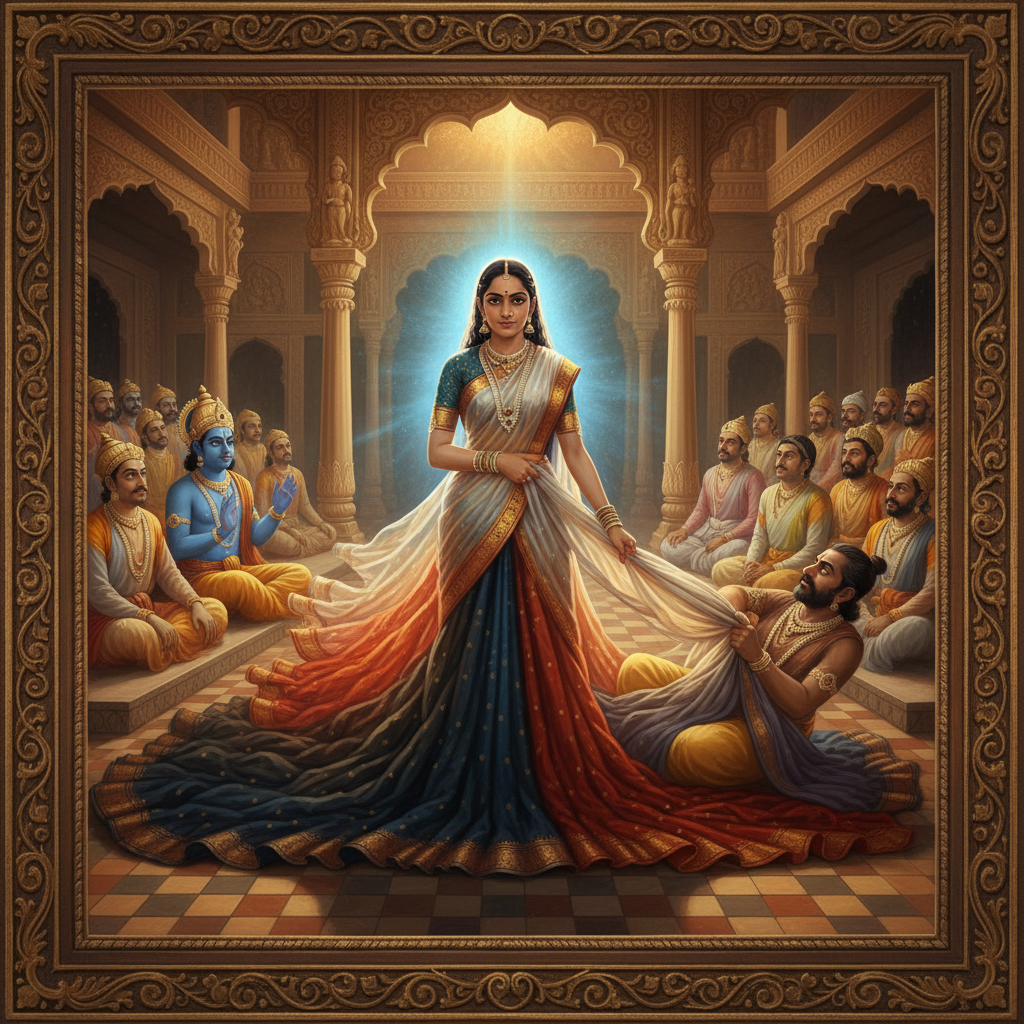
The classical illustration is the scene in the royal assembly. The Pandavas are the divine qualities; the Kauravas are egoism, impure mind, impure intellect. Draupadi is viveka buddhi, the intuitive intellect, which the lower self is perpetually trying to drag into degradation. Duhshasana begins to disrobe her. Nobody helps. Her mind looks for who will help me and finds no one, and only then does she realize that God is the only source of help and invoke Krishna. The cloth begins to multiply. Swamiji’s reading of what the multiplying cloth means is the most practically useful passage in the class. The sari is the mind under purification. Each layer pulled away is a defect removed — and the layer underneath it, being subtler, is beautiful. It is also still defective. Tamas gives way to rajas, rajas to sattva, and at every stage the newly uncovered layer looks like arrival. His instruction is simply not to be satisfied there. There is always a higher level against which the present one is not the goal. This is the correction for the most common form of spiritual stalling, which is not backsliding but contentment with a genuine improvement. And Duhshasana, the world’s constant pull toward degradation, ends the scene unconscious. Not defeated in argument. Neutralized, so that it no longer pulls. Divine presence then shines through Draupadi, which is what was under all the layers the whole time.
Artharthi: asking for the means
Artharthi is ordinarily read as the desirer of wealth, and Swamiji gives the literal meaning and then the mystical one: pursuing the purpose of life. This is the hand aspect. What are you going to do in the practical world? To enhance your activity you need resources, and so you turn to God for resources, for proper inspiration and insight, for the facilities that let an idea become effective. Dhruva is the illustration, and the story is about how that petition matures. King Uttanapada has two queens, Suniti and Suruchi, which Swamiji reads as two waves in one mind: the one that pursues righteousness and the one that pursues taste for sense enjoyment. Suruchi insults Dhruva and blocks him from the throne. His mother sends him to God. He goes into the forest, practices intense austerity, and is initiated by Narada into om namo bhagavate vasudevaya. He went to win a kingdom. When Vishnu finally appears and offers him what he came for, he has nothing to ask: “Your Darshan is all that I want.” He is given liberation and the kingdom both. Swamiji’s gloss is that the soul’s movement legitimately has two purposes behind it, bhoga and moksha — live your life joyously, and attain liberation — and that the second does not require the cancellation of the first.
Jijnasu: sent to console, and consoled
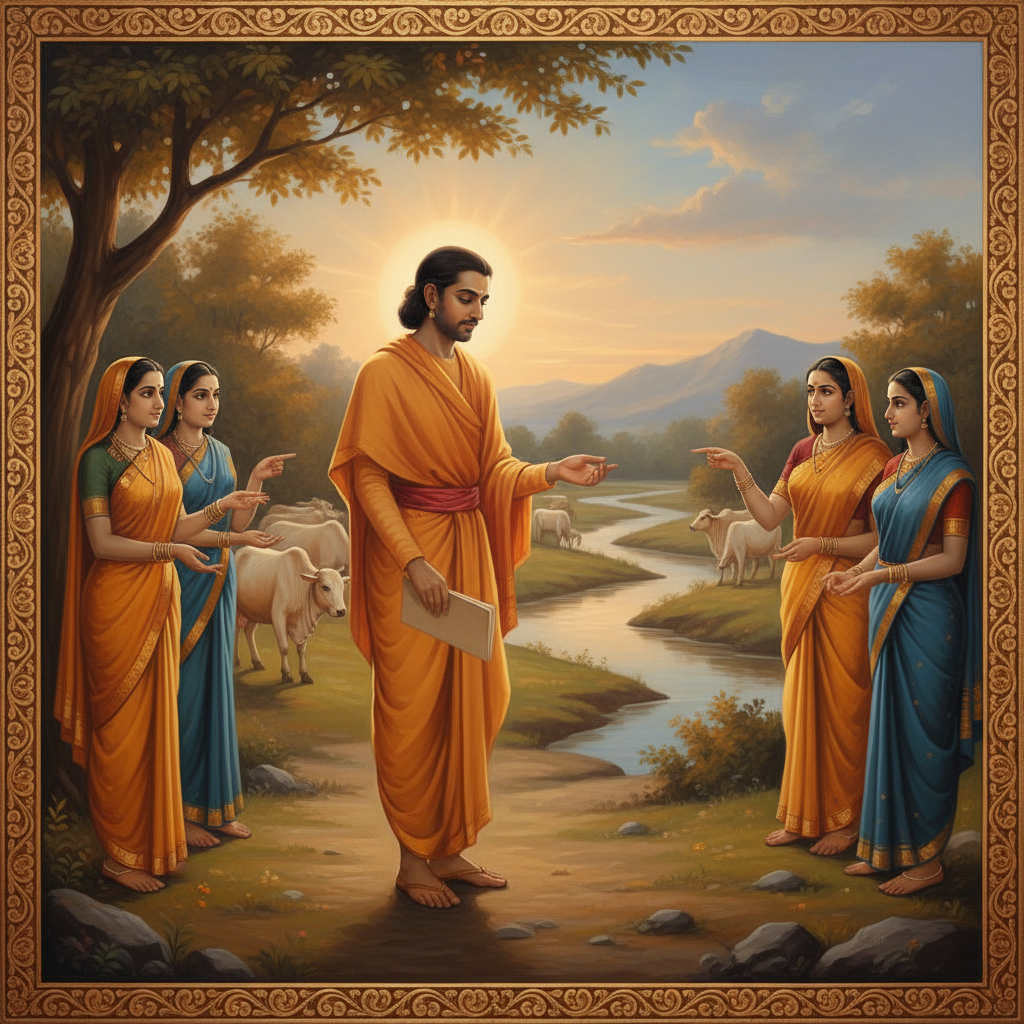
Jijnasu is the seeker of knowledge, the same devotion routed through the head, and the illustration is Uddhava. Krishna has left Vrindavana for the royal stage of his life. Uddhava, who sits with him often, expresses sympathy for the gopis: how miserable they must be feeling without you. Krishna sends him to console them. Uddhava goes proud of the errand, carrying the message that Krishna sends his love to all of them and knows how miserable they have been. The gopis are baffled. “What makes you think we are miserable?” When Krishna was with them, they say, they could not be with him all the time — only whenever he came and stole some butter. Now he is in the cows who give milk, in their hearts, in their children, in the forest, in the very air, in the sun and the sky. “Real Kṛṣṇa now is everywhere.” That Krishna cannot leave them even for a moment. Uddhava came to teach and was taught, and what he realized is precisely the goal of Vedanta: the inquiry into who am I, I am not the body, I am not the mind, arriving intellectually at aham brahmasmi. Swamiji adds the warning that makes this the jijnasu section rather than the jnani one. It should not sound dry like a desert. There has to be an opening in the heart, and joy dancing up out of it. The head alone gets the sentence right and the experience wrong.
Jnani: not a fourth type
King Janaka, who conversed with Yajnavalkya and the rishis, is the scriptural illustration of the jnani bhakta. But the structural point is the one that reorganizes the verse: the jnani is not a fourth category standing beside the other three. He is an arta bhakta, and a jijnasu bhakta, and an artharthi bhakta, and when those three are integrated, that is what the word jnani names. Which is why the real illustration is Arjuna, and why Krishna says that among the Pandavas, he is Arjuna. Verse seventeen then calls that devotee the best of all worshippers: ever united, one-pointed, supremely dear to God, and God supremely dear to him. A perfectly religious personality is one whose heart is the climax of bhakti yoga, whose hand is the climax of karma yoga, whose head is the climax of jnana yoga, and who is not lacking any one of them. Swamiji immediately guards the sentence against the obvious misreading. It does not mean God loves some people more. God loves all. But “Divine Love is obstructed by human limitations.” His image for the obstruction is unusually homely. You are asleep on a good bed; the bed is holding you. If you are having a horrible dream, you are not experiencing the bed. You are enfolded by divine presence, internally and externally, and a mind gripped by ignorance does not feel it. An ego emerges which is not you, takes up a false identity, goes looking for a false attainment, and the world of illusion closes over — while all of it is love of God. When bhakti succeeds, the illusion breaks and you wake up, and what you wake into was there the whole time.
Verse 19, and the sun that could not climb out
The nineteenth verse: after many lives of progressive evolution one acquires wisdom and worships with the vision that Vasudeva alone is all that exists. Vasu comes from vas, to reside. He who resides in everyone, in whom all beings abide, the interpenetrating essence. And who is Brahman? “He is the madhu of the Madhu-vidyā. He is the honey.” Swamiji gives the poet’s version beside the Sanskrit. A gopi saturated with love of Krishna goes out looking for the beauty of her beloved, afraid at first that he may already be gone, and finds him everywhere she turns — and then, to her surprise, finds him as the reality of her own person. The seeker, having found, is no longer a seeker. Which makes union an allegory rather than an event, and he says so plainly. A river that has entered the ocean is no longer a river. And the sun reflected in a jar of water does not, on realizing what it is, walk out of the jar, go up to the sun and shake hands with it. There is no such thing. The understanding is itself the liberation, “because the sun was never in bondage.” The bondage was developed on the basis of a conditioned mind. “Once you enlighten the mind, the reality is always there.” You do not have to join the reality. “Remove the cloud, the sun shines forth.” He closes on the question of how long this takes, and declines to answer it. Buddha tells his devotees in the Jataka tales: “I became Buddha not just in one life; I have been working for it through many lives.” In one of them he was a bull, asleep in a forest, woken by monkeys jumping on his neck and pulling at his ears and looking into his nose. The instinct said crush them. A second feeling said these are babies, they are enjoying, let me enjoy with them. That change of attitude is the process of evolution — and the very fact that a person wants liberation at all is already the result of an enormous distance already covered. So, Swamiji says, you do not have to come to the number.
Terms
- arta bhakti — devotion through the heart; distress felt for love of God rather than for ordinary loss
- artharthi — literally the desirer of wealth; mystically, devotion that pursues the purpose of life and asks for the means
- jijnasu — the seeker of knowledge; devotion routed through the intellect
- jnani — here not a fourth category but the integration of the other three
- granthi — the knot of subtle desires bound up in the heart, which devotion melts
- vasana — a subtle latent desire that expresses through the heart and shapes what a person wants
- viveka buddhi — the intuitive intellect; what Draupadi represents, and what the lower self perpetually tries to drag down
- shreya and preya — the good and the pleasant; the choice a purified mind becomes able to see
- pravritti and nivritti — the outward movement into the world and the returning movement toward liberation
- prema drishti — the vision of love, described as the way a mother looks at her child
- bhoga and moksha — joyous living and liberation; the soul’s two legitimate purposes
- Vasudeva — from vas, to reside; He who resides in everyone and in whom all beings abide
For reflection
- Which of the three faculties — hand, heart or head — is your natural door to practice, and which of the other two have you quietly let go dormant?
- Where in your own practice have you mistaken a subtler layer of the sari for the end of the sari?
- Dhruva went into the forest for a throne and left without asking for it; what did you originally come to this for, and has that petition changed?
About this lecture
Srimad Bhagavad Gita, Chapter 7, Jnana-Vijnana-Yoga, verses 16, 17 and 19. Lecture 82 by Swami Jyotirmayananda, Yoga Research Foundation. The complete archive of Swamiji’s lectures is free to all.
This study guide is drawn from the archived teachings of Sri Swami Jyotirmayananda.