
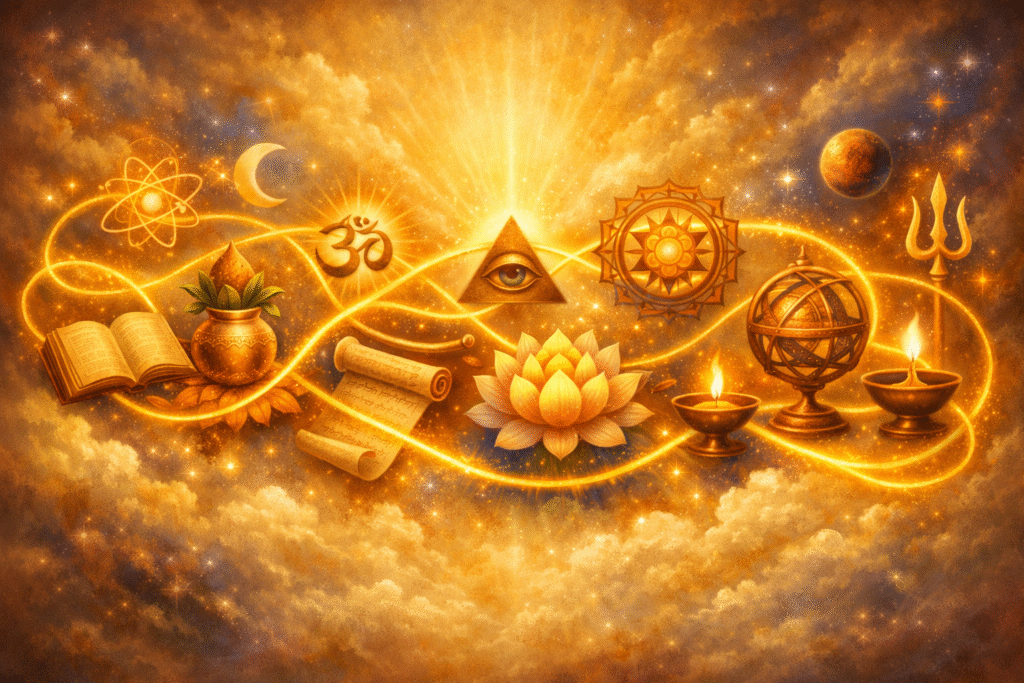
Welcome to a profound journey into the human mind! Sri Swami Jyotirmayananda, a direct disciple of Swami Sivananda, embarks on a new series exploring Patanjali’s Yoga Sutras. This timeless text is arguably the most systematic and practical guide to understanding and mastering the mind ever composed.
This inaugural lecture opens with the very first word of the Yoga Sutras: Atha. It means “Now.” More than just a temporal marker, it’s a beginning wrapped in blessing, signaling a sacred undertaking.
What is a Sutra?
The word sūtra literally translates to “thread.” Imagine a beautiful garland of flowers; each bead is held together by an unseen thread running through it. Similarly, a sutra is designed to hold together a vast body of wisdom within a few compact words. These aphorisms are crafted to be memorized and meditated upon, allowing the mind to contain profound truths in a small, accessible container.
It’s important to understand that Patanjali is not the “author” of the Yoga Sutras in the modern sense of creating new ideas. Instead, he is a sūtrakāra — a compiler who skillfully threaded together the scattered insights of yogic wisdom that had existed for millennia. Just as Sir Isaac Newton discovered the law of gravitation but did not create gravity itself, Patanjali revealed what had always been true, organizing it into a coherent, practical system.
The First Sutra: Atha Yogānuśāsanam
The opening word, Atha, is an invocation. It calls forth blessings for the monumental work ahead, signaling that what follows is sacred and undertaken with the right intention. It’s a declaration of readiness for spiritual instruction.
Yoga, in this context, refers specifically to Rāja Yoga — often called “the royal path.” Patanjali deems it royal because it provides foundational support for all other paths of yoga: Karma Yoga (the path of action), Bhakti Yoga (the path of devotion), and Jñāna Yoga (the path of knowledge). Without the discipline of the mind and senses that Rāja Yoga provides, no other path can truly bear fruit. It’s the bedrock upon which all spiritual progress is built.
Anuśāsanam signifies a teaching given with a grand, deliberate plan. This isn’t an improvised sermon or a collection of random thoughts; it’s a complete, systematic instructional project. The Yoga Sutras are meticulously divided into four pādas (chapters):
- Samādhi Pāda: Focuses on the highest attainment and states of meditative absorption.
- Sādhana Pāda: Details the practices and disciplines necessary for spiritual progress.
- Vibhūti Pāda: Explores the powers and attainments that can arise from deep yogic practice.
- Kaivalya Pāda: Describes absolute freedom and liberation.
Interestingly, every major Indian scripture begins by presenting the highest goal first, then works backward to detail the methods. This ensures that even those who cannot immediately grasp or reach the ultimate goal always know what they are moving toward.
The Definition of Yoga: Yogaś Citta-Vṛtti-Nirodhaḥ
The second sutra provides the complete, concise definition of yoga: Yogaś citta-vṛtti-nirodhaḥ. In essence, Yoga is the control (nirodha) of the waves, or modifications (vṛttis), of the mind-stuff (citta).
To truly grasp this definition, we must first understand what the mind is according to yogic philosophy.
The Cosmic Mind
The mind, in this profound view, is not merely a secretion of the brain. It is a cosmic source of energy that is channeled through the nervous system. Think of electricity: it’s an enormous, pervasive force, yet it flows gently and precisely through the wiring of a house. When light bulbs fail, the electricity doesn’t die; it simply finds another path or remains latent. Similarly, when bodies die, the cosmic energy that maintained the body continues to exist.
The mind, or citta, has four distinct aspects that are radiations of one underlying mental process, rooted in a cosmic basis:
- Manas: The ordinary thinking mind, responsible for perception, doubt, and desire.
- Buddhi: The intellect or reason, responsible for discrimination, judgment, and decision-making.
- Citta: The memory bank, the storehouse of impressions, past experiences, and subconscious tendencies (saṃskāras).
- Ahaṅkāra: The ego, the sense of “I-ness” or individuality, which creates identification with the body and mind.
Behind the entire citta lies Cit — pure awareness, absolute consciousness. It’s a beautiful play on words: take the “T” out of citta, and you get cit – the ultimate Reality, Brahman, God.
The Five States of Mind
Patanjali classifies the mind into five fundamental states, each representing a different level of stability and clarity:
- Mūḍha: The dull, lethargic, or deluded state, often characterized by inertia and ignorance.
- Kṣipta: The distracted, agitated, or restless state, where the mind jumps from one thought to another.
- Vikṣipta: The occasionally steady state, where the mind can be concentrated for short periods but easily lapses back into distraction.
- Ekāgra: The one-pointed or concentrated state, where the mind can focus deeply on a single object without distraction. This is a crucial step towards higher states.
- Niruddha: The fully controlled or transcendent state, where the mind’s modifications are completely restrained, leading to profound peace and realization.
The definition Yogaś citta-vṛtti-nirodhaḥ addresses two crucial aspects of this journey:
- Sādhana: This refers to daily spiritual practice. It involves having a dedicated place, a specific time, a consistent posture, and the discipline to practice every day.
- Siddhi: This is the internal transformation that occurs. When the latent impressions (saṃskāras) have changed so profoundly, one no longer needs a specific meditation pose or external conditions to enjoy mental peace and stability.
The Story of Vālmīki
Scriptures offer us inspiring examples of the transformative power of yoga, even for those seemingly beyond redemption. Consider the story of Vālmīki. He was once an ordinary thief, a hardened murderer, notorious for his violent ways.
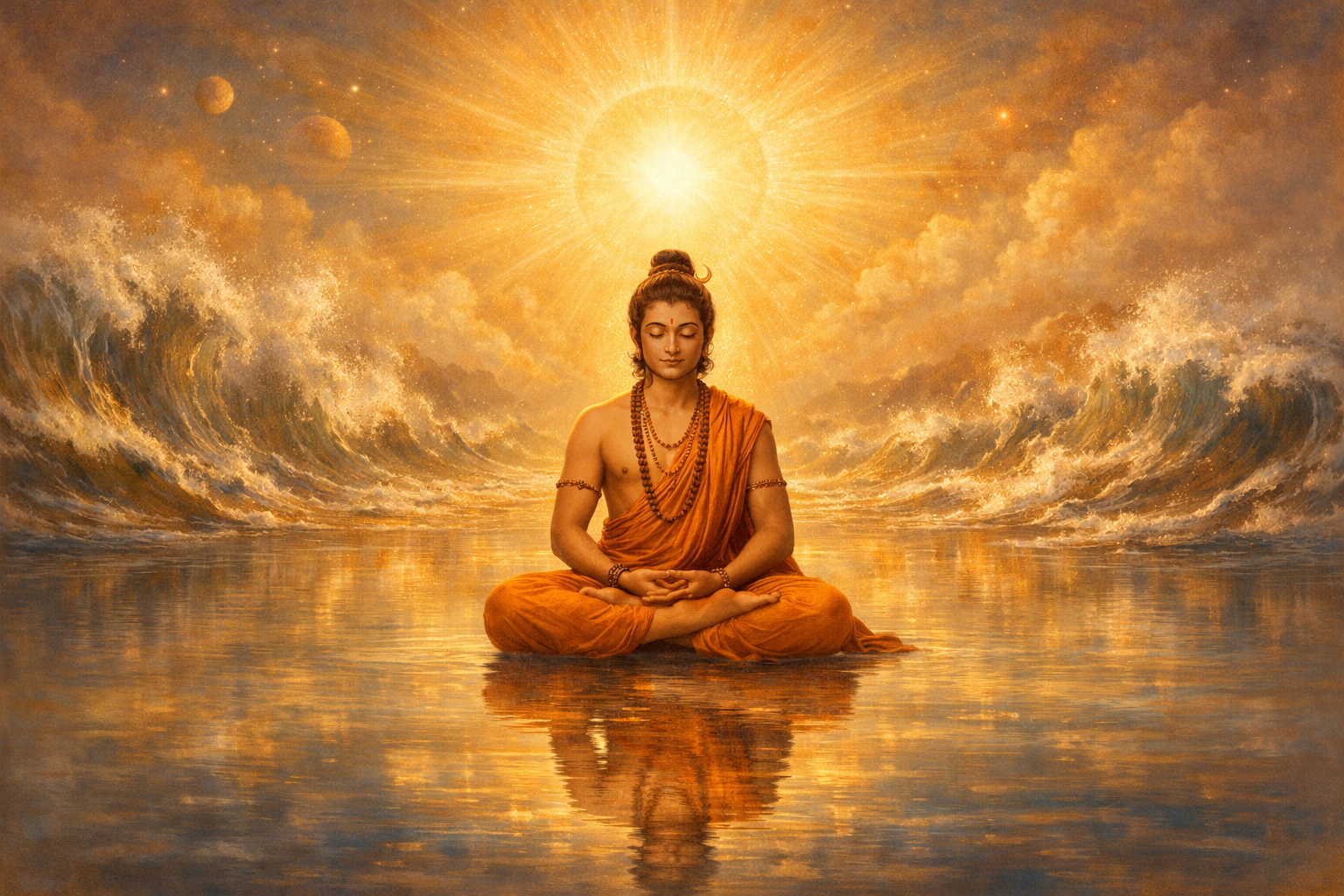
Through the grace of satsaṅga (holy company) with Sage Nārada, Vālmīki’s heart began to soften. This profound internal shift culminated dramatically one day when he witnessed a hunter kill one of two birds playing together. His heart, once hardened by crime, cried out in anguish, and from that deep sorrow, poetry spontaneously flowed from him. That poetry became the foundation of the epic Rāmāyaṇa, and he went on to compose the monumental Yoga Vāsiṣṭha, a profound philosophical text. If such an incredible transformation is possible for a hardened criminal, imagine what is possible for you?
Vṛttis: The Thought-Waves
If citta is likened to an ocean, then vṛttis are its incessant waves. Take a moment to watch your mind for just five minutes: you might think of a past event, then your mind jumps to an unrelated future task. Perhaps a pumpkin, then parliament. Sunshine, then darkness. This magical, often chaotic dance of thought-waves – what they do to you, and crucially, how to handle them – is the central subject of the entire Yoga Sutras.
The Threefold Discipline: Mānasā Vācā Karmaṇā
Scripture is called śāstra because it provides a threefold impact, guiding us toward holistic discipline:
- Discipline of the mind (mānasa): We must cultivate judgment about what to think, consciously directing our mental energy.
- Discipline of speech (vācā): Our words must carry meaning, truth, and an inspiring glow. The ancient wisdom teaches that words are often more powerful than daggers.
- Discipline of action (karmaṇā): Our actions must be controlled and guided by viveka-śakti, the power of discriminative understanding.
Rāja Yoga: The Royal Path
Rāja Yoga earns its title as “the royal path” because it provides essential support and structure to all other paths of yoga and indeed, to life itself. It offers a safe and direct route: even if you close your eyes and diligently follow the principles of Rāja Yoga, there will be no harm, only progress. Its practice does not require you to change your religion or abandon your cultural roots; instead, it empowers you to become a better Christian, a better Hindu, a better Muslim, or a better practitioner of any faith or philosophy. Rāja Yoga provides invaluable insight into sādhana – how to live day-to-day life, integrate meditation, look after your health, and profoundly explore the limitless possibilities of the mind.
Scholar’s Corner: Key Sanskrit Terms
To deepen your understanding, here are some essential Sanskrit terms from this lesson:
- Atha yogānuśāsanam: “Now the teachings of yoga are commenced.”
- Yogaś citta-vṛtti-nirodhaḥ: “Yoga is the control of the thought-waves of the mind.”
- Citta: The mind-stuff; the entire mental process including mind, intellect, memory, and ego.
- Vṛtti: A thought-wave, modification, or fluctuation of the mind.
- Nirodha: Control, restraint, transcendence, or cessation.
- Sūtra: A thread; a concise aphorism containing profound wisdom.
- Rāja Yoga: The royal path of yoga, focusing on mental discipline and meditation.
- Samādhi: Highest meditative absorption, a state of profound concentration and union.
- Sādhana: Spiritual practice, discipline, or effort.
- Viveka-śakti: The power of discriminative understanding or discernment.
- Saṃskāra: Latent impression, mental residue, or subconscious tendency.
- Mānasā vācā karmaṇā: “Through mind, speech, and action” – the threefold discipline.
Embark on Your Journey!
This is just the first step of an incredible journey through Patanjali’s Yoga Sutras – arguably the most systematic and practical guide to the human mind ever composed. Bookmark this series, revisit each lesson, and allow these teachings to resonate within you. Remember, the mind is cosmic, and your capacity for transformation is truly beyond imagination.
Watch the full lecture here: https://youtu.be/5kBMNw8duw0
This study guide is drawn from the archived teachings of Sri Swami Jyotirmayananda.
Great choice. I like to read the teaching in list form.