
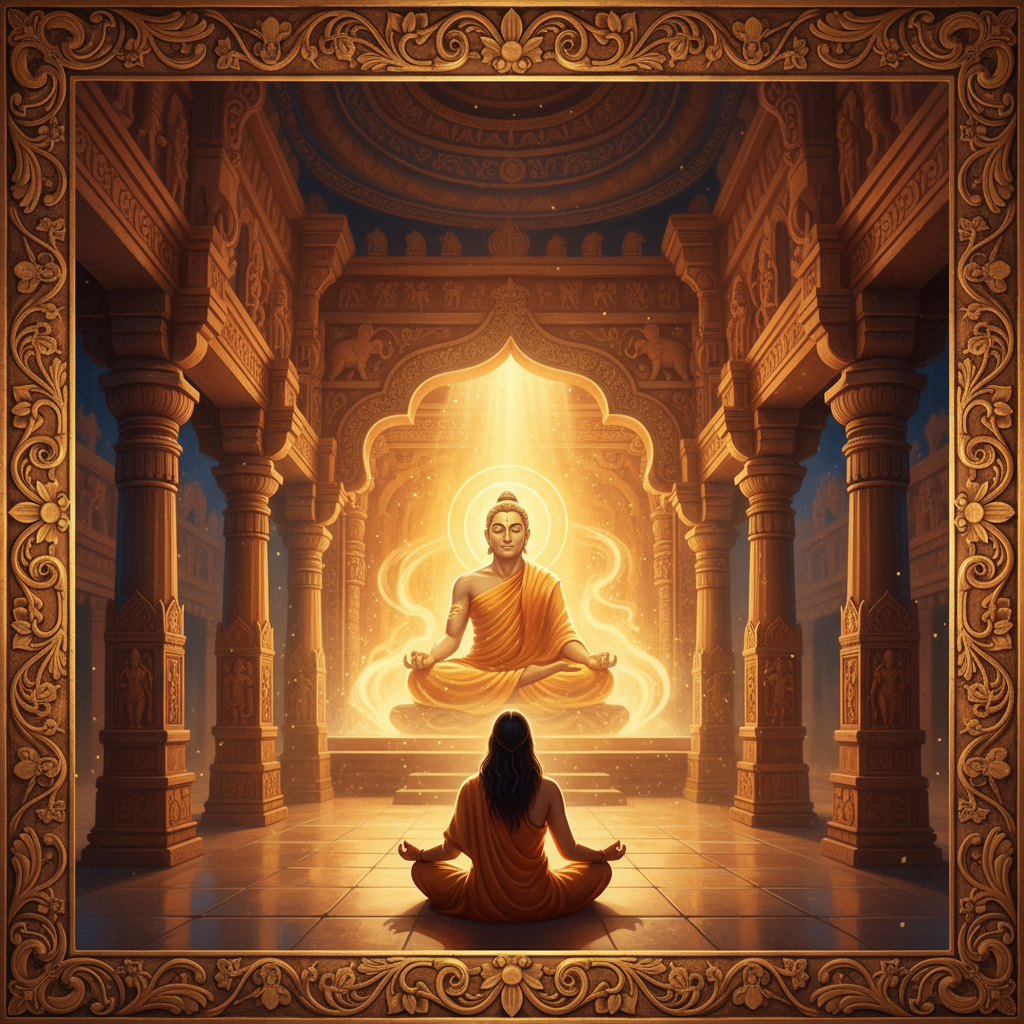
When modern life presents us with endless anxiety, fear, and doubt, it is easy to feel completely trapped by our circumstances. However, ancient scripture offers a profound cure to this modern symptom: understanding that the mind itself is merely a projector. Sri Swami Jyotirmayananda, a direct disciple of Swami Sivananda, presents this timeless wisdom through the classical text of the Yoga Vasistha, awakening us to our true nature.
King Bali and Shukracharya
In the Upashama Prakarana, Section 26 of the Yoga Vasistha, we encounter King Bali, who has developed profound dispassion. He invokes his guru, Shukracharya, seeking the ultimate truth. As Swamiji explains, these spiritual stories are not merely historical facts; they carry a dynamic value for all time. Every soul faces the inner processes described in the Ramayana, Mahabharata, and Yoga Vasistha. The teachings given to King Bali are vast and high, revealing that the self often becomes identified with the projected illusions of the mind, which is the root cause of all bondage.
The Cinema Screen Analogy
To comprehend pure consciousness, Swamiji uses the brilliant metaphor of a cinema show. When you watch a film, you become entirely involved in the story—the past, present, future, and countless details on the screen. Yet, behind all the action, there is simply light being refracted through a film negative. The light itself never undergoes any problem, whether it reflects a demon, a sage, or a tragedy. The soul is that light of lights. All human experiences are mental projections, and the pure screen of consciousness remains untouched by the passing clouds of worldly events.
Mano Nash: Dissolving the Mind
Through shravana (listening), manana (reflection), and nididhyasana (meditation), the spiritual aspirant prepares their mind for the revelation of the Self. As one advances, a state known as Mano Nash occurs. The mind no longer creates a basis for anger, hate, or greed. It merely serves as a pure channel to progress toward God. The illusions drop away, and you begin to watch the projections of life without being negatively affected by them. You become the vast sky, and all worldly problems simply move by like clouds.
Understanding “Thou Art That” (Tat Tvam Asi)
The great utterance of the Vedas, Tat Tvam Asi (Thou Art That), is awakened by the guru within the disciple. “Thou” represents the ultimate reality that created the entire world. Swamiji teaches that you are not the small, trembling reflection in a pot of water; you are the absolute sun. By removing the veil of ignorance (avidya) and mental illusion (maya), the realization of Aham Brahmasmi (I am Brahman) becomes highlighted in your personality.
The Light of Lights (Kathopanishad)
Drawing upon the Kathopanishad, Swamiji reminds us that the ultimate reality is not illumined by the sun, the moon, or the stars. When Brahman shines, it is His shine that gives light to the sun and the stars. God is light, and that light resides within your own heart. By turning inward and seeking that light, you find lasting liberation.
Scholar’s Corner
Text: Yoga Vasistha
Section: Upashama Prakarana (On Quietude), Section 26
Context: King Bali receives instruction from his preceptor, Shukracharya, learning that the three worlds are nothing but pure consciousness, and that the illusion of worldly attachment can be dissolved through wisdom.
Glossary
- Mano Nash
- The dissolution of the impure mind; when the mind ceases to generate egoistic projections and becomes a pure channel for divine awareness
- Tat Tvam Asi
- “Thou Art That”—one of the Mahavakyas (Great Sayings) of Vedanta, signifying the unity of the individual soul with the Absolute
- Brahman
- The ultimate, unchanging reality, pure consciousness, and the light of all lights
- Shravana
- Listening to the scriptures with focused attention
- Manana
- Deep reflection and reasoning upon the teachings heard
- Nididhyasana
- Sustained meditation that leads to direct realization
- Avidya
- Spiritual ignorance; the veil that obscures one’s true nature
- Maya
- The cosmic illusion that makes the one appear as many
- Aham Brahmasmi
- “I am Brahman”—the realization of one’s identity with the Absolute
Watch the full lecture: https://youtu.be/MFG-TdyZdAk
This study guide is drawn from the archived teachings of Sri Swami Jyotirmayananda.