
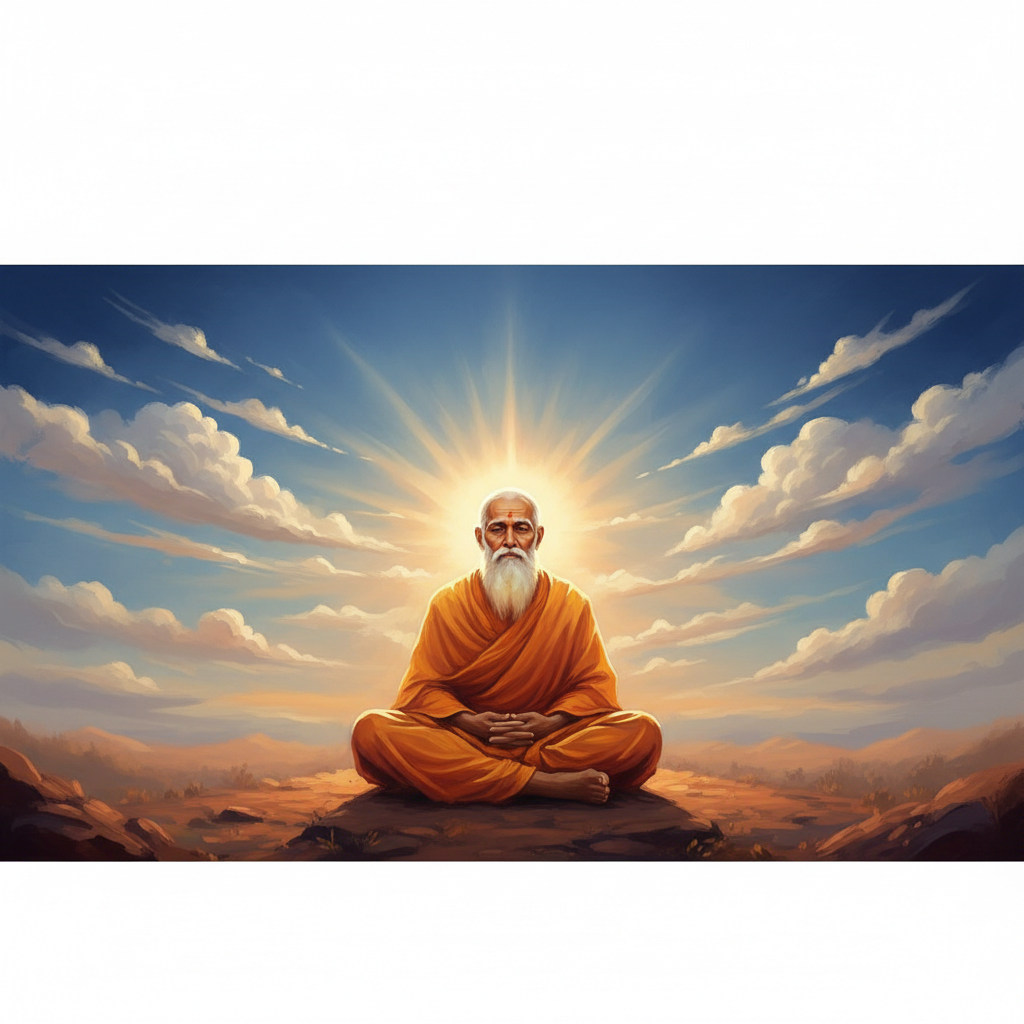
Become the Sky
The goal of yoga is not to fight the mind. It is to become the sky.
The sky has no contradiction with the clouds. Soft clouds of dazzling beauty drift across it; black clouds gather with thunder. The sky remains the same. It has no raga-dwesha, no clinging and no aversion, toward any of them. “Whichever way the clouds want to stay,” they stay, and the sky is untouched.
This is the state Patanjali calls nirodha, the final resolution of yoga. Once the mind has done its work and revealed the Self within you as the Absolute, the mind is no longer needed. You may stay with it or stay beyond it. You have become the sky, and thoughts are only passing clouds.
In Lesson 4, Sri Swami Jyotirmayananda revisits the foundation of the Yoga Sutras and then unfolds Sutras 1.5 and 1.6: the five kinds of thought-waves that make up the entire experience of your life, and the five afflictions that bind the mind.
A Brief Reiteration
Atha yogānuśāsanam. Now begins the teaching of yoga. Yogaś citta-vṛtti-nirodhaḥ. Yoga is the stilling of the modifications of the mind.
The mind is the chitta, the mind-stuff. It performs four functions, and we give each function a different name. When it picks up impressions from the world through the senses, it is called manas. When it evaluates and rationalizes, it is buddhi. When it asserts “this is me, this is mine,” it is ahankara, the ego. When it stores and remembers, it is the chitta in its narrow sense.
One mind-stuff, four faces. Just as you are the same person who is a parent at home, an officer at work, a friend elsewhere, you are named differently in different situations but you remain one. The chitta is that one stuff.
All these functions are known as vrittis, thought-waves. And the entire world-experience, from bondage to release, depends upon your vrittis. Like a cinema show, where the whole drama depends on a series of projections on the screen, all your experience is a play of thought-waves upon the screen of consciousness.
The Three Gunas: The Lake and the Sun
Until you are realized, you are identified with your thought-waves, and those waves carry the three gunas: sattva, rajas, and tamas.
Picture the sun shining upon a lake. In the sattvic state, the lake is calm, with only the faintest shimmer of small waves. The sun is reflected perfectly. That is the peaceful, joyous state, shanti.
When rajas rises, the lake grows agitated. The sun has not gone anywhere, but the restless water can no longer hold its image. “Where has the sun gone?” the lake cries, and grows angry at the very creatures within it. When tamas dominates, the water is dull and turbulent. Yet through all of it, the sun is the same, shining all the while.
The gunas keep changing according to past karmas. The art of the spiritual life is to handle rajas and tamas so that they serve to enhance your sattva. All three are necessary. If there were no tamas, you could not even sleep, and without rest there is no liberation. What matters is that sattva must dominate.
The Five States of the Mind
The mind moves through five broad states:
Mudha is the dull, deranged state, the lowest, where a person is scarcely sane.
Kshipta is the distracted, restless state, where most people predominantly live, always seeking excitement, gathering impressions that scatter the mind.
Vikshipta is the more cultured state, where sattva has begun to develop and now and then controls rajas and tamas. These are the people the world looks up to, good until a challenging situation arrives, when even they do not know how much they will explode.
Ekagrata is one-pointedness. Now you have entered the yoga state. The lake has glimpsed the sun, and by controlling the waves, the whole sun will one day be revealed.
Nirodha is the final state, where the Self stands revealed and the mind is no longer required.
Sutra 1.5: The Fivefold Vrittis, Painful and Not Painful
Vṛttayaḥ pañcatayyaḥ kliṣṭākliṣṭāḥ. The thought-waves are of five kinds, painful (klishta) and not painful (aklishta).

This is the heart of the practice. Every thought-wave can be directed positively or negatively. The same five faculties can either create trouble for you or remove it. The discriminating responsibility lies within you. Before you can wield that responsibility, you must understand what the five thought-waves are.
Sutra 1.6: The Five Thought-Waves
Pramāṇa-viparyaya-vikalpa-nidrā-smṛtayaḥ. Right knowledge, wrong knowledge, imagination, sleep, and memory.
Pramana – Right Knowledge
Pramana, right knowledge, is what sustains practical reality. It is not “ethical” knowledge; it is simply correct knowledge, like saying two plus two is four, whether that fact is pleasant for you or not. Patanjali gives three sources of right knowledge (Sutra 1.7): pratyaksha (direct perception, what you touch, see, taste), anumana (inference, seeing smoke and knowing there is fire, the basis of all scientific discovery), and agama (testimony, the word of a trustworthy person, and at the highest level the testimony of the scriptures and sages).
Viparyaya – Wrong Knowledge
Viparyaya, wrong knowledge (Sutra 1.8), is knowledge not established in the true form of the object. The classic example is the snake seen on a rope. There is a rope; your knowledge fails to fit its real shape. Yet even wrong knowledge has its place. The feeling that the earth is steady beneath your feet is, strictly speaking, wrong knowledge, but it is good for you.
Vikalpa – Imagination
Vikalpa, imagination (Sutra 1.9), is perception that follows mere words, void of an actual object. You see a snake where there is not even a rope. Imagination can be destructive, the seed of gossip and fear; or it can be creative, the source of all poetry, and the doorway by which the human mind is urged to contemplate the form of the Divine.
Nidra and Smriti
Nidra (sleep) and smriti (memory) complete the five. Swamiji leaves these two as a suspense for the next lesson.
These five compose your entire mental process. From birth to death, the whole story of your life is defined by these vrittis, and your progress in the world depends on how you handle them.
The Five Kleshas
On the spiritual path, you must understand the klishta vrittis, the ones that create the kleshas, the afflictions. There are five.
Avidya (ignorance) is the first, the soil in which the others grow. Asmita (egoism) is its product. Ego itself is normal and necessary, like a walking stick on uneven ground. What is wrong is to believe that you are the stick. Raga (attachment) and dwesha (aversion) form the system of likes and dislikes that, shaped by karma, makes each person’s experience unique. No two people kept in the same room will dream the same dream. Abhinivesha (the fear of death) is the last, and it flows directly from the illusion “I am the body.” If you are the body, then every birthday is a countdown, and the only solace is that your children will remain, an empty solace indeed.
Little by Little: The Aklishta Movement
Here is the practical key. The same mind that, bogged down by kleshas, deprives you of every blessing can be turned, by simple adjustment, toward freedom.
Instead of asserting “I am the body” and building all your stress upon it, turn the mind to prayer, to japa, to the truth “I am the soul.” As the Gita says, just as a person casts off worn clothes and puts on new ones, the soul changes bodies, and the body is of little importance. Each such insight creates an aklishta movement, a movement that contradicts fear, softens the ego toward humility, loosens attachment, and lets ignorance give way to light.
“Little by little, you make a change in the movement of your mind.” No matter how long it takes. Even the question of time, Swamiji reminds us, is itself a vritti of the mind.
The Screen Behind the Projection
Return, finally, to the sky. The patch of blue you call yourself was only ever defined by the clouds that surrounded it. When the thought-waves are purified, that small patch is revealed to be one with the boundless sky. Nothing new has happened. It is only a matter of revelation.
“To be a yogi is to understand that, in reality, these thought-waves are not taking you away from what you are.” The I-am is the screen behind every projection of life and death, gain and loss. The clouds may do as they wish. The sky was never bound.
Scholar’s Corner
The Sutras of this lesson:
- 1.5 — vṛttayaḥ pañcatayyaḥ kliṣṭākliṣṭāḥ — “The modifications are fivefold, painful and not painful.”
- 1.6 — pramāṇa-viparyaya-vikalpa-nidrā-smṛtayaḥ — “They are right knowledge, wrong knowledge, imagination, sleep, and memory.”
- 1.7 — pratyakṣānumānāgamāḥ pramāṇāni — “Perception, inference, and testimony are the means of right knowledge.”
- 1.8 — viparyayo mithyā-jñānam atad-rūpa-pratiṣṭham — “Wrong knowledge is false knowledge not established in the real form of the object.”
- 1.9 — śabda-jñānānupātī vastu-śūnyo vikalpaḥ — “Imagination follows from words, empty of any real object.”
On right speech:
Satyam vada, priyam vada. “Speak the truth; speak what is pleasant.” Truth must be spoken, but there is an art in how to speak it.
Invocation to Patanjali:
Yogena cittasya padena vācāṃ malaṃ śarīrasya ca vaidyakena yo’pākarot taṃ pravaraṃ munīnāṃ patañjaliṃ prāñjalir ānato’smi. “I bow to Patanjali, the best of sages, who removed the impurities of the mind through yoga, of speech through grammar, and of the body through medicine.”
Closing (Isha Upanishad):
Oṃ pūrṇamadaḥ pūrṇamidaṃ pūrṇāt pūrṇamudacyate, pūrṇasya pūrṇamādāya pūrṇamevāvaśiṣyate. Oṃ śāntiḥ śāntiḥ śāntiḥ. “That is whole. This is whole. From the whole, the whole arises. Taking the whole from the whole, the whole alone remains.”
Glossary
| Term | Meaning |
|---|---|
| Chitta | The mind-stuff; the basic mental substance |
| Manas | The sensing, perceiving aspect of the mind |
| Buddhi | The evaluating, rationalizing intellect |
| Ahankara | The ego; the “I-maker” |
| Vritti | Thought-wave; modification of the mind |
| Klishta | Painful; afflicting |
| Aklishta | Not painful; un-afflicting |
| Sattva, Rajas, Tamas | The three gunas: purity, restlessness, inertia |
| Mudha | The dull, deranged mental state |
| Kshipta | The distracted, restless state |
| Vikshipta | The cultured but not fully steady state |
| Ekagrata | One-pointedness |
| Nirodha | The final stilling; resolution of the mind |
| Pramana | Right knowledge |
| Pratyaksha | Direct perception |
| Anumana | Inference |
| Agama | Testimony; scriptural authority |
| Viparyaya | Wrong knowledge |
| Vikalpa | Imagination; verbal construction |
| Nidra | Sleep |
| Smriti | Memory |
| Avidya | Ignorance |
| Asmita | Egoism |
| Raga | Attachment |
| Dwesha | Aversion |
| Abhinivesha | Clinging to life; fear of death |
| Klesha | Affliction |
Watch the Full Lecture
From a lecture by Sri Swami Jyotirmayananda. Watch the full Patanjali’s Yoga Sutras series on our channel, and join us for the nightly premiere.
This study guide is drawn from the archived teachings of Sri Swami Jyotirmayananda.