

The lecture opens without preamble, on a chain of questions borrowed from the Upaniṣads. What gives light to the senses? The mind. What gives light to the mind? The intellect. What gives light to the intellect?
There the chain stops, because there is nothing further up to climb — and the phrase set against that terminus is jyotiṣām api tat jyotiḥ, the light of lights. Notice the kind of question it is. Not what is bright, but what does the illuminating. Your eyes do not create the room; they reveal it. Follow that regress far enough and you arrive at something never revealed by anything else, because it is what reveals.
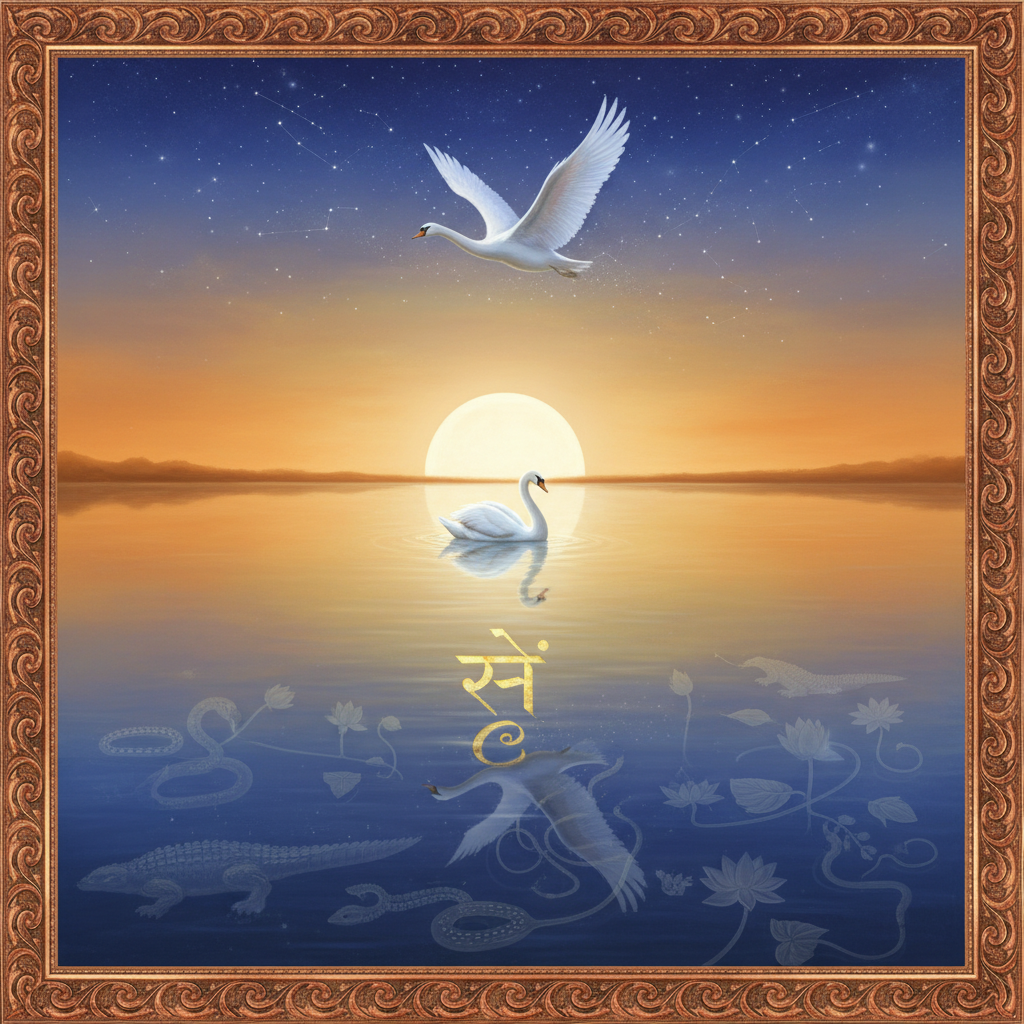
The fifty-one minutes that follow are Prahlāda discovering that this light of lights is not a distant cosmic fact but the thing looking out of his own eyes. He continues his vicāra — spiritual reflection — through three images the Yoga Vasistha returns to again and again: the autumn sky once the rain clouds have passed, the lake that shows crocodiles while agitated and sky once calm, and a swan whose Sanskrit name conceals the sentence I am That.
The hinge arrives at 30:31, and it is the reason to watch. Everything before it describes change: the mind heated by inquiry, hammered by practice, molded into a better shape. Then Swamiji turns and says the goal is not a change at all. You do not polish metal into shining. You move dust off metal that was already shining. Becoming belongs to karma and self-effort; being is revelation, and what it reveals never needed improving.
If you have ever felt that practice was not working because you were not becoming better fast enough, that distinction is the one to sit with.
Passage index
- [00:00] Light of lights: what illumines the intellect?
- [01:53] Yoga Vasistha, Upaśama Prakaraṇa 35: Prahlāda’s reflection
- [02:26] Make a deal with your “I”: the ego is not the Self
- [04:49] The autumn sky: a mind free of egoistic clouds
- [07:30] The lake of the mind: crocodiles or the sky
- [14:19] The swan in the lake: the haṃsaḥ pun, “I am That”
- [21:34] Flame without oil: Brahman needs no other source
- [24:03] You are the sky: jīvanmukti and the untouched witness
- [26:21] The hammer of inquiry: how sādhana molds the mind
- [30:31] Enlightenment is not becoming: the metal was always shining
- [32:51] Faith, renunciation, inquiry: Prahlāda’s three removals
- [43:22] From bhavasāgara to ānandasāgara: the ocean of bliss
Make a deal with your “I” — the ego is not the Self
The ideal is put in unexpectedly plain terms: if you want the whole purpose of your life fulfilled, make a deal with your “I”.
The strangeness is the point. The deal has two clauses that seem to contradict. First, realize that the ego is not your real “I”. Second, take on the considerable work of dealing with that ego — so you are asked to labour over something that is not you. And the payoff is stranger still: you shine only when the ego subsides.
Who is doing the work, then? The question is left standing rather than resolved, which is honest.
The ideal is reached progressively. Day by day you assimilate spiritual knowledge, until the illusory “I”, having beheld the real “I Am”, bows down and vanishes. Then comes an observation that undercuts any premature satisfaction. Day by day, your “I” does not actually bow down — it hides behind the pillow when you go to sleep, and the moment you wake it comes back and grips you. Only in enlightenment does it bow down and disappear, and then for good.
The autumn sky — the kleśas as rain clouds
Prahlāda’s first image for a cleared mind is seasonal: the autumn sky, free of the dark rain clouds of egoistic vision. Śarad-ṛtu is the season after the rains have gone, opening with a clarity the monsoon never allows, and the full moon shining in an amazing way — śaraccandra, the autumnal moon.
Then the question a study guide should always ask of an allegory: what does it really mean? The rain clouds are the kleśas — ignorance, egoism, attachment, hatred, fear of death. And the development goes further than most treatments. A cloud does not merely obscure the sun. It rains. What comes down is the whole karmic process: karma leading the soul through the three kinds of tāpa — subjective, objective, and what the tradition files under act of God — and driving it from one birth to another without pause.
So the cleared sky is not a nicer weather report about your inner life. It is the end of a downpour that had been moving you from body to body.
The lake of the mind — crocodiles, then the sky
For anyone who finds the sky abstract, the lake carries most of the lecture.
A mind with waves constantly entering it does not reflect the moon clearly. Look into an agitated lake and you see sharks, crocodiles, snakes — and mixed among them trees and flowers, the pleasant arriving as distorted as the frightening. But when the lake becomes calm, something new appears. Along with everything already there, you begin to see the sky.
Here the teaching turns practical and slightly uncomfortable, because the sky’s arrival settles nothing. A choice opens that was not available before: stay looking at the snakes and the fishes, or enjoy the glimpse of the sky. The same mind has made room for reflecting God’s presence — and you may decline.
Swamiji is unsentimental about the early stage. Sattva comes in, and now and then, along with the worry and the stress, you notice the sky is there too. But somehow the sky is not interesting. That is the dull-witted stage, and naming it plainly is a kindness — most practitioners have that experience and quietly assume it disqualifies them.
What changes it is sādhana. With practice the sky becomes gradually more interesting than the mental worries, and a genuine astonishment sets in: the same mind that gave you all the trouble is now catching something beyond imagination. The mind holds all the grammar, all the literature, every international language, and cannot describe the grandeur of the sky.
Further on, the reflections stop mattering. The sky alone is real. And the lake gets re-described one last time as a place where bliss blooms as lotuses — the same lake, with divine virtues for flowers. The crocodiles of craving have not been fought. They were only ever reflections.
The swan and the pun — haṃsaḥ and so’ham
Then a swan, soaring through the sky, comes down to sport in the lake of the heart. The swan carries a pun: the Sanskrit for swan is haṃsaḥ, and so’ham, “I am That”, makes the same sound when the words are joined. One word, two meanings — the popular one a bird, the higher one the identity of the individual with the Absolute.
The remark worth keeping is that the sages made many such tricks, identifying great ideals with animals and birds. The Upaniṣads work with cows; Kṛṣṇa is the one who drinks the milk. The principle is left in view: the tradition hides its highest claims inside its homeliest images, and a reader in a hurry walks straight past them.
Flame without oil — self-effulgence and parama-prema
The lecture then gathers images for self-effulgence, and this is its most rigorous stretch.
The sun is ever luminous, its light from no other source. That is the simile; what it illustrates is the “I am”, the Absolute Sun. Brahman is dispeller of the darkness of the heart — and the darkness gets populated with a small menagerie whose humour is doing real work: the creatures living in your heart are worries and anxieties with big heads and buffalo necks, foxes, jackals. When the light is revealed they are dispelled. Not fought. Dispelled, which is a different mechanism.
All-pervading is then defined against a common misreading. Pervading does not mean the objects are real with something else inside them. Your dream world is pervaded by your own consciousness — and dream objects are not real to begin with. Waves are pervaded by the ocean; in a cinema every picture is pervaded by the screen.
Invisible also gets a precise sense: beyond the range of the senses. What falls inside that range we call visible, and Brahman does not — while remaining what lights up mind and senses both.
And flame without oil. Every illumination in the world runs on something: old lamps needed oil, modern light needs a charge. The sun needs no charge.
One further name is given, and the reasoning attached to it is quietly enormous: the Awakener of Supreme Love, parama-prema. The urge to love and be loved is innate, in birds, animals, humans, everywhere. It is fulfilled absolutely only in enlightenment, because Brahman is the source in which loving and being loved are blended rather than divided between two parties.
You are the sky — jīvanmukti and the untouched witness
The mystic lamp burning in the heart is the awareness aham brahmāsmi, and it is unshakeable — but the claim is made carefully. You may appear to be shaken. Your body will be shaken; your mind will be shaken. The world you live in is always shaking. And still: you are like the sky.
We look up and everything goes on shaking in front of the sky, with observers below inventing reasons about what is happening to that cloud and why. The one thing nobody notices is that the sky is not shaking. That is the description of jīvanmukti, liberation while living.
The reading given to it is generous. A sage’s personality belongs to the world, and in it you will see clouds of change and a good deal depending on how you want to see. But the sage, who is the sky, neither smiles at the clouds nor frowns at them; the sky very tenderly takes care of them. The whole party of clouds is coming, and the sky simply opens — come, all this field is best for you, you do not have to pay any rent, not a cent, it is quite evident.
The rhyme is Swamiji’s, and the lightness is not a break from the teaching. It is the teaching. A sky that charged rent would be a cloud.
The hammer and the mold — how sādhana works
Now the mechanism, in the image of a forge. As red-hot iron is beaten and molded into a desired shape, so Prahlāda has beaten the mind that was tainted by worldly desires with the hammer of spiritual inquiry.
The two tools are distinguished cleanly. Inquiry works as fire — jñāna performs the function of heat, making the metal workable. Sustained effort is the hammering. Insight without effort heats metal nobody shapes; effort without insight beats cold iron.
What is being shaped is more pliable than we assume. The mind must be purified from distraction into concentration, from impurity into purity, and the change is allowed by repeated practice — sādhana as a constant beating. The same mind that built a framework of demonic structure, the same mind that created everything negative, goes through a little fire and a little hammering, and it is molded. The features have changed. We are looking at things in a different way. The process culminates when the mind comes to the grip of meditating on aham brahma.
Enlightenment is not becoming — the metal was always shining
Everything so far has described change. Here the lecture turns and says the goal is not a change at all.
Each time you mold your mind, that is a process of becoming, and what you become is then you. An angry person becomes quiet; a wicked person becomes saintly. Changes go on occurring, and they are real. But the attainment of enlightenment is not an act of becoming.
The distinction is carried by two versions of one image. In the first, you alter the metal and now the metal shines; before that, the shine was not there. In the second, the metal was already shining and there was dust over it. All you do is move the dust. The metal is shining by itself.
So long as your ideal rests on change, it is becoming — I have become better, and better. But in realization the “I am” has not become better. It shines. The real “I am” does not need to be better.
The point is tested with a reflected sun. Clean the water where the sun reflects and the reflection goes on improving. None of that applies to the sun, which is beyond the whole movement. Becoming belongs to karma and self-effort; being is revelation. Becoming is not dismissed — these things have their role and they are fine. But the ultimate goal is not the result of certain actions. It is a revelation of reality.
This is the sentence to carry out of the lecture. Almost every discouragement in practice comes from measuring a revelation on a scale built for improvement.
Faith, renunciation, inquiry — Prahlāda’s three removals
Each obstacle is then paired with what removed it.
Faithlessness by faith. Where faith is missing, quick guidance is given: come to the teacher.
Craving by renunciation. This needs the Gītā’s distinction between sakāmya and niṣkāmya action — with desire behind it, and without. People act, and behind the acting is a wish to see the ego’s expectation fulfilled. Confine yourself to that and you will be in misery, for a plainly stated reason: the ego does not have the intelligence to hold the highest expectation. It wants fulfilment inside time, space and causation, and such fulfilment depends on mental process. A comfortable substitute is cleared away here too — liberation is not a long residence by the ocean lasting forever, nor the cirañjīvīs of popular story, sages five hundred years old still hiding somewhere since Rāma’s time. The illusion is not ridiculed; it is simply not allowed to stand in for the real thing. Renouncing ego-based expectation is what saṃnyāsa means.
Ignorance by inquiry. Inquiry is a subtle introspective quest — Where am I? Who am I? — and it is not ordinary intellectual work. It is led by a divine pull, and a deep interest in it develops only at a certain purity of mind. Then, characteristically, the high point gets a joke: what you call me, me — meowing all the time — is not me. So get away from the me and all its meowing. The pun makes abandoning the ego sound less like heroism and more like turning down the volume on a cat.
The test of arrival is a spontaneity, not an intensity. Before realization it was entirely natural to feel I am the body; nobody had to convince you. So: do you have that same spontaneity in I am the sky, I am unshaken pure awareness? That, and not a quantity of experience, is the definition of liberation. Which carries its own humour — when you realize you are Brahman, that realization is itself liberation. Brahman does not need liberating.
From bhavasāgara to ānandasāgara
The section closes with a crossing. First the bhavasāgara, the salty ocean of the world process, where every soul goes again and again into another body without end. Then, released from the fetters of desire and delusion, Prahlāda has become the surging ocean of bliss — ānandasāgara. His mind has become quiescent like a fire that has consumed all its fuel: not suppressed, finished, with nothing left to burn.
The parting advice about the second ocean is unguarded in the best way. If you drown in the ocean of bliss, it is not bad. If you swim, that is fine. Whichever way you are in it, even out on the waves, it is wonderful. If you get lost in it, there is nothing wrong with that.
Every verse ends by adoring the Self, and the natural objection is met head-on. Who is being adored? The “I am”. He points to his own heart, but it is not the ego. He who abides in your heart and in the heart of all — that He is you. So’ham, I am That.
One line remains, and it is the most human moment in the hour. Having spent his life turning to and fro for God, everywhere, up and down, Prahlāda finds the error and reports the only difficulty left: how can I fold my hands?
If there is no second party, the gesture of worship has nowhere to point. He makes it anyway.
For reflection
- Which lake have you been looking at today: the fish and the crocodiles, or the sky that was in the water the whole time?
- Name one thing in your practice that is dust-removal rather than self-improvement. Then name one that is only self-improvement — and let it be that, without contempt for it.
- The “I” hides behind the pillow at night and grips you on waking. Watch that handover tomorrow morning without trying to change it.
- Where are you measuring a revelation on a scale built for becoming better?
Terms
- vicāra
- spiritual reflection; sustained inquiry into a question until it yields
- kleśa
- the afflictions: ignorance, egoism, attachment, hatred, fear of death
- śarad-ṛtu / śaraccandra
- the autumn season; the autumnal moon
- haṃsaḥ / so’ham
- swan; “I am That” — the same sound, two meanings
- parama-prema
- supreme or absolute love
- jīvanmukti
- liberation while still living
- aham brahmāsmi
- “I am Brahman”
- sakāmya / niṣkāmya
- action with desire; action free of desire
- saṃnyāsa
- renunciation, here defined as renouncing ego-based expectation
- bhavasāgara / ānandasāgara
- the ocean of worldly becoming; the ocean of bliss
Watch the full lecture at https://youtu.be/l1lqDvMJxcY
This study guide is drawn from the archived teachings of Sri Swami Jyotirmayananda.