
“In the name of wisdom, if your personality begins to lose softness of the heart, goodness of the heart, generosity, charity, joyousness—if your heart loses these, you are not going to be really liberated.” Swamiji states the warning before a single mantra is chanted. A moment later, the diagnosis: “Intellectually, you may become very conceited, but liberation will not be possible.”
That is aimed at the very people most likely to be listening. Someone who studies Vedānta for years accumulates vocabulary, distinctions, a working map of the mind. The danger is not that the study fails. The danger is that it succeeds and hardens — that the student ends the decade sharper than when they began and less kind. Swamiji names the only condition under which the ego actually goes: “It’s only in the state of absolute, joyous love that ego dies, egoism moves away.” Not analysis. Not precision. Warmth.
He then leaves the warning alone for half an hour and returns to it, restating it almost word for word. Everything between the two statements is the body of Section 36, and the repetition tells you how to read that material: it is all in service of a heart that has stayed soft.
What sits between is unusual in form. Prahlāda, the ideal devotee of the Yoga Vāsiṣṭha and simultaneously “an absolute jñānī,” turns and addresses his own soul as though it were a separate person — congratulating it, scolding the body that troubled it, reminding it of humiliations it need not repeat. Vālmīki writes the teaching as a dialogue between a man and his own Self. Swamiji is explicit that this is craft rather than record: “Don’t take it literally because nobody recorded it.” The separation exists so that we can overhear it.
Passage index
- 00:00 Wisdom that costs the heart its softness
- 02:01 Upaśama Prakaraṇa 36: Prahlāda, bhakti and jñāna
- 03:07 “Congratulations to my soul”: addressing your own Self
- 07:10 Mantharā and the guṇas: tamas sublimated into sattva
- 13:49 The elephant of mind: vāsanās and the wicked horses
- 17:24 Śūrpaṇakhā as viṣaya-vāsanā: retraining the ears
- 21:28 Dormant in the ignorant, awake as worldly enjoyment
- 26:56 Deho devālayaḥ: the body as the temple of God
- 30:53 Behind the iPad, the real “I Am”
- 35:45 The screen that gives reality to the projection
- 43:34 “Adorations unto Me”: the duality falls away
- 46:54 Vasantavad lokahite carantaḥ: enlightenment must spread
Congratulating your own soul: the form of Section 36
The section’s first movement is a burst of relief. “Congratulations to my soul!” Prahlāda says, and then: “You have discovered your essential nature. How long you have been wandering!” He lists what the soul has put down — pride, anger, hate, crookedness — and delivers the verdict as news: “Good news! You are not just confined to the body; you are the Self underlying all that exists.”
Then the register shifts and he does something stranger. He congratulates the soul for never having been bound in the first place. “Actually, how can you ever fall under the sway of guṇas? That was a wonder.” Swamiji supplies the image that holds both halves together: “You can always congratulate the desert for being free from mirage.” The desert was never wet. Nothing was removed from it. The congratulation is real and the bondage was not — which is the whole Vedāntic position compressed into one dry joke.
Why one day’s understanding is not enough
Having granted the recognition, Prahlāda immediately guards it. “Remember again and again the humiliated state that you brought upon yourself through ignorance.” Swamiji reads this as holding up a mirror, with the implication that it will not happen again — and then presses the practical point hard, because this is where most students lose the thread: “One day you have understood all is illusion; that’s not enough.”
He is almost impatient about the frequency. The mind must return to the affirmation “again and again and again.” Then comes the joke that carries the instruction: “Every day before you take your breakfast—I’m joking, but…” The joke is the teaching. Understanding is not a possession you acquire once and store. It is a state the mind falls out of, daily, and must be walked back into.
He gives the sequence to walk: śakti, bhakti, mukti — strength to stay on the path, devotion that makes life’s movement sarasa (juicy, flavourful), and only then liberation. Notice that devotion sits in the middle of the chain, not as an alternative to knowledge but as the thing that keeps knowledge from drying out. This is the opening warning restated as method.
The sky, the clouds, and the emperor: what actually changes
Prahlāda spends a stretch describing the difference enlightenment makes, and it is a change in what experiences can do to you.
He begins with memory. “Those evil days have passed,” he tells his soul, “wherein you have been tortured by worries and anxieties.” Swamiji is careful about how one should revisit them. “But don’t go into the past memories with a sob-weeping mind. Go into the past memories with a laugh.” He supplies the laugh himself, in a two-line verse about waking from a nightmare of excess: “I ate tons of cream. But it was only a dream.” The point is not that the suffering was trivial. It is that a healthy person does not stay inside a troubled dream after waking, and “you begin to smile.”
Then the status. “But now, you abide in the body even as an emperor” — and he immediately corrects the image upward: “Not ordinary emperor. One whose desires are ever fulfilled.” This is the definition of the enlightened state in this section: not the acquisition of what you wanted, but the ending of the condition in which wanting could grip you.
And finally the image the whole passage exists for. Before, “every little misery gave you a good slap.” Now “all the miseries of the world drift like clouds. And you are the sky.” Swamiji tests the metaphor rather than leaving it decorative: “Can the clouds flap the sky?” The miseries have not stopped arriving. They have stopped landing on anything that can bruise.
Mantharā and the guṇas: sublimation rather than suppression
The guṇas enter the lecture as a character. Mantharā, the hunchback of the Rāmāyaṇa who cannot bear Rāma’s coronation, is what sattva, rajas and tamas become when they are not aligned — the part of you that objects to your own good fortune. Swamiji describes the alignment as an upward sublimation: tamas into rajas, rajas into sattva. When that happens, the figure transforms rather than being defeated: “then Mantharā is no longer the hunchback; she will become a standing-up Sarasvatī.”
Left unaligned, each guṇa has its own signature failure. Tamas manufactures inertia. Rajas produces “amazing distractions in your mind.” And sattva — this is the subtle one — creates “the illusion that you can gain happiness in the world,” steering the mind toward bhoga, enjoyment. Even the highest of the three can mislead when it is aimed at the world instead of through it. The same prakṛti that could carry you “now is working in a deceitful manner.”
The elephant and the wicked horses: how vāsanās actually arrive
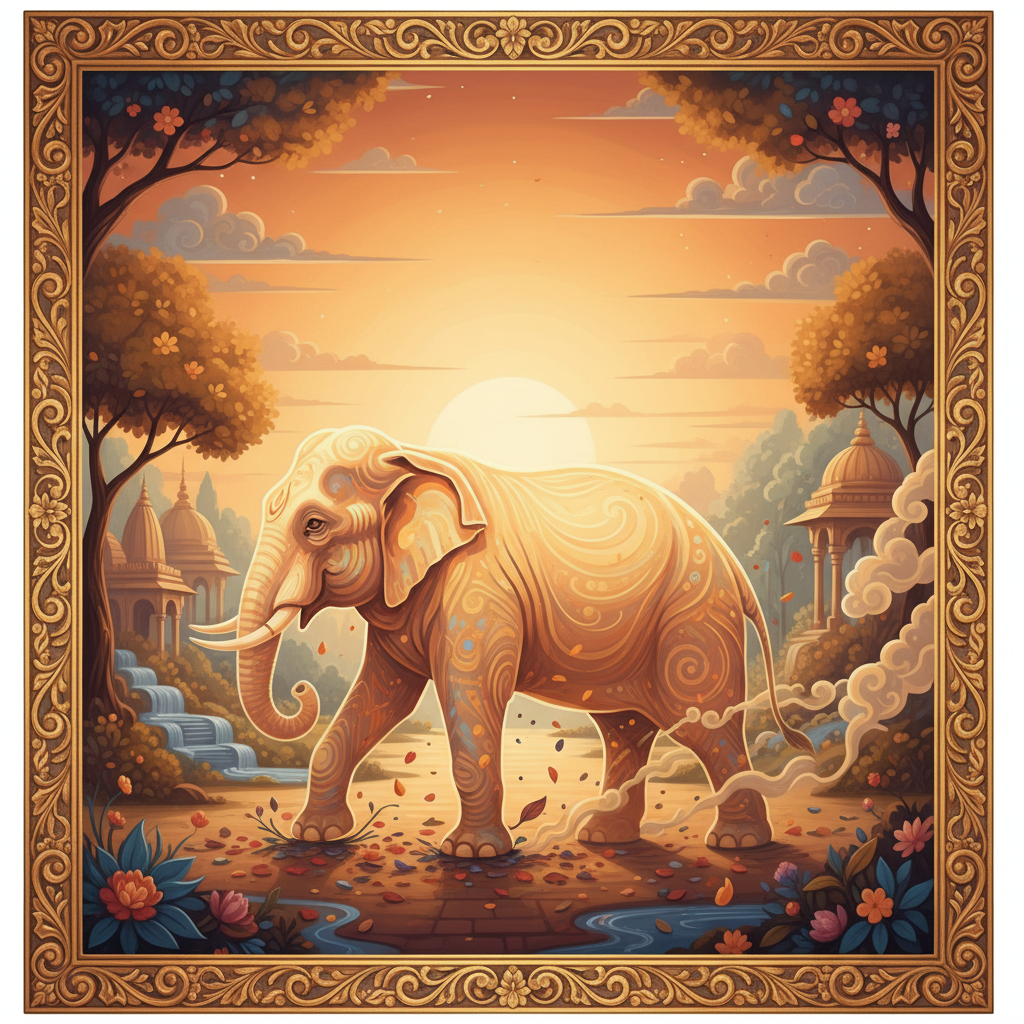
Prahlāda tells his soul it has “vanquished the elephant of mind,” and Swamiji identifies the elephant precisely: the vāsanās, the subtle desires stored in the subconscious. What makes the image useful is the description of arrival. Vāsanā-driven energy “moves like an elephant moving very gracefully.” It is “so soft” on entry — soothing, even pleasant. The devastation comes after: elephants in your garden, “tremendous chaos.”
This is the practical value of the passage. A vāsanā does not announce itself as a compulsion. It announces itself as something mild and reasonable, and its “effect on your daily life is tremendous, both ways, positive or negative.” The second image sharpens it further. The senses and conscious mind are horses; malina vāsanās, impure ones, make them duṣṭa — wicked horses that lead you into durdarśa, into “situations that degrade your personality.” The horses are not the problem. What has been fed to them is.
Śūrpaṇakhā and the retrained senses
For sense-craving specifically, viṣaya-vāsanā, Swamiji reaches for Śūrpaṇakhā — the demoness who approaches Rāma with flattery and whose nose and ears Lakṣmaṇa cuts off. He is characteristically funny about the mechanism of desire’s disguise, noting that she presents herself as beautiful when she is not, by “demonic magic.”
The ears get the extended treatment, and the criticism lands close to home for anyone with a phone. Human ears, he says, are so involved with “unnecessary things, lots of news. So no meaning at all.” Then the deeper cut, aimed at the material rather than at the listener: the news items themselves have no depth of character. And yet they keep changing, and the mind keeps working to keep up with them. His conclusion is not renunciation of hearing but its reassignment. Satsaṅga should become attuned to the senses, so that bhajanas, kīrtanas, inspiring talks, “and even birds and animals and trees” all bring the same message. “Through your sensitive ear, they must bring glory of God.” Then, he says, “Śūrpaṇakhā in you has been well treated.”
Deho devālayaḥ: the body as the temple of God
Earlier in the dialogue Prahlāda scolds the body for the trouble it caused. Now he reverses completely, and Swamiji marks the turn with the verse: deho devālayaḥ proktaḥ. “Look at your body not as your residence, but as the residence of God.”
Three images follow, each locating the indwelling Self somewhere the body cannot be separated from it. “You are the fragrance in the flower of the body.” You are the nectar in the orb — the whole body treated as a moon radiating it. And you are the sap that permeates trunk, branches and leaves alike. Then the question a temple invites, and its answer: “Where is His shrine? Where is He located?” — “God is from toes to the head, entire body permeated by God.” There is no inner chamber. The reverence has nowhere to concentrate, so it has to spread.
The screen, the iPad, and brahma satyaṃ jagan mithyā
Two analogies carry the metaphysics, and one is startlingly contemporary. Swamiji points at an iPad. All the history, geography and astronomy you have ever read reaches you through brain and nervous system, through the device. “And behind the iPad, all the source energy that works through the iPad, the real ‘I Am’—that’s the Absolute, that’s Brahman.” Different iPads run different dramas; “Brahman remains exactly the same.”
The second analogy is older and does different work. “The screen is the one that gives reality to all projected images. If the screen itself moves away, what will the projection look like?” Here the Self is not the source behind the display but the ground that lends it whatever reality it has — which is why brahma satyaṃ jagan mithyā, Brahman is real and the world illusory, is not a dismissal of the world. Remove the screen and nothing remains to dismiss.
Between the two, Swamiji inserts the guardrail that ties the hour back to its opening. Brahman must be brought “into your heart as the source of infinite love,” not approached mathematically. Scriptural study begins as intellectual work, and “intellectual knowledge must help your heart to develop more love of God.” If it does the opposite, his verdict is blunt: “If it takes you away from bhakti, then your knowledge of scriptures is very poor” — and perverted. He is equally direct about ritual outgrowing itself: “Temple adoration is a kindergarten method of remembering God, of connecting with God.” Not forbidden. Outgrown, once “every little thing that you handle becomes a pūjā.”
Existence as the common denominator: the dream and the doubter
Between the two analogies Swamiji works a third one harder than either, the one that makes the metaphysics testable. Imagine dreaming, he says. In the dream you are seated on a chair, and “you find your body hit by a car.” Your legs ache, your arms ache, the whole body aches. Meanwhile — “but higher in you” — “you are lying on the bed. You have nothing, you are completely free.”
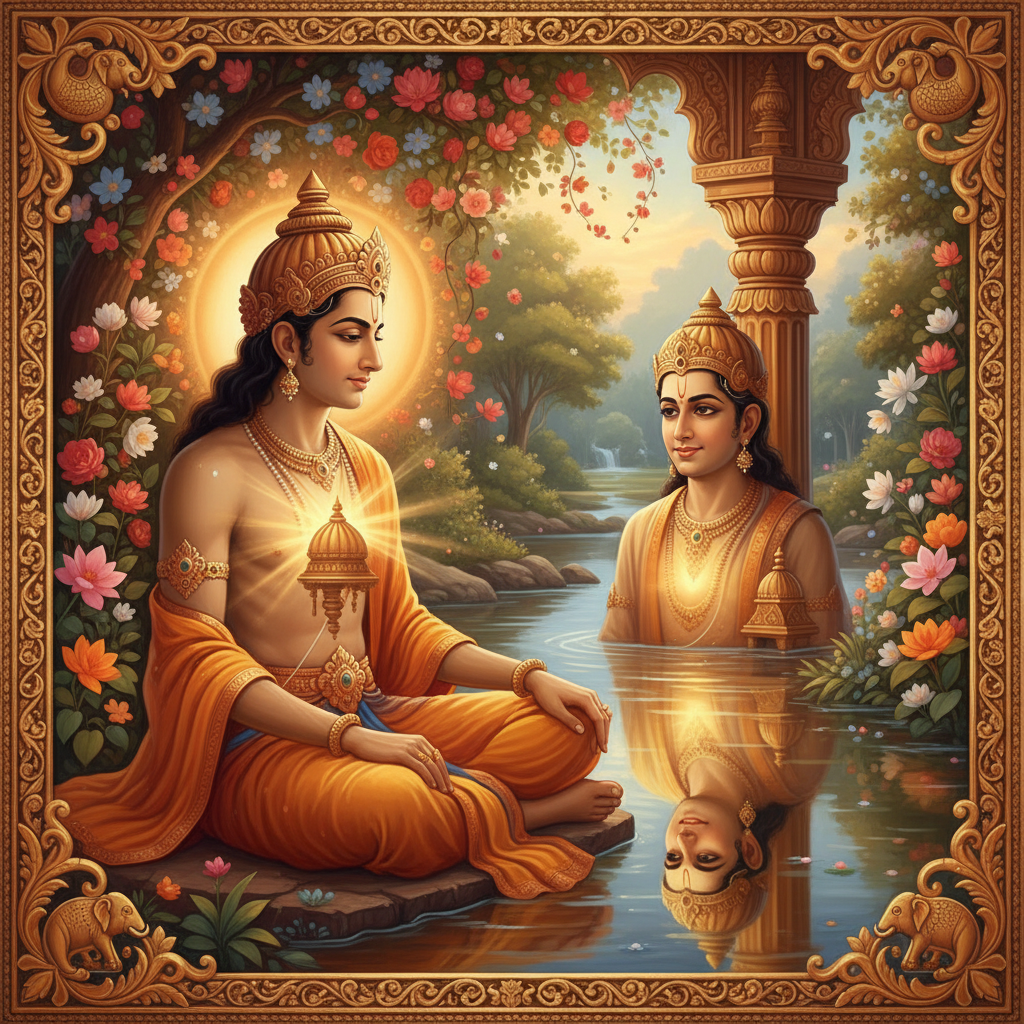
He then pushes past the obvious reading. It is not only your dream body that is yours. “In your dream, you are looking at the sky. Where is that sky? Your own consciousness.” Past, present and future in the dream, the mountain in the dream, even, as he puts it, the roach of the dream. “The entire world of your dream is permeated by your own consciousness.”
The argument closes with something unexpected from a teacher who has just warned against approaching Brahman mathematically. He addresses the student of mathematics directly: describe any object you like, and “existence is the common denominator.” Pain is. Happiness is. The found pen is; the lost pen is. “All things you are gaining, they are shifting. But something is not moving away. The awareness, existence behind them.”
And the last move is the sharpest. Deny the whole world if you like — say you do not believe in God. “You are not negating yourself, the non-believer.” You may doubt everything, but you cannot doubt the doubter. That residue which cannot be effaced is what the tradition calls Sat, and Swamiji collapses the terminology in a breath: “Saccidānanda—these are just synonyms.”
“Adorations unto Me”: when the duality falls away
The dialogue has been running on two levels — a man speaking, a soul being congratulated. Swamiji explains why the split was needed at all: a trace of previous memory, avidyā-leśa, makes the speaker seem separate from the soul that has attained enlightenment. “This separation has been done so that you can hear the dialogue.”
Then Prahlāda steps up and the duality goes. “I have bloomed into the fullness of the Self. I have attained nirvāṇa. I have vanquished ignorance and its effects. I have become the innermost Self.” And finally the line that would be intolerable from anyone who had not earned it: “Adorations unto Me, who am Brahman, the Absolute.” No longer congratulating the soul as another. Worship with no second party left in the room.
Vasantavad lokahite carantaḥ: enlightenment must spread
The lecture’s last movement is a correction, and it is the reason Section 36 does not end at the summit. Prahlāda passes into nirvikalpa-samādhi and remains “like a painted picture” for a very long time — and Swamiji reads this as dramatization rather than the ideal. “If he had attained enlightenment, he wouldn’t have done that.” Lord Viṣṇu arrives specifically to draw him out of it and back into his duties as king.
The principle is stated as vasantavad lokahite carantaḥ — the enlightened move for the world’s welfare as spring does. “Enlightenment should not be viewed as becoming static in body and mind,” but as blossoming that “must express” its fragrance. Swamiji is dry about the alternative, noting that bears do not get up for six months either, and “they’re called Yogis.”
Spring is the right image because it is involuntary and general. You do not distribute it. “You don’t have to go after it with detail.” Which gives the hour its closing line, and the answer to the warning it opened with: “Not a single wave can rise unless many other waves are lifted up.” A liberation that hardened the heart could not lift anything. That is why softness was the test.
Questions for reflection
- Where has study made you sharper without making you kinder?
- Which soft, reasonable arrival in your day is actually the elephant entering the garden?
- What reaches your ears daily that has, in Swamiji’s phrase, no in-depth character?
- If the body is God’s temple from toes to head, what changes in how you treat it today?
Terms in this lecture
- Upaśama Prakaraṇa — the fourth book of the Yoga Vāsiṣṭha, on quiescence of mind.
- Vāsanā — a subtle desire stored in the subconscious; malina vāsanā is its impure form.
- Viṣaya-vāsanā — craving specifically for sense objects; viṣaya-rasa is their flavour.
- Guṇas — sattva, rajas and tamas, the three constituents of prakṛti (nature).
- Deho devālayaḥ proktaḥ — “the body is called the temple of God.”
- Avidyā-leśa — a residual trace of ignorance remaining after realization.
- Brahma satyaṃ jagan mithyā — Brahman is real; the world is illusory.
- Saccidānanda — absolute existence, awareness and bliss.
- Vasantavad lokahite carantaḥ — “moving for the welfare of the world, as spring does.”
- Nirvikalpa-samādhi — absorption without distinction of subject and object.
Yoga Vāsiṣṭha, Upaśama Prakaraṇa, Section 36. Lecture 179 by Swami Jyotirmayananda, Yoga Research Foundation.
Listen to the lecture in full: https://youtu.be/uXqSilOFfxQ
It is free to listen to, and so is the entire archive, at yogaresearchfoundation.org.
This study guide is drawn from the archived teachings of Sri Swami Jyotirmayananda.