
This lecture takes up Balkanda from Doha 196, in the stretch just after Rama’s birth, and it turns on a distinction most readings of the passage skip. On the surface the verses record a royal celebration: King Dasharatha opens his treasury and gives away elephants, chariots, horses, gold, cows and diamonds, and the people go home content. Read as history, that is all it is, and Swamiji says plainly around the four-minute mark that history is not what he is after. He is after the subtle insight the list conceals.
The distinction is between the gift and what the gift stands for. Each of those six items names an inner capacity, and the sequence of them is a description of a person being assembled: confidence first, then integration, then durable value, then wisdom. From there the lecture moves to what that assembled contentment is actually for, and this is where it becomes practical. Contentment turns out to be one of four gatekeepers standing at the palace of liberation, and Swamiji’s claim about them is unusual: you do not have to satisfy all four. Please one sincerely and the rest open, because they were never separate to begin with.
The second half is a different kind of teaching. The naming ceremony arrives, Sage Vasishtha names the four sons, and the names stop being labels. Each one turns out to name an aspect of a single awakening, and the name Rama is opened as a piece of mantra science with a specific effect on the person who repeats it. The lecture ends by climbing three rungs, from God with form, to God without form but still with qualities, to what remains when the concepts go too.
Passage index
- 00:00 I Am Not the Body, Mind, or Ego
- 01:38 Balkanda, Doha 196: Rama Incarnates in Four Aspects
- 02:42 Dasharatha Opens His Treasury
- 03:48 Faith Walks Like an Elephant
- 04:47 Chariots, Gold, Cows, Diamond: The Gifts Decoded
- 08:01 Santosha, the First Gatekeeper of Liberation
- 10:04 Shama, Satsanga, Vichara: The Other Three Gates
- 15:24 The Lesson of Sleep and Dream
- 25:33 The Naming Ceremony Begins
- 28:01 The Mantra Science of Rama
- 33:26 Saguna Sakara to Nirguna Nirakara
- 40:28 Bharata, Shatrughna, Lakshmana
The gifts are not an inventory
Swamiji spends the first ten minutes refusing to treat the charity list as inventory.
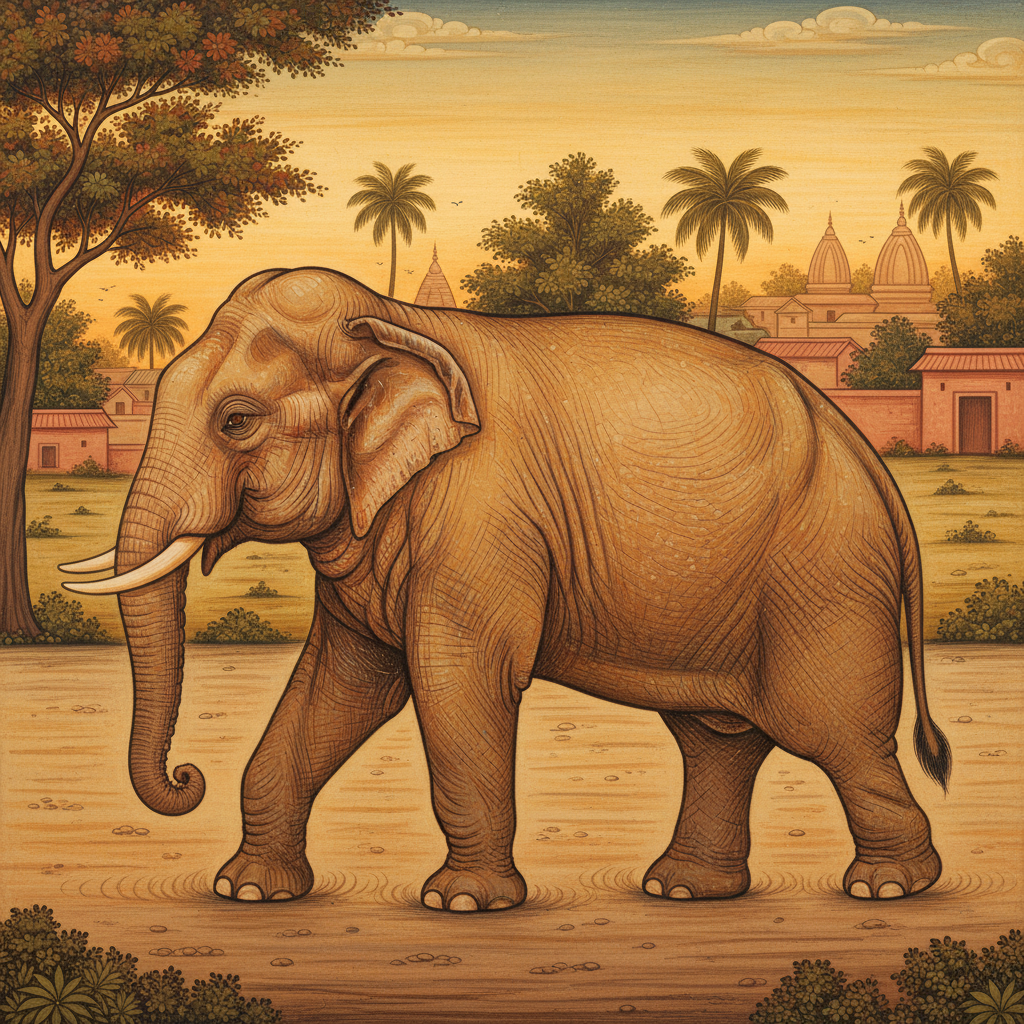
The elephant comes first, and it is the most vivid image in the lecture. Elephant energy is faith-based confidence, the kind that keeps moving at its own pace. He describes being criticised and abused by the people around you and not fighting back, not fleeing, but staying amused while the elephant goes its own way. The dogs bark; the elephant continues. What makes this more than a consoling image is where he puts it in the sequence: this is the first gift, the ground floor. Nothing else gets built on a person who reorganises themselves around every criticism.
Chariots and horses come next, and they work as one unit. The horses are the senses, the reins are the mind, and the chariot is an integrated personality. His warning here is memorable and slightly comic: the intellect should not be doing drunk driving. Integration is not suppression of the senses but the ordinary condition of something being properly in order.
Gold is spiritual value, and the reason gold rather than another metal is that gold keeps its shine under adverse conditions, even when melted. Other values dim; this one does not. Cows are the wisdom of the Upanishads, and if you cannot give the cow, he says, at least give the milk – bring that wisdom to people in whatever portion you can. The diamond is wisdom itself.
Then he inverts the whole picture. If you become a source of this, the gifts describe your effect on other people: you allow elephant energy to rise in those around you, you help bring their chariots into order, you render their horses healthier. The charity stops being something Dasharatha did once and becomes a description of what a mature spiritual life does continuously.
The four gatekeepers
The four gatekeepers are the practical centre of the lecture, and they earn the metaphor.
Santosha is the one he treats at greatest length, because it is the one most often misread. Contentment is not resignation and not a lowered ceiling. He calls it dynamic, and the mechanism he describes is precise: if you have santosha you put all your energy in the right direction, and if you lack it you hold your energies under nervous tension, waiting to see whether the effort will pay before committing it. That waiting is the actual loss. The content person is not the one doing less; they are the one whose force is not being spent on hedging. Underneath it sits the understanding that you lack nothing, which is why he immediately says not to compare yourself with others, and to trust that what has been given is what your evolution requires. Then use what you have, and let what comes come.
Shama is serenity, and the definition is behavioural rather than mystical: a mind that does not swing with the situations presenting themselves through the day. His image for it is the sky, which has no particular interest in what the clouds are doing, and then a correction that keeps it honest – trees do have to swing, but they swing in order to stay rooted, not to scatter. Serenity is not rigidity. It is developed, he says, through satsanga, study, and japa, and it deepens on its own once the project of self-discovery becomes interesting enough that the noise of the world stops competing well.
Satsanga is good association, and the function he assigns it is specific. Every soul has an instinctive urge toward saccidananda; satsanga awakens that urge and points it in the right direction. He weighs it against everything else on a scale: put all the pleasures and prosperities of this world and the heavenly worlds on one side, and a few moments of satsanga that rang the bell in your heart on the other, and the few moments outweigh the pile, because everything on the heavy side shares one defect. It perishes.
Vichara is reflection, and his framing of it is almost rueful. A person can become a great scholar, read all the Vedas, absorb volumes of discipline, and still not have landed the simple thing: that the real you has nothing to do with time, space and causation. What escapes the mind is not the obscure material but the most direct and vital point. Vichara is the process that finally lets an understood truth be assimilated rather than merely known.
The claim that holds the four together is the one worth carrying: they are so interrelated that pleasing one pleases all. And he adds a guardrail – please them, but not by wrong means.
The lesson given every night
Between the gates and the naming ceremony he turns to a lesson he says is administered nightly, free of charge, to everyone.
In deep sleep the entire world moves away from you, and you do not miss anything. He draws the conclusion carefully: if the world can be completely absent and nothing is lost, the world has no real bearing on what you are. So do not define yourself by the world, the body, the senses, the mind, the pranas, your wealth, your house, your popularity, or your relations. All of it leaves nightly. What remains is what the lecture opens with: not the body, not the mind, not the intellect, not the ego, but existence, consciousness and bliss.
Dream teaches the second half of it. The dream world is a full replica of daily life, complete with worry about the past and the future, with people who do not exist, with accidents and prosperity. He allows himself a joke – in waking you may have five children, in dream ten – and then makes the point land: all of that population and all of that geography emerged from your own consciousness, and the whole of it is you, lying on the bed. Extend the same reasoning to the waking world you have studied and gathered knowledge about, and the conclusion is the same one Vedanta keeps offering and the mind keeps declining to take. This is exactly the material vichara exists to work on.
The gift that harms the receiver
Before the naming ceremony Swamiji returns to Dasharatha’s charity with a qualification that is easy to miss and hard to forget once heard. The king promoted contentment among the people around him, which is what makes the giving admirable. But not everything handed over is a gift.
Do not give the kind of gift that will make the receiver mad. He is explicit that he means this both allegorically and practically, and he names drugs and intoxicants as the plain case. The allegorical case is the one with wider reach: if you are giving advice, do not give wrong advice for some purpose of your own ego. The test is not the generosity of the giver but the effect on the receiver, and a gift that flatters the giver while damaging the person who takes it is not charity at all. Placed where it is, immediately after ten minutes on the six gifts as inner wealth, the warning reads as a check on the whole allegory. The capacities are real, and handing someone the counterfeit version of any of them does harm.
He also draws out something quieter from the same passage. Time passed in Ayodhya, the verse says, and nobody noticed day or night. Swamiji reads that first as an ordinary observation – during a wedding or a festival, people lose track of the clock while they are absorbed in what they are counting out to give. Then he goes further: time relates to the mind, and it is not the truth. Beyond the mind there is no time at all, and sleep is the illustration everyone already has. The practical form of this is the one worth keeping. To the extent inner peace has been restored, even partially, even well short of enlightenment, time passes and you do not go on accumulating stress from its passing.
The name as mantra
The naming ceremony gives the lecture its second engine.
Dasharatha asks Vasishtha for a name, and the sage answers that this being has countless names and he will give one according to his own understanding. The name is Rama, glossed in the verse as the ocean of bliss and the abode of joy, one drop of which makes the three worlds happy, and the bestower of peace to all planes.
Then Swamiji opens the name as mantra. He sets it beside Om, which the Upanishads evolved first and which stayed abstract – there is no story attached to Om, and it takes a particular kind of mind to be held by it. Rama keeps the terminal M and its ananda, and replaces the opening with Ra, which he identifies as the bija of the navel centre, the agni-bija, the seat of what he calls the karma-granthi. His account of the effect is anatomical: Ra opens the kundalini through the navel centre, and with the A-M the ajna chakra opens and the sahasrara begins to shower its nectar. The consequence for practice is that the mantra acts on the nervous system whether or not the person repeating it has any philosophical position on it. He points out, almost as an aside, that R and M recur across the world’s languages, and treats that as evidence of a universal science rather than a coincidence.
The four brothers then divide the work of one awakening. Bharata is bhakti, and the name traces to bha, light – the light of love, of knowledge, of practical reality – all of it proceeding from love of God. He observes that this same love is what instinctively sustains every creature, including the bird who leaves on a long errand without a phone and remembers to return to the beak of her baby. Shatrughna destroys the enemies, which are named as kama, krodha, lobha, moha, mada and matsarya, and his role is karma yoga: action that purifies the heart. Lakshmana is the fountain of divine qualities, daivi sampat, and in daily practice he is dhyana – with the reminder that meditation is not primarily a posture but an inner flow of understanding and feeling.
The ascent closes the lecture. Saguna sakara is God with form, and it exists so that people understand God is not out of reach. Saguna nirakara he illustrates domestically: when someone you love returns after years, you look at them at first, and then you stop looking and simply communicate – the form stops mattering while everything it carried remains. Nirguna nirakara is the last rung, where even the finest concept is surrendered. Brahman defined as sat is a wonderful definition, and it is still a concept in your mind; realisation is what happens when the concepts move away along with the mind that held them.
Lakshmana, and how to read your own progress
Lakshmana carries the most technical material in the lecture, and it repays slow reading.
Following the Puranic picture, Lakshmana is Shesha, the cosmic serpent whose countless hoods sustain the universe while Vishnu rests on them. Swamiji concedes the image is hard, then gives the reading that makes it work: all world experience rests on the thought waves of the mind. There is no object standing on its own. It is the mind that produces the experience of physicality, which is why you touch people in dreams and can describe how it felt, and why a person rendered unconscious can have a great deal done to their body without being present to any of it. Your mind has a few thought waves; the cosmic mind has all of them, and those boundless hoods are Hiranyagarbha, which enfolds saguna Brahman.
In daily practice this same Lakshmana is dhyana, meditation, and the lecture insists that without meditation there is no realisation. The corrective follows immediately: meditation does not mean permanent residence in a steady cross-legged pose. It is a process of internal understanding, an inner flow of divine feeling.
The most immediately usable part is the etymology. From Lakshmana comes lakshana, the ordinary Hindi word for a symptom or characteristic – what a hospital means when it asks after a patient’s lakshan. Swamiji turns the question on the practitioner. When you are doing sadhana and want to know whether you are making progress, ask what the lakshanas of that progress are. The diagnosis works in both directions, positive and negative. This is the answer to a question every sincere practitioner eventually asks, and the answer is not a feeling but an inventory: how much daivi sampat has actually developed. How much Lakshmana is operating through you depends on how many good qualities you have built, and those are observable.
He ends the thread with purpose. Lakshmana is the abode of the divine qualities, and through them the whole world is sustained, because the world has a reason to exist and that reason is dharma. The Lakshmana personality is the one that brings about the situations in which dharma comes out on top. Where there is dharma, there is victory – and the route to that victory inside a person is the unglamorous development of those characteristics.
Terms
- Santosha – contentment; in this lecture, the settled knowledge that nothing needed is missing.
- Shama – serenity; a mind that no longer swings with each change in circumstance.
- Satsanga – holy association; company that awakens the soul’s own aspiration.
- Vichara – inquiry, Vedantic reflection; the turning over of a truth until it is assimilated.
- Saguna sakara – God with qualities and with form.
- Saguna nirakara – God with qualities, form no longer needed.
- Nirguna nirakara – beyond qualities and beyond form, where concepts themselves fall away.
- Namakarana – the naming ceremony, one of the traditional samskaras.
- Daivi sampat – the wealth of divine qualities.
For reflection
- Of the four gatekeepers, which one is already partly open in your life, and which keeps swinging shut?
- Where are you still waiting for circumstances to justify your effort, instead of putting the effort in first?
- The lecture claims you lose the entire world every night and miss nothing. What does your own experience of deep sleep actually tell you about that?
Tulsi Ramayana (Sri Ramcharitmanas of Goswami Tulsidas), Balkanda, from Doha 196. Lecture 87 by Swami Jyotirmayananda, Yoga Research Foundation. The complete lecture archive is free to listen to, and always will be.
This study guide is drawn from the archived teachings of Sri Swami Jyotirmayananda.