

What this lecture takes up
Patanjali spends three chapters elaborating what he states once, briefly, in the first. Sutras 1.17 and 1.18 are that statement about samadhi itself, and Sri Swami Jyotirmayananda returns to 1.17 in this ninth lesson deliberately rather than by accident. “Seventeenth Sutra, I have already talked about it and I will reiterate because of its importance,” he says at 5:27, and the reiteration is not repetition. The first pass named the four levels. This one places them inside a larger map: the five states in which a mind can actually be found, from the dull mind that cannot reason to the one-pointed mind where the study of samadhi begins at all.
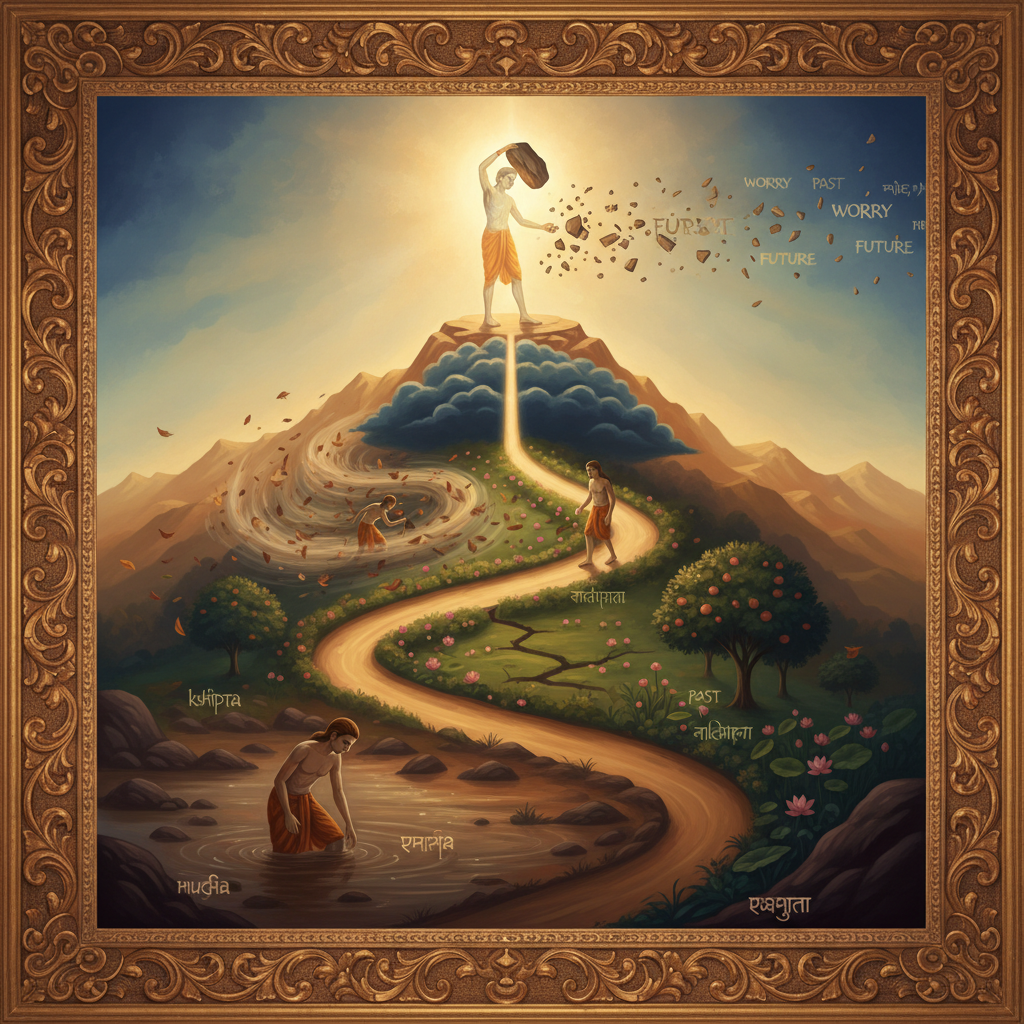
The distinction the lecture turns on arrives at 14:32, and it is uncomfortable. There is a state of mind that looks like attainment and is not. It belongs to what Swamiji calls the cultured community, people who are compassionate, who in all situations bring good feelings and good qualities. “But there’s only one defect.” Under great provocations, “they lose their goodness. How much will they lose? They don’t know it.” That is vikshipta, and its defect is not cruelty but unpredictability. “You are not under your control.” A mind can be genuinely good and still have no security in it.
From there the lecture climbs. Ekagrata, one-pointedness, is where samadhi becomes a subject rather than a word. The four levels of samprajnata samadhi follow in order, each still lit by the illusion of the thought-waves. Then sutra 1.18 names what lies past the ego, and Swamiji does something unusual with it: he refuses to describe the summit as an experience. He describes it as a subtraction. What precedes it is virama-pratyaya, the mind’s own special stoppage. What follows it is samskara-shesha, a residue of impressions that oppose the whole machinery of projection. And the way you recognize the change is not a vision. “You had burden on your head before and you didn’t feel the burden.”
The image the lecture keeps returning to is a cinema show, and it carries the whole teaching. Every perception, existent or absent, is a projection thrown on a screen. Comedy and pathetic dramas have been shown, and the screen remains untorn.
Passage index
Each entry opens the lecture at that moment.
- 00:00 – Cold open: the goodness that breaks under provocation
- 00:42 – Invocation to Patanjali
- 01:15 – Purifying the mind, the body, and the speech
- 04:47 – Sutra 1.17 and samprajnata samadhi
- 06:11 – The chitta and its five vrittis
- 11:06 – Mudha, kshipta, vikshipta: the mind’s lower states
- 15:14 – Ekagrata and the mind beyond the nervous system
- 18:14 – Vitarka, vichara, ananda, asmita
- 23:19 – The risk of stopping at the ego
- 30:50 – Sutra 1.18: virama pratyaya and samskara shesha
- 32:33 – The cinema show and the screen that stays untouched
- 38:04 – Nirodha samskaras and the burden that lifts
Three scriptures for three instruments
The invocation Swamiji recites at 0:42 credits Patanjali with three gifts, and he takes each one in turn. Yoga was given for purifying the chitta, the mind-stuff. Vaidyaka, the Ayurvedic medicine, was given for purifying the body. Grammar was given for purifying the tongue, and Swamiji immediately blocks the literal reading: “not that type of purification speech.” Speech, not the physical organ.
Why grammar sits beside yoga and medicine is the interesting part. “And speech is very next to your mind,” he says at 2:08. “You can’t show your mind, but you can bring to, you show your speech.” Speech is the one part of the inner life visible from outside: “Your goodness, your graciousness, your culture expresses through the tongue easily.”
Then he turns the compliment around. Perfect language implies simplicity, profound thought, and control over an instrument structurally too small for what it carries. “Language is very weak, little. It’s just like a bullock cart. Wisdom is tons of weight.” Which is why inspired writing shows strain rather than polish: “You see the language but the language is shaking. Something profound is behind it.”
The body gets the same honest treatment. It is the instrument, and it cannot be relied on by itself. “You can’t trust your body to stay on in a particular sadhana, in a particular type of project of discipline.” The remedy is not more force but alignment: bring body and mind together, so that a project once undertaken is one you will actually follow.
The chitta and its five vrittis
Chitta in this lecture means mind in its totality, not one faculty among several. Swamiji divides it by access rather than by name. Below the waterline, the unconscious goes on holding impressions and the subconscious brings some of them close to the surface, where they are called vasanas, subtle desires. For working purposes he groups subconscious and unconscious together as simply what is beyond your conscious mind.
Within the conscious range there are three: manas, picking up perceptions; intellect, rationalizing and evaluating; and ego, asserting “this is me, this is mine.” The trouble is that they do not take turns. Ego “doesn’t care for evaluating etcetera. It waits for the intellect,” and sometimes oversteps it. “Ego simply says I like it.” The intellect says that it is good for you. When ego outruns intellect, you get what Swamiji names plainly as a disorganized personality, and he does not treat this as a defect in a few: “You begin your life disorganized, most of people, not all.”
The thought-waves produced by all this aim at five points. Pramana is right perception, seeing a rope as a rope and not a snake, and it also arrives through scriptural knowledge and inference. See smoke: “You know, fire and smoke, they are always together.” Most studies of science, he notes, rest on inference. Viparyaya is the inverse, a snake where the rope is. Vikalpa is imagination, which needs neither: “Even though there is no rope and no snake, you see snakes everywhere.” Smriti is recollection, and nidra is sleep, where recollection and practical knowledge alike get drowned.
The five states of the mind
The vrittis are not the classification. How you handle them day after day is. “These vrittis, the manner in which you handle them in your day-to-day life, that evolves the type of mind that you live with.” Profound study, Swamiji says, brings five classifications of that evolved mind.
Mudha is the lowest, the dull mind. The intellect has no strength in it and there is no clear reasoning, while constant impressions of anger, hate, and greed are tossed about by stress and fear. His image is hydrological: “You’re looking at a lake that has lots of sediments, sediments that go on creating mud.” Nothing good grows in that water. Swamiji then makes a concession most maps of the mind omit. Everyone holds these states in different degrees, and the ability to be abnormal should be there in every individual, “as long as you can spring out of it.” The pathology is not the visit. It is the inability to leave.
Kshipta is the mind constantly running in different directions, and it is an improvement, which is counterintuitive until you see his reasoning. A mudha mind can look peaceful. He reaches for a Hindi pun to make the point: the difference between buddhu and Buddha, where one is light and the other only resembles it.
Vikshipta is the cultured mind, and it is where the lecture spends its sharpest attention. Then ekagrata, one-pointedness, “not to be many pointed.” The fifth, nirodha, is the restraint that sutra 1.18 will describe from the inside.
Why vikshipta offers no security
The cold open of this lecture is the vikshipta passage, which tells you where its center of gravity is. These are people who belong to a cultured community, compassionate, bringing good feelings and good qualities into all situations. The defect is singular and it is not a character flaw. It is a load limit.
“Under difficult situations, under great provocations, they lose their goodness. How much will they lose? They don’t know it.” The not-knowing is the whole problem. A good person with an unmeasured breaking point cannot be relied upon by others or by themselves. “So vikshipta level doesn’t give you security. You never know what’s going to happen to you, to people around. How situations will impact your mind.”
This is also where Swamiji withholds a title that a listener at this level might assume. Coming up to this state, you are not yet a yogi in the more precise sense of the word. Not because goodness is worth little, but because goodness that has never been tested at its limit is not yet stable. Only when the mind begins to move beyond vikshipta and enter ekagrata does the precise sense of the word begin to apply.
Ekagrata and the mind that is not the nervous system
Ekagrata is a sustained flow with precision, continuity, and clarity. Practically: “When you have goal in view, your mind should be able to focus. Leave everything aside.” Perfecting it, or even working at perfecting it, brings the first taste of lower samadhi, of having placed your feet in a different dimension.
Then the lecture makes its most physiological claim. Until this point, “you are aware of your mind that is very closely knitted with your nervous system,” and so long as that identification holds, the mind has given you no higher dimension at all. The shift is recognizing that mind is not based on the nervous system. The nervous system is wiring; mind is what flows through it.
The consequence he draws is large. “Therefore, your soul has the capacity to draw from the mind amazing strength, strength that the nervous system can’t bear.” That potentiality lies in everyone, and getting insight into it is the opening into the samadhi level, the superconscious. Swamiji adds that it is not always deliberate. In people who have built a good personality and worked on wonderful qualities, with devotion to God, “suddenly flashes of this experience come natural.” This is why, he suggests, everyone believes in blessings and everyone wants to hear that they will be remembered and prayed for. Scientifically you do not know how it works. “But it’s instinctive, there is something in you that can touch the heart of others.”
The four levels of samprajnata samadhi
Samprajnata is samadhi “still involved with the illusion of the vrittis, thought-waves.” It is lower samadhi, and it has four rungs.
Vitarka is a mind handling good and positive thoughts alongside negative ones, trying to manipulate both types, not yet arrived at a precise understanding. Vichara is where reason becomes clearer, so that you move consistently toward the positive and the mind begins to empty itself of erroneous concepts and of the illusions it has been holding. Asad-vichara moves away gradually, asat being that which is not real, and Swamiji anchors it in the prayer every student knows: asato ma sadgamaya, from unreal lead me to the real. He then names the cost of the alternative with unusual bluntness. A mind engrossed in things that have no impact on it, and in things about others that are not real either, “leads itself to mudha level. Dull, the whole day has passed, nothing is accomplished.”
Ananda is joyousness, the discovery of how much possibility you carry, though the ego still restricts it. Asmita is the deepest, where you have stepped up to the very level from which ego arises, and “there’s only a very thin wall separating you from this level to the cosmic I Am.” At the source of the ego you enjoy the melody so’ham asmi. Swamiji notes precisely who is speaking: “I’m not this personality, I’m not the mind. Who is saying it? It’s the level of the ego that’s expressing it.”
The risk of stopping at asmita
Every one of these levels can be a terminus, and asmita is the dangerous one. “The risk is you have exaggerated view of yourself.” His example is Hitler, and the analysis is more interesting than the condemnation: the premise was not false, only misapplied. What must not happen is that the truth becomes identified with ego, creating superiority.
The mechanism is worth following. At the ego level you discover resources beyond imagination, and unlike a lottery win these are resources in the terms of eternity, limitless. All the psychic powers are present in the human personality. So the risk becomes siddhis pursued for their own sake. Swamiji is funny about the small ones, imagining a man proud of knowing what the neighbors are cooking without visiting the house, and says outright that he is joking. Then he takes the general point seriously: “Technology is an extension of mental power.” Scientists discovering the laws underlying subtle elements and creating devices are performing a mental extension. And a mind can operate without the technical object.
The test is use. A yogi who pursues a siddhi and then uses it for the good of others purifies the heart and moves ahead. If not, “it stays inflating the ego. Then a person can become into a demoniac personality.” Hence, he observes, demons across all religions have amazing powers. Satan had a lot of power. Ravana had amazing powers. The way past the risk is not renouncing the resources but making the ego transparent: “Immediately you allow your ego to become transparent through devotion, surrender to God.”
Sutra 1.18: virama pratyaya and samskara shesha
Patanjali gives the highest samadhi one line. Swamiji reads it structurally: asamprajnata samadhi is that of which virama-pratyaya is the preceding state and samskara-shesha is the succeeding state. “It comes like an elephant, something preceding it, something succeeding it.”
Pratyaya means perception, and all experience is in the terms of pratyayas. In waking there are two kinds: bhava-pratyaya, the perception of existence, and abhava-pratyaya, the perception of non-existence. Sleep is not an exit, because the sleep process is itself backed by a thought-wave, and what you experience there is abhava-pratyaya, absence. “In waking state you are dealing with illusions, in dream state you are dealing with it. In sleep you think that at least I’m not out of it. You are not.”
Virama is what happens when a movement starts to tick off the entire projected illusion. “Stop it. Virama. Special stoppage.” The mind that has set upon virama says, “No more, I’m not interested.” Everything from Brahmaloka down to the blade of grass falls within the range of mental thought-waves, which is pravritti; the turn toward nivritti is this refusal. His image for it is a swan shaking its wings, saying no to all pravritti, all illusions.
The cinema show and the screen
“For easy understanding, think of a cinema show.” Whatever appears on the screen is created by projections, and pratyayas are projections. They create the illusion that there is a big palace, and the illusion that the palace has been demolished. It is, it isn’t. Daytime, night, no one there. Even the report that there is nothing to experience is produced by the same projector.
Enlightenment, in this frame, is a recognition rather than an acquisition: “that you begin to realize, oh, I have been watching the cinema show. The screen has been the only thing before my eyes. And that screen didn’t do anything, it’s the same.” Then the two lines the lecture is built on. “Rains came and torrential storms came and went and screen has not been touched by it.” And: “Comedy and pathetic dramas have been shown and the screen remains untorn.”
“So is consciousness.” The practical question follows immediately, and it is a question about attention, not about belief: how do you switch attention from the world of projections your mind is constantly creating, to the screen? Lower samadhi is the first movement of that switch, made before the screen is fully understood. What you need, he says, is not better perceptions but “absence of perceptions,” and as that absence grows, whatever you are seeing becomes more and more transparent until the screen outshines all of it.
How to recognize nirodha samskaras
As the elephant moves on, impressions of a different nature gather: impressions that oppose the illusions. “The term is used, nirodha-samskaras.” A mind that spent its life manufacturing impressions now manufactures impressions against the whole process. “It has created a neutralizer.”
Then Swamiji asks the question a study guide should not skip. “And how do you recognize it?” His answer is entirely negative, and entirely checkable. “You had burden on your head before and you didn’t feel the burden.” “You are worrying about all things and now you don’t worry about it.” The involvement with past, present, and future has moved away. You felt you were nothing but the body, completely drowned in it, and now you do not feel that way. “The whole world becomes like a tree and you are a bird flying far away.”
He states the criterion outright: “The increasing absence of the negativity of your mind is a characteristic of the growing nirodha-samskaras.” Not a light, not a sound, not a power. Less negativity, and less weight.
Stripping the sun
The closing image answers the fear hidden under all of this, which is that subtraction means loss. Strip the sun of everything that happens on the Earth planet. Take one single day of the sun’s work: clouds, rainbows, all drops shining. Strip all of it. “The sun is not affected,” and it is not depleted of its glory.
The Self is stripped of the entire world process in the same way, the enormous experience gathered through mind and senses, from life to life, through trillions of lives. “And you are not losing anything.” You are the sun. You are what the screen is. “That is called enlightenment.”
Scholar’s Corner
The two sutras Swamiji recites are Samadhi Pada 1.17 and 1.18. Sutra 1.17 is vitarka-vicara-ananda-asmita-rupa-anugamat samprajnatah, which makes the four terms the forms that accompany samprajnata samadhi, not four separate samadhis, a distinction Swamiji preserves when he calls them levels rather than kinds. Sutra 1.18 is virama-pratyaya-abhyasa-purvah samskara-shesho’nyah: the other, asamprajnata, is preceded by the practice of the perception of cessation, with a residue of samskaras.
The five states of the chitta Swamiji enumerates, mudha, kshipta, vikshipta, ekagrata, and nirodha, are not given as a list in Patanjali’s text. They belong to the commentarial tradition built on 1.2, yogash chitta-vritti-nirodhah, and are standard in the Sivananda lineage’s teaching of Raja Yoga. Reading 1.17 through them is Swamiji’s own pedagogical move, and it is the reason this lesson is not a repetition of the previous one.
The five vrittis he lists, pramana, viparyaya, vikalpa, smriti, and nidra, are Patanjali’s own, given at 1.6 and defined across 1.7 to 1.11. The prayer asato ma sadgamaya is from the Brihadaranyaka Upanishad, 1.3.28. The lecture closes with the purnamadah invocation from the Isha Upanishad and the threefold shanti.
Glossary
- Chitta – mind-stuff; the mind in its totality, conscious and beyond.
- Vritti – a thought-wave; a modification of the chitta.
- Vasana – a subtle desire; an impression brought near the conscious mind.
- Pramana, viparyaya, vikalpa, smriti, nidra – right perception, wrong knowledge, imagination, memory, sleep.
- Mudha – the dull state; intellect without strength, a lake thick with sediment.
- Kshipta – the scattered state, running in all directions.
- Vikshipta – the cultured state, whose goodness has an unmeasured breaking point.
- Ekagrata – one-pointedness; sustained flow with precision and continuity.
- Nirodha – restraint; the stilling in which the higher samadhi is described.
- Samprajnata samadhi – lower samadhi, still accompanied by the illusion of the vrittis.
- Vitarka, vichara, ananda, asmita – its four accompanying forms.
- Asamprajnata samadhi – the higher samadhi, beyond the ego level.
- Pratyaya – a perception; bhava-pratyaya of existence, abhava-pratyaya of absence.
- Virama-pratyaya – the special stoppage; the cessation that precedes the higher samadhi.
- Samskara-shesha – the residue of impressions that succeeds it.
- Nirodha-samskaras – impressions that oppose the process of projection; the neutralizer.
- Siddhi – a power attained through yoga.
- Pravritti / nivritti – the outgoing movement into the world / the turn away from it.
- So’ham asmi – “I am That”; the melody at the source of the ego.
Questions for reflection
- Where is your own breaking point, and have you ever measured it, or only assumed it?
- Swamiji’s test for progress is the absence of negativity and weight, not the presence of any experience. By that test, what has changed in the last year?
- The reflected sun in the jar cannot find its answer in the jar or the water. What does that rule out about where you have been looking?
- What remains when every projection has been stripped away?
Watch the full lecture
Lecture 9 in the Raja Yoga Sutras series, recorded Sunday, April 22, 2012, by Sri Swami Jyotirmayananda, direct disciple of Swami Sivananda (1953 Sanyasa), Yoga Research Foundation.
The complete archive of these lectures is free at Swami Jyotirmayananda Live, and the full Patanjali’s Yoga Sutras playlist follows the series in order.
This study guide is drawn from the archived teachings of Sri Swami Jyotirmayananda.