
A study guide to Yoga Vāsiṣṭha, Lecture 185 — Upaśama Prakaraṇa, Sections 45 and 46, with Swami Jyotirmayananda
What this lecture takes up
A man named Gādhi is granted one boon by Lord Viṣṇu, and he does not ask for liberation. He asks to see how far māyā extends. Swamiji reads the request in Gādhi’s own framing — an insight into the extension of Your māyā, out of curiosity to see how much it is — and notes that Viṣṇu grants it anyway, with the promise that the seeing will itself lead to mukti. That promise is the hinge of the whole lecture. It means the vision that follows is not a punishment for asking the wrong question. It is the answer to the question, delivered in the only form that could land.
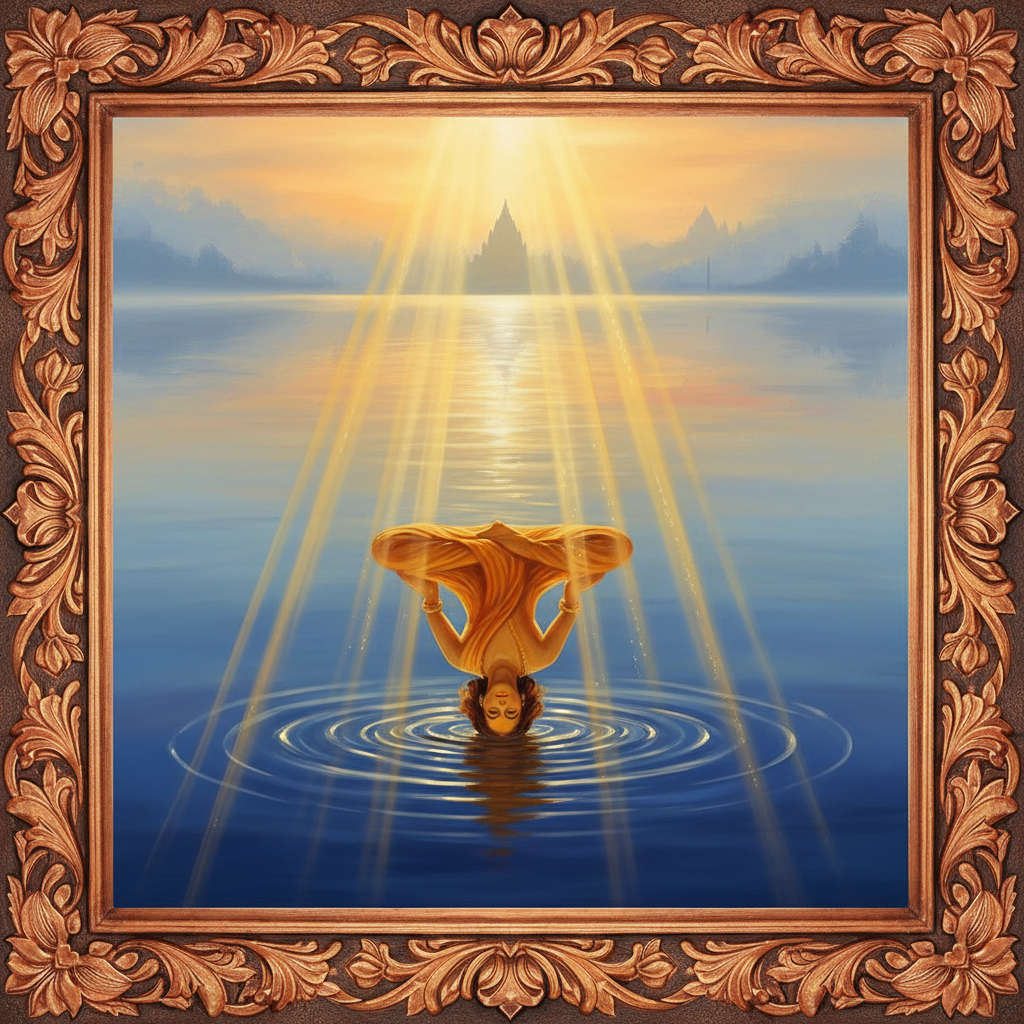
What follows is one of the strangest passages in the Yoga Vāsiṣṭha. Gādhi ducks beneath the water in the middle of his daily worship, and surfaces having lived an entire other life: he watches his own death and cremation, is reborn into a caṇḍāla household as a boy named Katañja, takes up hunting, marries, fathers children, loses every one of them to a famine, wanders half-dead into a Himālayan kingdom, is garlanded king by a temple elephant, rules eight years in genuine glory as King Gavalā, and is destroyed in an afternoon when an old friend from the forest calls out his former name within earshot of the palace. He walks into fire. And then he is standing in the lake again, with his worship unfinished, asking who am I? What have I seen? What have I done?
The lecture is not a retelling. Swamiji reads the story as psychology, and unfolds the names as he goes. Gādhi is gā, movement, toward dhī, the enlightened intellect. Katañja is cut off from añjana, the mystic ointment that beautifies vision — and is also the thorny bush that flowers deceptively. Gavalā is that same movement joined to bala, strength, the strength drawn from the cows of Upaniṣadic wisdom. The names are the stages of a single soul.
And the organizing image is medical, not moral. The hunter is not condemned. He is diagnosed.
Passage index
- 0:00 — What seems dear to you
- 1:07 — Invocation
- 2:16 — Upaśama Prakaraṇa 45: the story of Gādhi
- 5:45 — Viṣṇu’s boon: to see how far māyā extends
- 7:00 — Falling into the vision: his own death and cremation
- 13:03 — Reborn a caṇḍāla in a hunter’s household
- 15:22 — The deer and the dear: bhava-vyādhi, the world as hospital
- 22:39 — Famine, loss, and the wandering to Kīra
- 24:09 — The elephant’s garland: Katañja becomes King Gavalā
- 28:56 — Section 46: eight years of glory, and the friend who names him
- 38:18 — Who am I, irrespective of where the body is
- 40:48 — Vairāgya is not dejection, and Gādhi wakes in the water
The boon that was not liberation
Gādhi is introduced as a brāhmaṇa of the Kośala country and a great devotee of Viṣṇu, whose practice had an unusual shape: he prayed submerged. He would enter the lake and offer his stotram from beneath the surface. Swamiji lingers on this, because the detail is already the teaching — instead of diving to look for fishes, he dives into the deeper waters of his mind. The man is not sightseeing in the water. He is going down on purpose.
So when Viṣṇu appears and offers a boon, we are watching a genuinely advanced practitioner make his request. And the request is curiosity. Swamiji is careful not to make this a failure. He says Gādhi’s mind was more fascinated by the world and its mystery about all things, and that he did not want to close up this page at once. That is not condemnation. It is an accurate description of a certain stage: a person can be deep in practice and still want to understand the mechanism of the world before letting it go.
Viṣṇu’s answer is the surprising part. He does not correct the request or substitute a better one. He grants exactly what was asked and adds that having gained that insight, you will be led to mukti, liberation. The lesser question is allowed to become the vehicle. This is worth sitting with, because it reframes what follows. Everything horrifying in Gādhi’s vision is, by Viṣṇu’s own word, part of a route to liberation rather than a detour from it.
Then a long stretch of ordinary time passes, and nothing happens. Gādhi enters the water one day thinking the boon has come to nothing — Lord Viṣṇu gave me the boon, and I have not experienced anything different. It is precisely at that moment of flat disappointment that he ducks under and passes over into the vision. The practice had not failed. The result simply did not arrive on the schedule he was watching.
Dream is the model, not the metaphor
Swamiji establishes early how the vision should be read, and he does it with sleep. The comparison is exact: as if you go to sleep and suddenly fall into a dream, you move into a dream world. Not a poetic likeness — a structural one. In dream you do not consent to the transition, you do not notice it happening, and you accept the new identity without argument. Sometimes you find yourself even your identity has changed: you are a human being, and you become a duck.
Then he widens it into the claim the whole lecture rests on. That is what is happening always until you attain absolute liberation; otherwise, you are just moving from one dream to another. The vision Gādhi is about to have is not an unusual event inserted into a normal life. It is a compressed, visible version of the ordinary situation. Waking life is the dream you have not yet noticed you are in.
This is also why Swamiji stops twice to warn against reading the story literally. All these are stories, he says, warning against going after them literally as though the details were exactly precise. The wheel Gādhi bumps into, the mechanics of how a man in a lake becomes a boy in a forest — none of that is load-bearing. What is load-bearing is the psychology, which is why he keeps returning to the names and the images rather than the plot.
Inside the vision, the first thing Gādhi sees is his own corpse, with his family around it grieving. He is more interested in the body than in the grief. And he notices something Swamiji pulls out as a subtle insight arriving on its own: the dead face is completely untouched by everything going on around it. Everything gets erased. Your face becomes like the sky.
How a fear becomes the fact
The rebirth is the cruelest turn in the story, and Swamiji gives it a precise cause. Gādhi is reborn into a caṇḍāla household — an outcast family. Why that family, of all families? Because of what had occupied the brāhmaṇa’s mind even during his worship: the constant thought let me be away from caṇḍāla, that no caṇḍāla should come near, that no caṇḍāla’s shadow should fall on him. And then the verdict — that caṇḍāla impression was so deep in him that he himself becomes a caṇḍāla.
The thing he spent a lifetime avoiding became the thing he was. Not as punishment, but as impression. What the mind holds continuously, it eventually enters. The avoidance was itself a form of continuous attention, and attention is what shapes the next situation.
Swamiji then does something that changes the register of the whole story. He takes the word caṇḍāla away from anyone else and gives it to the listener. He reads it through conduct: ca as kriyā, how you conduct yourself, and aṇḍa as the egg stage — if your activity is obstructed, kept in the egg, never hatched, then caṇḍāla. The outcast is not a social class in this reading. It is an unhatched life.
And he closes the loop with the definition that governs the rest of the lecture: as long as the soul views itself as the body, physical body, it is a caṇḍāla, an outcast. Every listener is included. The story stops being about a man in a forest.
The deer, the dear, and the world as hospital
This is the heart of the lecture, and it turns on a pun that works only in English, which Swamiji uses deliberately and repeats twice — once in the cold open and again in its proper place.
Katañja becomes a vyādha, a hunter, spending his days chasing deer. And here you understand the word dear as a pun. What seems dear to you — that is why you go on hunting day by day. Then the line the whole guide could be built around: what is dear to you is not really dear.
The diagnosis follows immediately. The world you are in is a kind of a hospital, and all souls are suffering from bhava-vyādhi, the disease of the world process. Because you have that disease, you have to come to the hospital. And then the etymological turn that makes the hunter and the patient the same person: the soul suffering from vyādhi is vyādha. Being habituated to hunting is the symptom of your disease.
This is a genuinely different frame from the one most people bring to spiritual life. The chase after objects is not framed as sin, weakness, or bad character. It is framed as a symptom, and symptoms are things you treat rather than things you are ashamed of. As long as the soul is gripped by ignorance and goes on hunting for pleasure, he is like a hunter.
He also anticipates the obvious objection — that some pursuits do succeed. He grants it and then removes the ground from under it: objects of the world seem quite desirable, and when you attain a certain stage of material prosperity, you feel you have attained the big thing, the biggest thing. But it takes time to realize it is not, because you have not attained even your physical body — you cannot sustain it, and everything moves away. The argument is not that success is worthless. It is that nothing here can be held, including the body doing the holding.
The elephant and the horse
When Katañja stumbles into the Kīra country, the king has just died without an heir, and the ministers fall back on an old custom: a temple elephant carries a garland, and whoever receives it on his neck becomes ruler, no questions asked. Katañja is garlanded.
Swamiji reads this as karma and then immediately makes it a fork in the road. Because Gādhi is being pushed spiritually, he is encountering that elephant — and the alternative is stated just as plainly. If you are not spiritually backed up, then you will be chosen by the horse, not by the elephant.
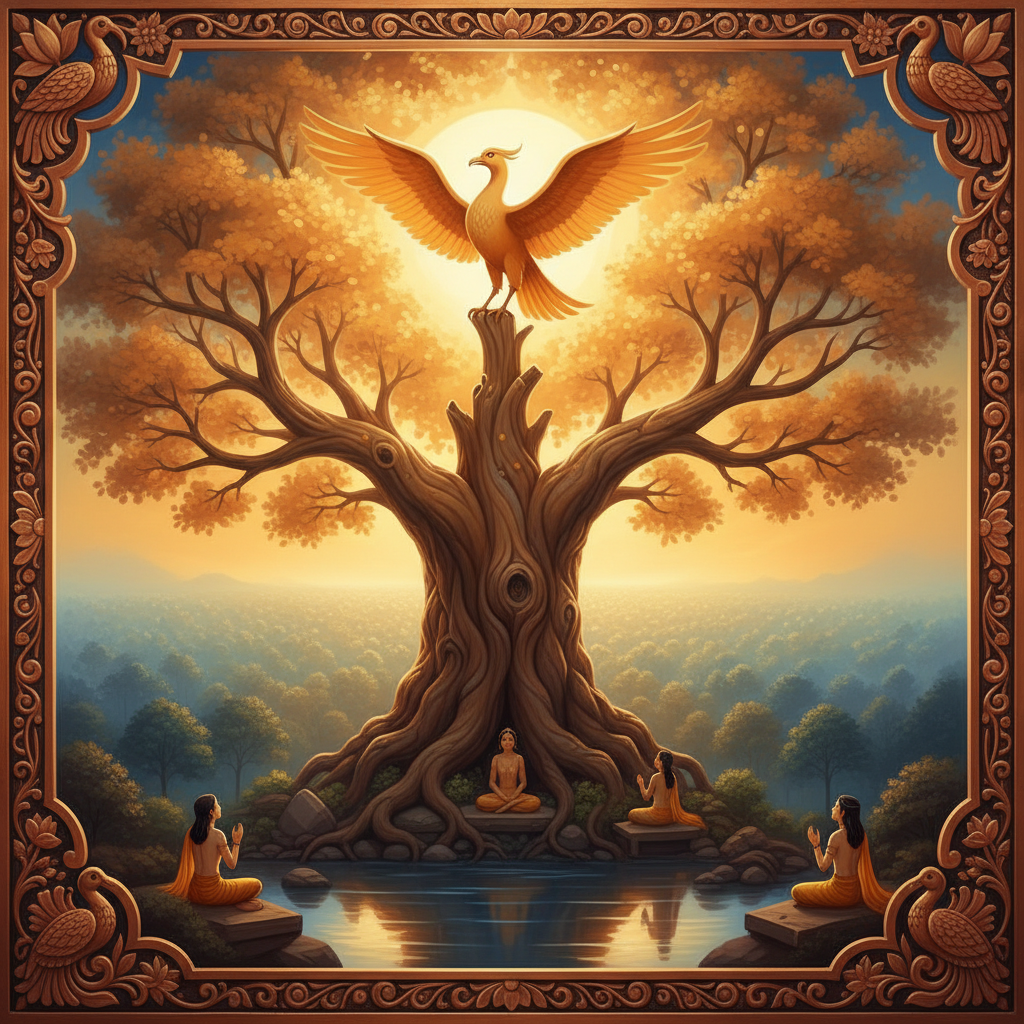
The horse is glossed a moment later. Horses are good in your chariot, but they are uncontrolled and they just drive your chariot. To be chosen by the horse is to be raised up by the fickle mind and then driven wherever it happens to run. The elephant is śraddhā based strength — faith-born, slow, deliberate, and load-bearing.
Both men become king. The distinction is not the outcome but what carried them there, and therefore what happens next. The image is quietly practical: two people can arrive at the same position, one on faith and one on appetite, and only one of them can hold it.
Eight years, undone by a name
Katañja rules well. Swamiji is generous about this — he became famous for his compassion, generosity, acts of nobility and various good qualities, so much so that it seemed as if he had forgotten his previous identity. This is not a story about a fraud. The kingship is real and the virtues are real.
What undoes him is a small, entirely ordinary restlessness. He began to miss his old style freedom, going after the deer, running into the forest. So he slips out the back door in plain clothes, into the royal gardens, for the sake of mere amusement. And precisely then a band of caṇḍālas passes on the road, and their leader recognizes him and shouts his name in delight — O Katañja! — while the queens and ministers listen from the upper balconies.
The collapse is total and immediate. Just as a dead corpse is ignored by all, so too the king was ignored by all. It is the same image Gādhi saw at the very start of the vision, when he stood over his own body. The story has folded back on itself. He is a corpse again, this time while still walking around.
Swamiji uses the moment to make a point about security that is easy to skip past. Your good karma can give you all, but the spoiler of all that is your unconscious — and therefore, no matter how prosperous you are, prosperity is never secure. The threat to the eight years of glory did not come from outside. It came from a forgotten layer of his own mind wanting to go and walk in the woods.
Who am I, irrespective of where the body is
Swamiji cuts the story short deliberately and turns to the listener: why not start recognizing who am I, irrespective of where your body is. Then the sentence this section is named for — your I am is totally different from your body. And the consequence: if you are the body, then you are a dead corpse, ignored by all.
He is careful about how this is taken. It is not a call to despise the body. Body identity has to be viewed in perfect objectivity and with open-hearted understanding, and he warns that being constantly fulfilled and satisfied with body identity becomes a big obstacle to enlightenment. The instruction is accuracy, not disgust. He even offers a blunt, almost comic test: if you cannot believe it, go into a hospital, get X rays, see what you look like.
Vairāgya is not dejection
The most useful correction in the lecture comes near the end, and it is aimed directly at serious students rather than beginners. Spiritual students make a big mistake — they associate the practice of vairāgya with dejection, misery of the mind, and stress. But vairāgya is totally different at the end.
Then the image that redeems the whole grim story. It is like a bird that enjoyed the whole tree all the time, but now, looking at its wings, flies — and when it flies, considers the whole forest little.
Nothing is taken from the bird. The tree it enjoyed is still there. What changed is that it discovered it had wings, and from the air the forest is simply smaller than it was. Dispassion in this reading is not renunciation performed as loss. It is a change of altitude that makes the old distances look proportionate.
He gives it a Sanskrit anchor — sarvaṃ duḥkhaṃ vivekinaḥ, to the discerning, all is sorrow — and then refuses the depressive reading of it. Once vivekabuddhi has developed, he says, you understand transience and perishability all around you, but not with a sense of pathos: with a sense of joyous discovery that you do not belong in that level of being perished.
The story does not close
Gādhi surfaces. He completes his ritual worship and climbs to his cottage, and only then does the scale of what happened register — all of it occurred in a short duration. He begins the inquiry: who am I? What have I seen? What have I done? He recalls that he is a brahmacārī whose mother has passed on, and cannot account for the wife and relatives, or the large caṇḍāla family and the life of hideous deeds. He concludes, correctly, that surely all this that I have seen has been workings of māyā.
And Swamiji refuses to let him have the resolution. He notes that Gādhi thinks he has learned the lesson — and then: but keep waiting. Something more is coming up.
The lecture ends there. It is a deliberate withholding, and it matches the lecture’s own argument. If waking life is one more dream, then the moment of thinking now I have understood the dream is itself likely to be occurring inside one. Gādhi has correctly identified māyā and is still standing in it. The insight was real, and it was not the end.
Terms in this lecture
- māyā — the power by which the one appears as many; here, specifically, the extent of the world-appearance Gādhi asked to see
- mukti — liberation, promised by Viṣṇu as the destination of the boon
- bhava-vyādhi — the disease of the world process; the condition for which the world is the hospital
- vyādha — a hunter; by Swamiji’s etymology, the one suffering from vyādhi
- caṇḍāla — an outcast; read here as the soul that takes itself to be the body, and as kriyā arrested in the egg stage
- śraddhā — faith-born strength; the elephant, as against the horse of the uncontrolled mind
- vairāgya — dispassion; explicitly not dejection
- vivekabuddhi — the discerning intellect that sees transience without pathos
- sarvaṃ duḥkhaṃ vivekinaḥ — to the discerning, all is sorrow
Questions to sit with
- Gādhi asked to understand the mechanism rather than to be free of it. Where in your own practice are you asking the smaller question — and would you accept it being answered the way his was?
- The caṇḍāla identity came from a lifetime of avoiding it. What are you holding continuously in mind by pushing it away?
- Swamiji frames the chase as a symptom rather than a fault. Does that change what you would do about it?
- Two men become king, one carried by the elephant and one by the horse. Which is carrying the position you currently hold?
- The bird loses nothing and gains altitude. Where has dispassion felt like loss to you, and would the bird’s version be recognizable as the same practice?
Yoga Vāsiṣṭha, Upaśama Prakaraṇa, Sections 45 and 46. Lecture 185 by Swami Jyotirmayananda, Yoga Research Foundation. The complete archive of Swamiji’s teachings is free to explore at yogaresearchfoundation.org.
This study guide is drawn from the archived teachings of Sri Swami Jyotirmayananda.