

Yoga Vasistha, Upasama Prakarana, Section 49 — Study Guide
Gadhi got what he asked for. He wanted to see the extension of maya, and Lord Vishnu granted it: two muhurtas with his head under water, and inside them a lifetime as Katanja the outcast, a fictitious kingship, exposure, and a fire that turned out to be river water. He surfaced satisfied. Then travellers described the same events to him as history, he verified every detail against the country itself, and the satisfaction collapsed.
This lecture is what Vishnu says after that. The verification was not a mistake — the country was real, and the events happened to a man named Katanja whose experience was reflected into Gadhi’s mind. What Vishnu corrects is the assumption underneath the question. Gadhi keeps testing whether the vision was real against a waking world he has never once tested. The teaching is that the waking world falls under the same jurisdiction, and the faculty responsible is not out there but in here.
Swamiji states the diagnosis in Vishnu’s words: the disease of the world process is considerably reduced in Gadhi’s intellect, but a root remains, and it has to go before anyone is established in the Self. The rest of the lecture is about that root — what it is, why intellectual clarity does not remove it, and what does.
Along the way it does something unusual for a Vedanta class: it takes the mind apart as a piece of equipment. Not the mind as a poetic figure, but manas, buddhi, ahamkara and the unconscious, each with a job, arguing at a dinner table over dessert. That machinery, Swamiji says, is the axle of the rotating wheel of maya; punya and papa, pleasure and pain, attachment and aversion are only its spokes.
The last third turns practical. Gadhi is sent for ten years to a mountain where sages live, to do three things in sequence — listen, reflect, meditate — and the lecture closes on the two supports without which none of it moves: bhakti to give the practice its pull, and vichara to keep the mind awake in the present.
Passage Index
- The rope and the snake — 00:00
- Invocation — 00:54
- Upasama Prakarana, Section 49: concluding the story of Gadhi — 02:03
- Katanja existed; Gadhi never became him — 08:00
- Folders within folders: the mind’s endless nesting — 09:44
- The four aspects of citta — 17:55
- The cinema screen is never touched — 21:32
- Citta, the axle of the wheel of maya — 26:17
- Shravana, manana, nididhyasana — 29:53
- Gadhi attains enlightenment — 35:16
- Maya, Brahman, and why jnana needs bhakti — 40:35
- Vichara, shama, and a mind without past or future — 45:14
The Story Ends and the Doubt Does Not
Swamiji retells the arc quickly, because the point is not the plot. A muhurta is forty-eight minutes; Gadhi spent two of them submerged, and inside that hour and a half he lived decades. Famine, displacement, an elephant that chose him king, exposure as an outcast, mass suicide by fire among those who had touched him, and finally his own leap into the flames — at which point the fire did not burn and his head came out of the water.
The first correction Vishnu makes is about ownership. The events were not invented and they were not Gadhi’s. A man called Katanja existed, and what happened to him is history. Because Gadhi had asked for the extension of maya, that history was transferred into his mind, and he supplied the missing piece himself: the conviction that he was the one it happened to.
That is the exact shape of ordinary autobiography. The raw material is real, the events occurred, and the insertion of an owner into the middle of them is the operation nobody notices performing.
Gadhi relaxes, then goes back, verifies, and returns with the same doubt in a new costume: how can this be illusion when the whole country confirms it? Vishnu’s answer ends the story. The world Gadhi is standing in while he asks the question is also maya.
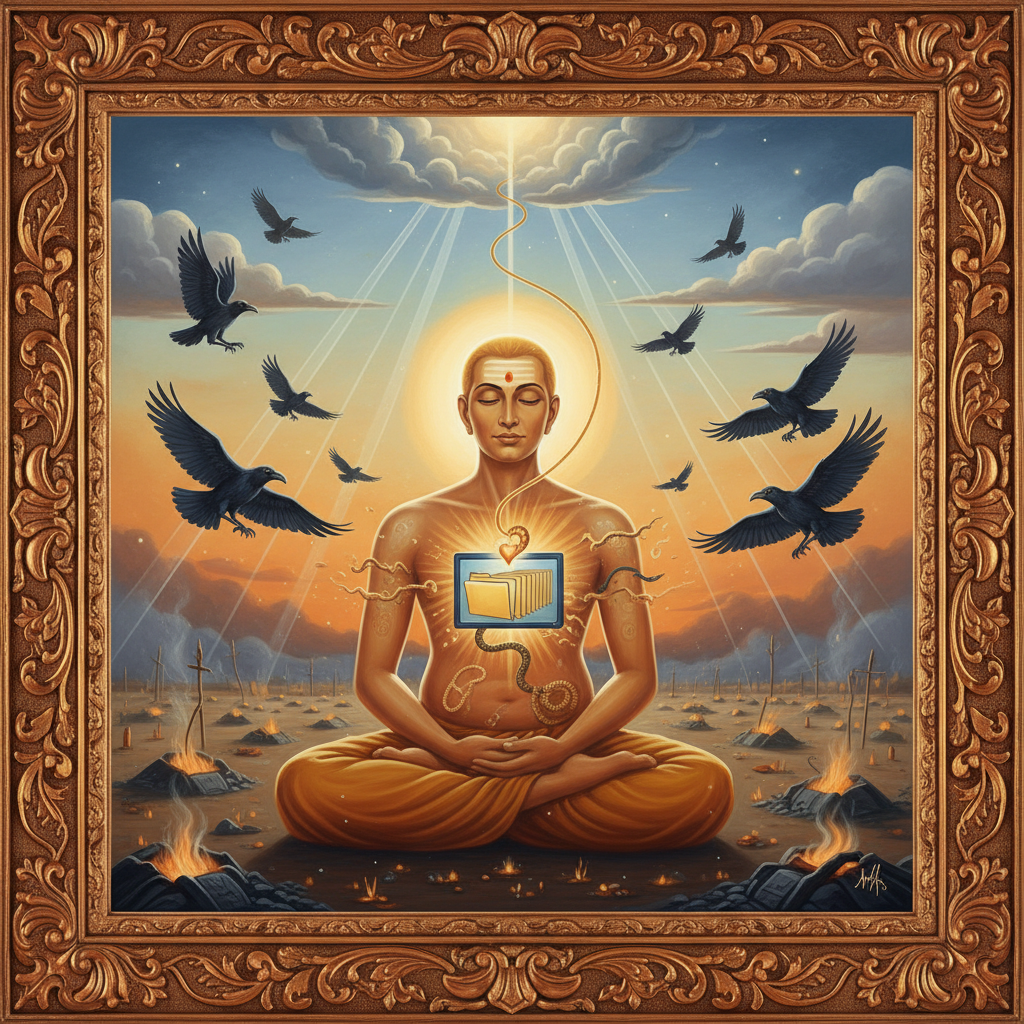
Swamiji gives the mechanism a modern image. A dream can open inside a dream. On a computer you make a folder, and inside it another folder, and inside that a file containing more folders. To a child the whole thing is a small box on a screen. Push anywhere in that one space and it opens, and it can go on opening. “Human computer is limited, but the Divine computer has no limit to it.”
Two Kinds of Knowledge, and Why Only One Cures
Vishnu tells Gadhi that the disease of the world process is “considerably reduced in your intellect.” Considerably reduced, not gone. Swamiji separates the stages carefully, because this is where sincere students stall.
The first kind of knowledge collects academic data. It is necessary and it does not liberate; nobody was ever freed by geography. The second studies scripture under guidance and goes further — but even at its best it splits in two: first a mental grasp that this is the goal, then the process of arriving.
The arrival has a name, sakshatkara, and Swamiji puts the difference in one sentence. “You realize the Self instead of just knowing what the Self is.” Everything before that is preparation, and the disease — a soul subjected endlessly to birth and death — is cured only by the realization, never by the description of it.
Citta and Its Four Aspects
Then he opens the mind up. Citta in the narrow sense is the unconscious; in the broad sense it is the mind entire, and the entire mind has four aspects.
Manas faces outward, picking up perceptions through the senses and delivering practical reality. This is what most people mean by the conscious mind.
Buddhi, the intellect, evaluates what manas brings in: accept or reject, right or wrong, good for you or not. Swamiji notes the speed with a small joke — it is faster than Google.
Ahamkara, the ego, sits above the intellect and is not obliged to respect it. Swamiji stages the argument at a restaurant. The dessert has been ordered; the intellect says the blood sugar is high; the ego says shut up and wins, because the decision was already made. It runs the other way too: the ego can encourage the intellect, and then the intellect shines.
The unconscious stores the essence of all of it, the way everything on a machine ends up compressed into one small file.
These four are not four things. Swamiji is explicit that they are one and the same, called citta together — and world experience is built on it.
The consequence he draws is physiological, and blunt. Every human being experiences on the basis of a nervous system. Eyes made a particular way see particular things; a vulture sees further than any human eye without instruments. World experience depends on the senses, is interpreted by the nervous system, and behind the nervous system is citta. And the demonstration is available nightly: “Your reality is just what you experience in your deep sleep.” Every night the entire world is withdrawn, nobody is shocked, nobody grieves it, and people wake saying they slept wonderfully.
The Screen, the Rope, and the Cloud
Three images do the philosophical work, and they say different things.
The screen. A projector throws frame after frame at high speed, and to normal eyes something very real is going on. The audience shakes; people break their teeth on peanuts during the suspenseful part. Meanwhile the screen is untouched: “Completely empty, none of all the story and nothing to do with it.” And it is not merely a bystander — it is what lends reality to every name and form appearing on it. Mind projects time, space, causation, past and future, gain and loss, the story of every life and all of history. The screen carries all of it and is marked by none of it.
The rope. The oldest simile in the tradition, and Swamiji opens the lecture with it before any invocation. You come upon it in half-light and the mind produces a snake. People run, slip on a banana leaf, tear their skin, injure themselves badly — all over a rope. “When light is brought, then it is nothing but a rope.” The injuries were real. The snake never was.
The cloud. This one does the most work, because it is the only one of the three that describes a process rather than a state. “Cloud is not a reality. It’s a bundle of moisture.” It is not a thing, and it can still blot out the sun and bend its light, creating the entire drama by being nothing in particular. Mind is exactly this: “It’s a bundle of illusion.”
But a cloud can thin. Swamiji turns the image forward: “the same mind now when it’s purified acts like a soft cloud” — a hole opens in it, and “The light has started coming in.” That, he says, is the actual condition of every aspirant. Not a mind abolished, a mind thinned. And it is what brought anyone to satsanga in the first place.
Citta as the Axle of the Wheel of Maya
Now the diagnosis becomes structural. “Your citta is the central axle.” The wheel it turns is the world process, and the spokes have names.
Virtuous karma is punya; negative karma is papa. Punya brings fortune and pleasure; papa brings pain. Pleasure produces raga, the wish to keep what gave it; pain produces dvesha. Punya and papa, sukha and duhkha, raga and dvesha — three pairs, six spokes, one axle. The soul, identified with citta, takes the whole rotation as its own and goes on experiencing life after life.
The design point is that spokes cannot be fixed one at a time. Removing a particular attachment or arranging for more punya does not stop a wheel; it changes which part of it is at the bottom. The wheel stops at the axle.
Which is why Vishnu’s instruction is short and physical. “O Gādhi, get up!” Do not take this lightly. “Practice inquiry and reflection.” Then the promise: “You will attain the unobstructed vision of the Self.” He suggests ten years in a mountain ashram, and vanishes — like a dissolving cloud, an extinguished flame, a wave subsiding into the ocean.
Shravana, Manana, Nididhyasana
Gadhi goes to the Rishyamuka mountains — read by Swamiji as the crown jewel of the sages. The plain instruction underneath the storyline: go where sages live, stay in their company, and under that guidance practise three things in order.
Shravana is listening, and Swamiji insists the word is not casual. “You hear, but you don’t really listen.” Real listening reaches further in: “Listen means what you hear. It touches your intellect, it has purpose.” An intellect touched that way is purified, and a purified intellect raises the whole level of awareness. New insight is awakened by listening, and it compounds day by day.
Manana is reflection on what was heard, and the illustration is a cow. You put fodder down and walk away. The cow appears to have eaten it, but it has been stored, and the chewing happens later, when nobody is watching. Give the mind good cud, Swamiji says, then wait for milk and butter. The test is specific: hold what you heard against your own insight and experience and see how it matches.
Nididhyasana is what happens when listening has pulled the mind into a single channel — one goal only. In Raja Yoga terms it moves through dharana, dhyana and samadhi. While the mind is held there, the intellect gains what it cannot gain by effort: “a deep insight is being awakened within yourself.”
The fruit has a name too. Out of nididhyasana the intellect emerges as intuitional intellect — like a window opening onto the sun, or waking from a dream to find that not a needle point of the dreamland survives.
Gadhi as Jivanmukta
Swamiji’s image for the change is seasonal. Just as trees are stripped of leaves in winter, viveka and intuitive knowledge strip the personality of its attachments. Gadhi wakes from the dream of the world process, free of sorrow and fear, and roams as a jivanmukta.
What he is careful to add is that nothing visible changes. If he was five feet tall, he stays five feet tall; if his hair was grey, it stays grey. “Though living in this world, he was immersed in the bliss of the Self.” To everyone around him he is the same man — and to his own older eyes as well, which is not him either.
The related image is the reflected sun. “Every reflected sun is the sun.” Counting the reflections and calculating how long each would take to travel back is a waste of a life. So with ego identity. “Your ego identity today will change.” The one that existed at five years old is gone, and the present one will go — possibly, Swamiji says, two or three days after hearing these teachings.
Why Jnana Alone Runs Dry
The next section opens with Vasistha addressing Rama: maya causes great delusion and is indescribable, Brahman is its only support, and by taking recourse to Brahman alone can anyone rise beyond it.
Taking recourse to Brahman has a prerequisite, and this is the most practical passage in the lecture. A God-ward mind is not produced by deciding to have one. It needs a channel, and the channel is bhakti. Bhakti itself needs shakti — strength — because a heart without strength picks love up in pieces. Swamiji quotes a film lyric to make it land: the pieces of the heart broke into thousands, some fell here, some fell there. Life after life the capacity for love has been developed and scattered.
So the sequence is shakti, then bhakti, then jnana. Once bhakti develops, the ego stops restricting the intellect, and the intellect becomes genuinely interested in the only questions that matter: who am I, and what is the reality behind the world.
He is candid about what happens without it. Tell an ordinary person to study Vedanta — that they alone are real and the world is illusion — and the honest response is: what am I going to gain from that? But let the jnana movement blend with the urge to love and be loved, and the practice becomes dynamic. Without that blending it is ineffective, and he reaches for two comparisons: a vein rather than an artery, and a mirage.
Vichara, Shama, and a Mind Without Past or Future
The closing instruction is about the present moment: during every moment, be mentally vigilant. The term is vichara, and Swamiji glosses it in an unexpected register — the mind should be alert and “spiritually addicted” to being thoughtful. Not thoughtful about acquiring more, which is not thoughtfulness at all, but in this direction: who am I, “How can I terminate the fear of death?”, how can I attain communion with God.
Behind all of them the same question, reduced to two words. “That I am should be so interesting to you that your whole life should be woven around this focus on I am.” That weaving is the vichara movement, and its mark is that adversity no longer produces dullness — the mind keeps working, recognising that the situation is like a dream and will pass, the way the moon comes out from behind a dark cloud.
Then the second instruction, one line. “Neither allow your mind to turn to the things of the past, nor allow it to dwell on things of the future.” Swamiji tests it against sleep, his favourite laboratory. Asleep, are you thinking of past or future? They move away, and the relaxation is total. In dream you again have both and are working to improve the future, and neither is real. When past and future move away, you are present — and being present is what wakes you.
Calm has a prerequisite of its own: leaving past and future in the hands of God. Sharanagati, surrender. This is where bhakti re-enters, not as sentiment but as the mechanism that makes calm possible. And calm opens into shama, serenity, which the tradition names as one of the gatekeepers to liberation.
The condition is stated plainly. As long as desire for objects is maintained, maya continues operating through the mind, the way a cloud goes on refracting the sun as long as moisture remains. But let sunlight into the cloud and the moisture diminishes without the cloud being hurt — it becomes happy, shimmering, dancing — until one becomes jivanmukta. “As long as there are clouds, so long will rain showers continue.”
When desire is renounced and the Self, distinct from the mind, is kept constantly before one’s vision, ignorance — the source of both the mind and the world process — is destroyed. That vision is the project of Vedanta reduced to an affirmation: neither body nor mind nor intellect nor ego; Saccidananda; I am That, I am.
The lecture ends on an image the tradition does not soften. “Wherever the mind exists, there do the desires and concerns for objects flock” — as crows and vultures flock to cremation grounds. And “The whole world is a cremation ground.” Those who have died are finished; the living are mortals; those coming are mortals too. Stay in the cremation ground and you will behave like its birds. Swamiji lets the harshness stand and names it: “The scriptures have no common courtesy.”
Terms in This Lecture
- citta — the mind in its totality: manas, buddhi, ahamkara and the unconscious taken as one
- manas — the outward-facing mind that gathers perception through the senses
- buddhi — the evaluating intellect
- ahamkara — the ego, which can overrule the intellect or release it
- sakshatkara — direct realization, as distinct from knowing about
- shravana, manana, nididhyasana — listening, reflection, sustained meditation
- punya, papa — virtuous and negative karma
- sukha, duhkha — pleasure and pain
- raga, dvesha — attachment and aversion
- vichara — vigilant inquiry in the present moment
- shama — serenity; a gatekeeper to liberation
- sharanagati — surrender
- jivanmukta — one liberated while living
- Saccidananda — existence, consciousness, bliss
- muhurta — a period of forty-eight minutes
Questions for Reflection
- Where in your own history have you inserted an owner into events that simply occurred?
- Which of the six spokes — punya, papa, sukha, duhkha, raga, dvesha — are you currently trying to adjust instead of addressing the axle?
- What did you hear this week that touched the intellect, and what did you merely hear?
- Where is your practice a vein rather than an artery: correct in structure and carrying no force?
Yoga Vasistha, Upasama Prakarana, Section 49. Lecture 187 by Swami Jyotirmayananda, Yoga Research Foundation, Miami, founded 1969. The complete archive of Swamiji’s lectures is free to all.
This study guide is drawn from the archived teachings of Sri Swami Jyotirmayananda.