
Introduction
In this profound lecture from the Bhagavad Gita, Chapter 6 (Adhyatma Yoga), Sri Swami Jyotirmayananda — a direct disciple of Swami Sivananda — takes the seeker deep into the heart of Samadhi. Drawing from verse 21 of this chapter, he unveils the four stages through which the Yogi passes on the way to absolute liberation, using analogies that make the most subtle states of consciousness accessible to the sincere student.
What Is Samadhi?
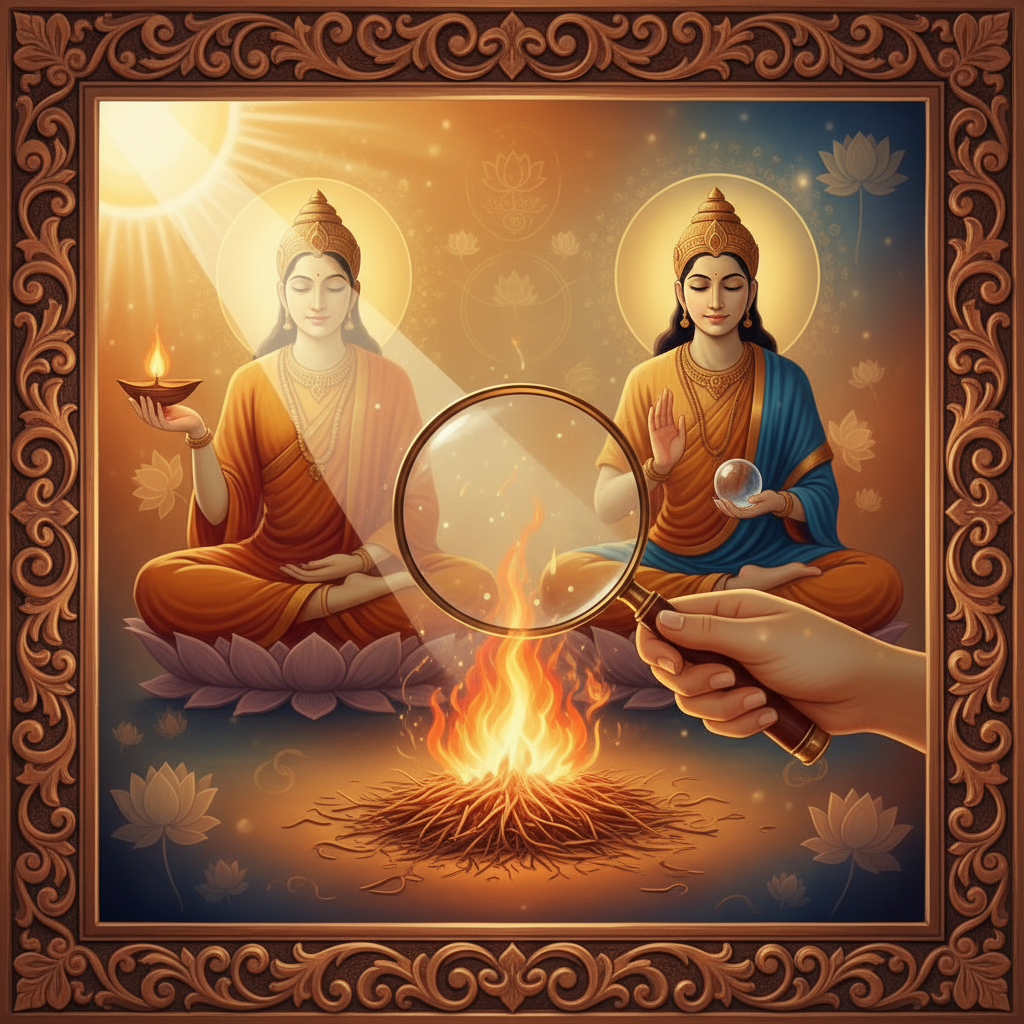
Samadhi is the super-conscious state that emerges when concentration (Dharana) and meditation (Dhyana) mature into their fullest expression. Swamiji offers a vivid illustration: using a lens to focus sunlight onto combustible material. First, you adjust the lens back and forth until you create a sharp focus — that is Dharana, one-pointedness. Then you hold it perfectly still — that is Dhyana, the continuity of focus. And then something unexpected happens: fire emerges. That fire is Samadhi.
Until you have tasted Samadhi, Swamiji teaches, your life moves in shallow water. Even a single touch of Samadhi leaves impressions so powerful that they haunt the practitioner, drawing them back to the practice again and again.
The Four Stages of Samadhi
Stage One: Savitarka and Nirvitarka
In the first stage, called Savitarka, the mind holds on to physical reality — but physical reality is a confused mixture of words, ideas, and actions. The mind becomes one-pointed without yet resolving this mixed state. When differentiation begins to occur — when the mind starts to separate the layers — this is called Nirvitarka.
Swamiji illustrates this with a simple riddle: when someone says “bring me a flower,” there are three flowers — the word on your tongue, the flower in the garden, and the sentiment behind the request. Every physical experience is a mixture of these three. In the first stage of Samadhi, the mind has not yet learned to separate them.
Stage Two: Savichara and Nirvichara
In the second stage, the mind moves beyond gross name and form into abstract meditation. The physical object that once supported the focus is no longer needed. Instead, the mind turns toward something that makes it thoughtful — vicara, reflection. This is the stage of upasana, where one meditates on God as Siva, as Rama, as a form that supports the mind’s journey toward the formless.
Savichara is the stage where further analysis is needed. Nirvichara is when deeper analysis reveals certain limitations and they drop away.
Stage Three: Sananda
When the mind moves beyond both physical and abstract objects, it enters a stillness where language is no longer needed. “When the heart is full, the mouth becomes dumb,” Swamiji reminds us. This is the stage of Sananda — profound joy.
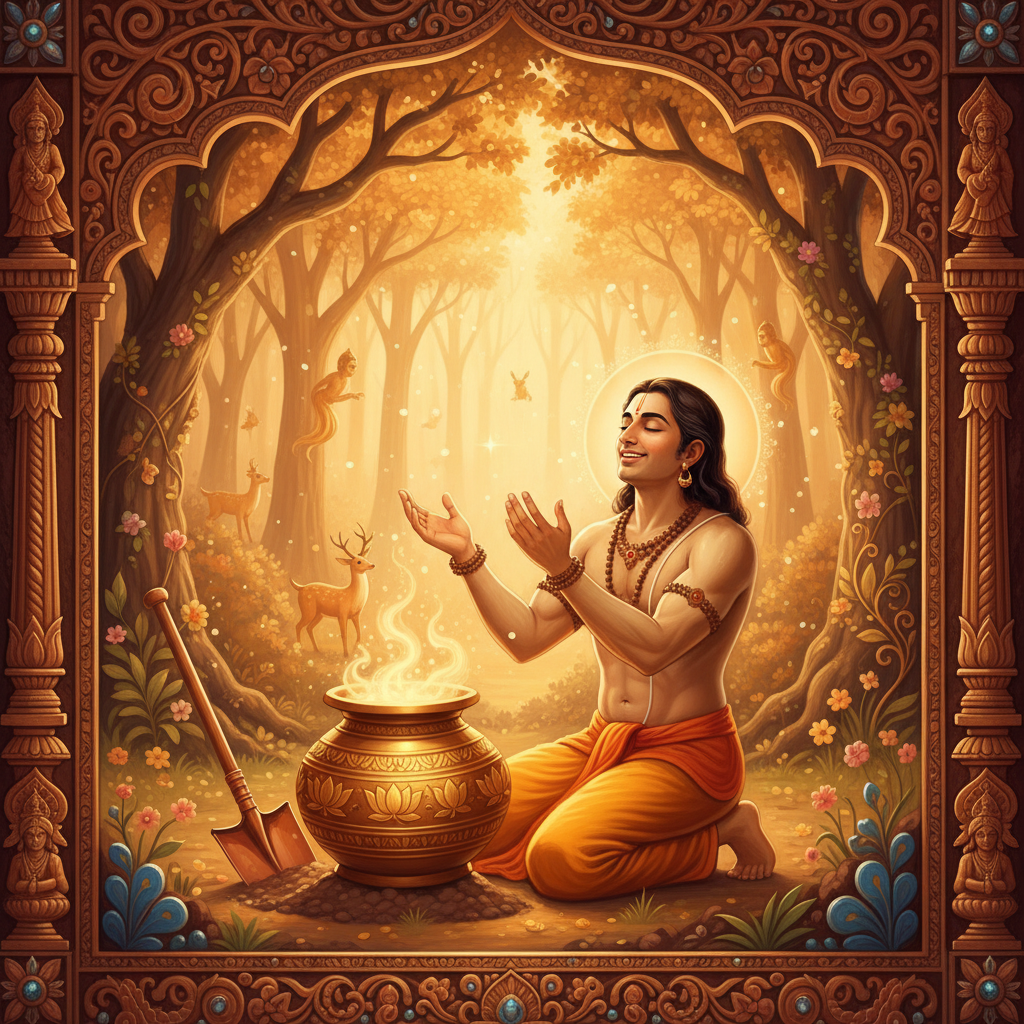
But this joy, powerful as it is, has not yet brought full liberation. Swamiji compares it to a treasure hunter who has discovered a pot of gold hidden in the earth. The moment he reaches the spot, he is so overcome with happiness that he forgets to dig. The joy is real, but the seeker must go further. The treasure has not yet been unearthed.
Stage Four: Sasmita
Sananda leads to Sasmita — the plane of pure “I-am-ness.” This is not egoistic. It is the very source of individuality, the root from which the sense of “I” arises. When the Yogi becomes established in this plane, viveka — discriminative knowledge — develops. The great truth dawns: the real “I” is Brahman. The individual soul, the Jiva, has been only a reflection.
Swamiji offers a beautiful image: a river that has been flowing toward the ocean finally meets it. At that moment, the river has no individuality left. It does not even make the ocean — it simply merges.
Beyond the Four Stages: Asamprajnata and Sahaj Samadhi
When the Yogi passes through Sasmita, the gate to Asamprajnata Samadhi — absolute Samadhi — opens. And when this Samadhi becomes sahaj, natural and effortless, the Yogi no longer comes in and out of the state. It becomes a perpetual inner experience.
Even then, Swamiji is careful to note, the physical body continues to operate. Physical limitations remain. Enlightenment does not make the body immortal. But the inward awareness is absolutely different. And that difference is liberation.
The Boundless Bliss of BG 6.21
The verse at the heart of this teaching reads: sukham ātyantikaṁ yat tad buddhi-grāhyam atīndriyam — “That bliss which is boundless, comprehended by the intuitive intellect alone, beyond the reach of the senses.”
Swamiji draws out three characteristics of this bliss:
Atyantikam — It has no end. Every experience of joy in the world ends and fluctuates. But the joy of Self-revelation is absolute. It is called Bhuma — the fullness from which nothing can be subtracted.
Buddhi Grahyam — It is attained by the subtle, intuitive intellect. As long as the intellect is conditioned by impurities — pride, conceit, greed — it cannot taste this joy. But as it becomes purified, it transforms from intellectual to intuitive. It becomes the bridge between the individual and the Absolute.
Atindriyam — It transcends the senses. All experiences based on fascination with sensory pleasure keep the seeker in a world of trouble — what the scriptures call Vishaya Sukha, the happiness of sense objects, which is Alpam — little, limited, and ultimately fraudulent.
Vishaya Sukha: The Illusion of Worldly Pleasure
Swamiji turns to the Ramayana for a powerful allegory. When Shurpanakha — the embodiment of sensory pleasure — approaches Rama (the soul), she presents herself as the most beautiful, the most desirable. But Rama, representing the mature aspirant, is already married to his will to attain liberation. He redirects her to Lakshmana (willpower). Lakshmana sends her back to Rama. Back and forth she goes, until finally Lakshmana chops off her nose and ears.
This is the process of Vairagya — dispassion. When you begin to truly listen to the limitations of sensory pleasure, when you start to understand that dependence on worldly objects creates impressions that haunt you life after life, the charm of those pleasures is destroyed. The nose — the organ of sensory attraction — is chopped off. The ears — that listen to the seductive promises of the world — are chopped off.
Vaikuntha: Absolute Satisfaction
All worldly satisfaction, Swamiji teaches, is kuntitha — thwarted, limited, with a spear at its throat. No matter how much good karma you do, as long as ignorance remains, your satisfaction is relative. The more you drink from the salty ocean of worldly pleasure, the thirstier you become.
But when you attain liberation, your satisfaction becomes the ocean itself. It has absolutely no restriction. This is the meaning of Vaikuntha — the realm of Lord Vishnu, where there is no kuntitha, no limitation. Your satisfaction is free.
The Three Types of Sorrow — and Freedom from All of Them
Swamiji concludes with a clear-eyed look at suffering. There are three types of sorrow:
Adhyatmika — sorrow arising from your own body and mind.
Adhibhautika — sorrow arising from other people and external creatures.
Adhidaivika — sorrow arising from natural forces: earthquakes, storms, cosmic events beyond any human control.
Even the heaviest sorrow — the loss of a loved one, the certainty of one’s own death — cannot impact the one who is established in liberation. Just as in deep sleep you are stripped of your physical reality, your mind, and your intellect, in Samadhi the Yogi is stripped of all identification with the limited self. And unlike sleep, Samadhi is permanent.
Conclusion
This teaching on Samadhi from the Bhagavad Gita is not merely philosophical. It is a practical map for the serious spiritual aspirant. From the first effort of concentration to the boundless joy of Sahaj Samadhi, Swamiji guides the seeker with clarity, warmth, and the authority of one who has lived these teachings for over eight decades.
The sky within you — pure consciousness — remains untouched by any storm. No matter how many negative karmas you have accumulated, no matter how many times you have faltered, that sky is ever the same. The invitation of this teaching is simple: turn inward, practice sincerely, and discover for yourself what the scriptures have always declared — Aham Brahmāsmi, I am Brahman.
From a lecture by Sri Swami Jyotirmayananda, a direct disciple of Swami Sivananda.
Bhagavad Gita, Chapter 6 (Adhyatma Yoga), Lesson 68.
This study guide is drawn from the archived teachings of Sri Swami Jyotirmayananda.