

From the Archives of Sri Swami Jyotirmayananda
Watch the full lecture on YouTube.
Tulsi Ramayana HQ79 Study Guide: Ravana, Kumbhakarna, and the Power of Divine Qualities
Sri Swami Jyotirmayananda, a direct disciple of Swami Sivananda, continues the Bala Kanda teaching of the Tulsi Ramayana by showing how the story of King Pratap Bhanu becomes a spiritual map of the human personality.
This lecture moves through a dramatic storyline: deception, impure food, a Brahmin curse, the destruction of a kingdom, and the rebirth of Pratap Bhanu as Ravana. Yet Swamiji does not leave the listener only with mythology. He draws out the practical teaching: every person carries a mixture of higher and lower tendencies, and liberation depends on allowing the higher Self to rescue the lower.
The Storyline and the Inner Meaning
Swamiji begins by reminding the listener that the Ramayana works on two levels. There is the storyline, which is absorbing and dramatic, and there is the deeper philosophy, which turns the story into a mirror for spiritual life.
The continuing story centers on Pratap Bhanu, whose destiny becomes linked with Ravana. A hostile force uses deception to turn the king's situation into disaster. The outer event is a plot against a king. The inner teaching is that ego, delusion, and wrong association can corrupt even a noble beginning.
How Negative Influence Spreads
Swamiji explains that goodness has a contagious blessing. When one becomes spiritually good, those who come into deeper contact with that person are also uplifted.
The reverse is also true. When anger, hatred, greed, and ego are encouraged, they become a kind of contagious negativity. One demoniac personality can influence many others, just as one saintly personality can uplift many. The practical question is therefore not only what we believe, but what quality of influence we carry into the world.
Food Means More Than What We Eat
One of the central teachings of this lecture is Swamiji's explanation of food. Food does not mean only what enters the mouth. It includes every influence that enters the senses, mind, emotions, and heart.
He cites the principle "Aahar shuddha, sattva shuddhi": when intake is pure, the mind becomes pure. When the mind is purified, deeper spiritual memory awakens. One begins to remember the real "I," not the ego's story about itself.
For this reason, impure food in the story points to impure impressions, impure entertainment, impure actions, impure association, and everything that weakens Divine qualities.
The Curse and the Law of Karma
When the Brahmins believe they have been betrayed, they pronounce a terrible curse: Pratap Bhanu and his family will become Rakshasas. A divine voice later reveals that the king was not guilty, but Swamiji emphasizes the tragic timing: the harm has already been done.
This becomes a lesson in karma. Once a destructive tendency has ripened into action, delayed understanding does not always erase the consequence. The story shows how ego and deception create a chain of events that must be lived through.
Pratap Bhanu Becomes Ravana
In time, Pratap Bhanu is born as Ravana. Swamiji explains Ravana's ten heads as the symbol of a distracted mind moving in every direction. The twenty arms suggest the many ways the distracted mind tries to support its desires.
Ravana means a force that weakens others. Demoniac power promises greatness, but it takes away peace, harmony, and inner strength. People support it because they are deluded by its promises.
Kumbhakarna and the Pot-Headed Mind
Pratap Bhanu's brother becomes Kumbhakarna. Swamiji interprets Kumbhakarna as the pot-headed condition in which teaching is heard but not digested. One may hear Vedanta and become fascinated by the statement "I am Brahman," but without purification, practice, and realization, the idea only inflates the head.
This is a subtle warning for spiritual aspirants. Sacred teachings must mature into humility and practice. Otherwise, even Vedanta can be used by ego.
Vibhishana and the Divine Possibility
Dharma Ruchi becomes Vibhishana, the devotee of Vishnu and a treasure of knowledge and realization. This is one of the tender turns in the teaching. Even within a demoniac family line, the Divine possibility remains present.
Swamiji points out that all beings have the same source in God. Demoniac energies are not separate from the Divine source, but they are short-circuited energies. They must be corrected, purified, and redirected.
Asuri Sampat and Daivi Sampat
Swamiji interprets the demons as Asuri Sampat, the demoniac qualities that arise within the human personality. Anger, revenge, cruelty, manipulation, and lack of discrimination can take many forms. Divine qualities are simpler and more transparent, while lower tendencies often hide behind many disguises.
The real work is not to study the world in a superior way. Swamiji turns the teaching inward: study yourself. Each person contains a mixture of Divine qualities and demoniac qualities, higher Self and lower self.
Man and Monkey: Self-Effort Blended With Grace
Ravana asks for a boon that he cannot be killed by anyone except man and monkey, thinking them weak. Swamiji gives this a profound spiritual interpretation.
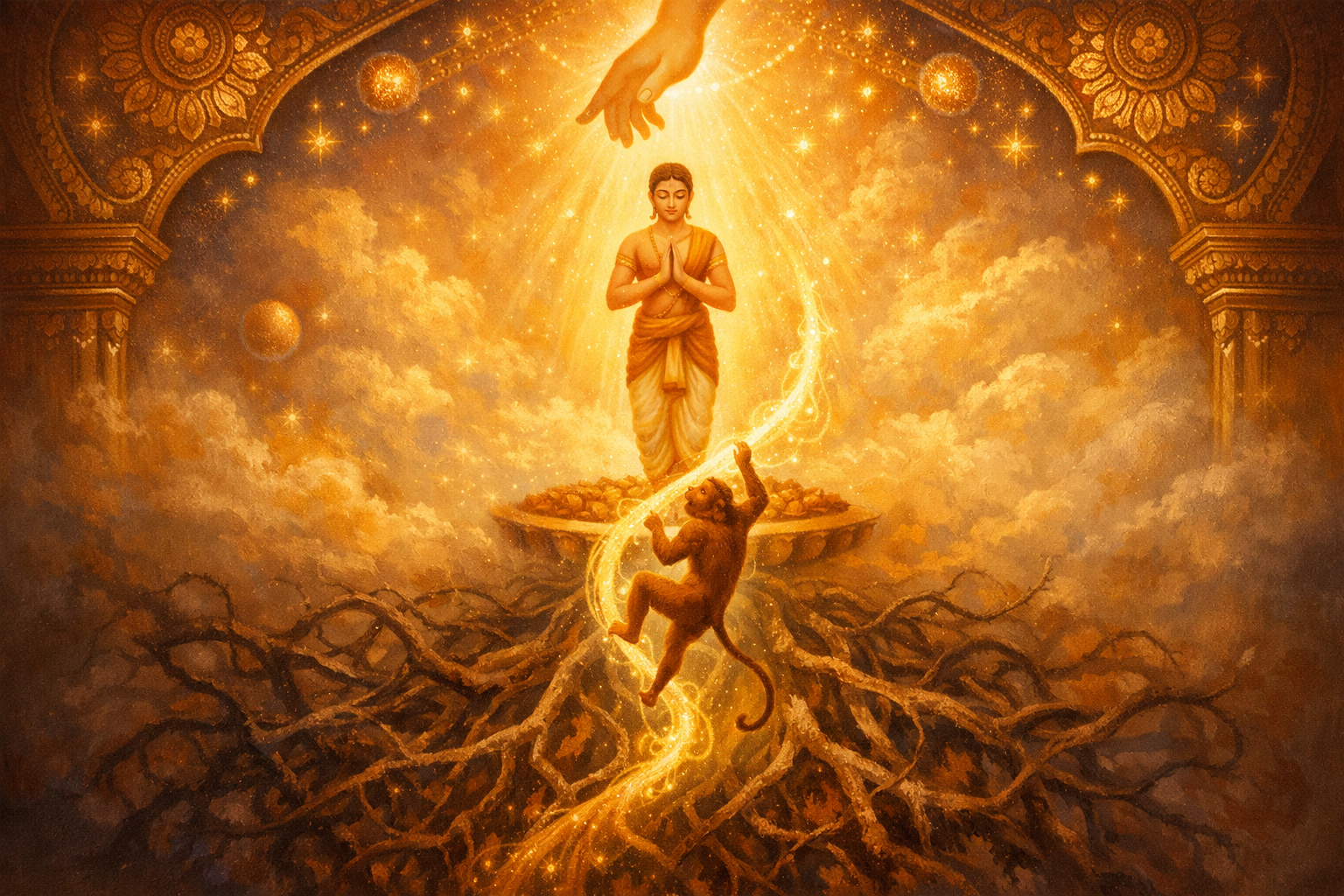
The monkey represents Purushartha, self-effort, including the discipline of the senses. Man represents God's presence as Jiva, the Soul. Together, they point to self-effort blended with Grace. Nothing external can destroy ignorance at its root. Only the awakening of the Soul, supported by disciplined effort and Divine Grace, can overcome the demoniac movement within.
Kumbhakarna's Boon of Sleep
At the end of the lecture, Brahma turns to Kumbhakarna. Seeing the danger his gigantic appetite would bring to the world, Goddess Saraswati intervenes through his tongue. Instead of asking for Indrasan, the throne of Indra, Kumbhakarna asks for Nindrasan, the abode of sleep. Thus his destructive force is limited through long sleep.
The story closes with humor, but the teaching is serious: Divine intelligence restrains destructive power when it threatens the welfare of the world.
Scholar's Corner
The lecture opens with an invocation to Lord Rama, praising Rama as blue-lotus-hued, tender, with Sita seated on His left side, holding bow and arrow.
The teaching belongs to the Bala Kanda section of the Tulsi Ramayana, moving toward Doha 172. Swamiji draws from the Pratap Bhanu episode to explain the later appearance of Ravana, Kumbhakarna, and Vibhishana.
Key scriptural principles in the lecture include "Aahar shuddha, sattva shuddhi," the purification of mind through pure intake, and the movement from Sattva Shuddhi to Dhruva Smriti, the steady spiritual remembrance that loosens bondage.
Sanskrit Glossary
Rama: The Divine incarnation praised in the opening invocation.
Sita: The Divine consort of Rama, seated on His left side in the invocation.
Bala Kanda: The opening book of the Ramayana, containing early events and spiritual foundations.
Doha: A poetic couplet form used in the Ramcharitmanas.
Pratap Bhanu: The king whose downfall leads, in the story, to birth as Ravana.
Ravana: The demoniac ruler interpreted by Swamiji as the force that weakens people and symbolizes the distracted mind.
Kumbhakarna: Ravana's brother, interpreted as the pot-headed condition where teaching is heard but not spiritually assimilated.
Vibhishana: Ravana's brother and devotee of Vishnu, representing knowledge, realization, and Divine possibility.
Rakshasa: A demon or demoniac being, also used symbolically for destructive tendencies.
Aahar Shuddha: Purity of intake, including sensory, mental, emotional, and physical nourishment.
Sattva Shuddhi: Purification of the mind.
Dhruva Smriti: Steady spiritual remembrance of the real Self.
Daivi Sampat: Divine qualities.
Asuri Sampat: Demoniac qualities.
Tapas: Austerity or disciplined spiritual practice.
Purushartha: Self-effort, especially disciplined effort toward spiritual growth.
Jiva: The individual Soul, God's presence in the living being.
Grace: Divine help that works with sincere self-effort to destroy ignorance.
CTA
Watch the full lecture here: https://youtu.be/UuPrk9sCPiM
Read and share the Study Guide:
Short link for sharing after publication:
Join the Community: https://bit.ly/4dgDWKn
This study guide is drawn from the archived teachings of Sri Swami Jyotirmayananda.
This is really interesting, You’re a very skilled blogger. I’ve joined your feed and look forward to seeking more of your magnificent post. Also, I’ve shared your site in my social networks!
This was beautiful Admin. Thank you for your reflections.
I’m often to blogging and i really appreciate your content. The article has actually peaks my interest. I’m going to bookmark your web site and maintain checking for brand spanking new information.