
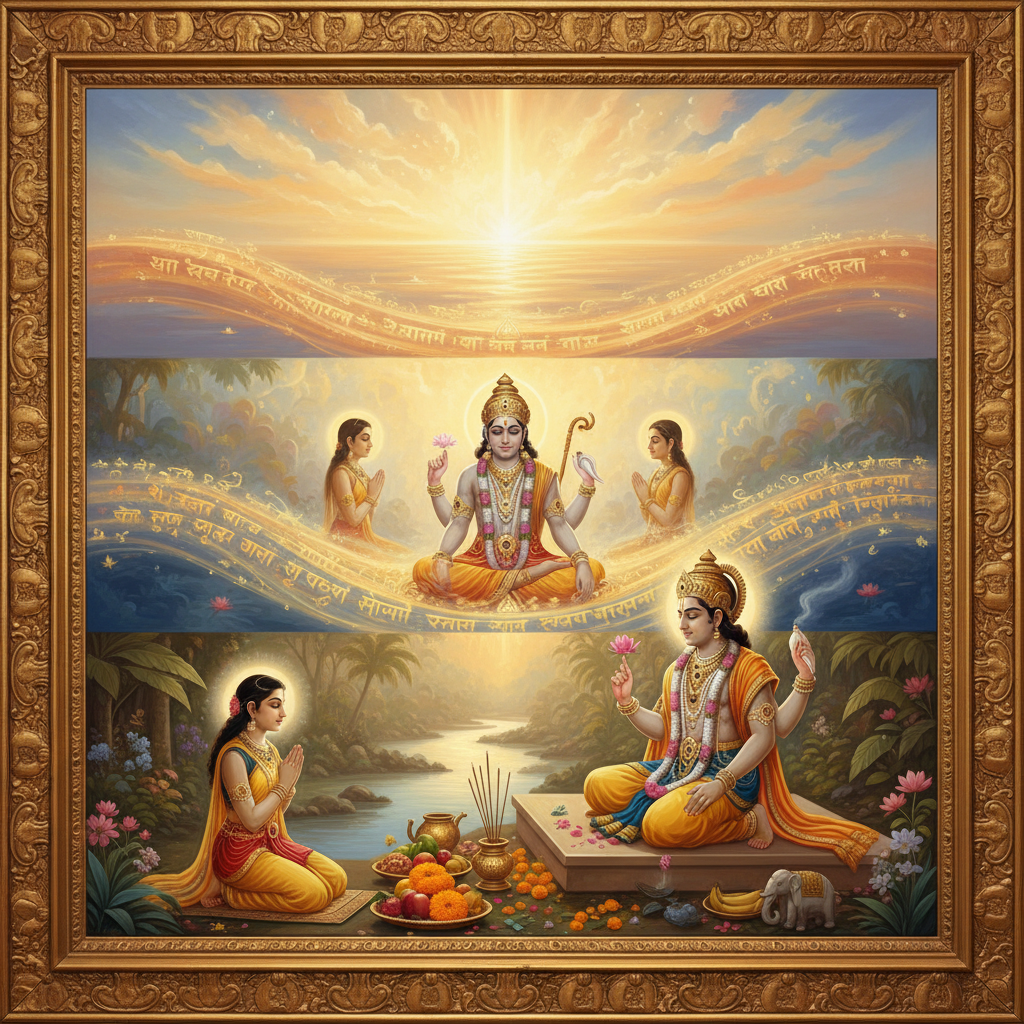
In Doha 145 of the Tulsi Ramayana, Sri Swami Jyotirmayananda unveils one of the most profound allegories in all of spiritual literature: the story of Manu and Śatarūpā. This is not merely a mythological tale. It is a coded map of the Soul’s journey from identification with the body to absorption in the Supreme Self. Sri Swami Jyotirmayananda shows how every detail of this ancient narrative carries a living teaching for the sincere seeker today.
The Austerity of Manu and Śatarūpā
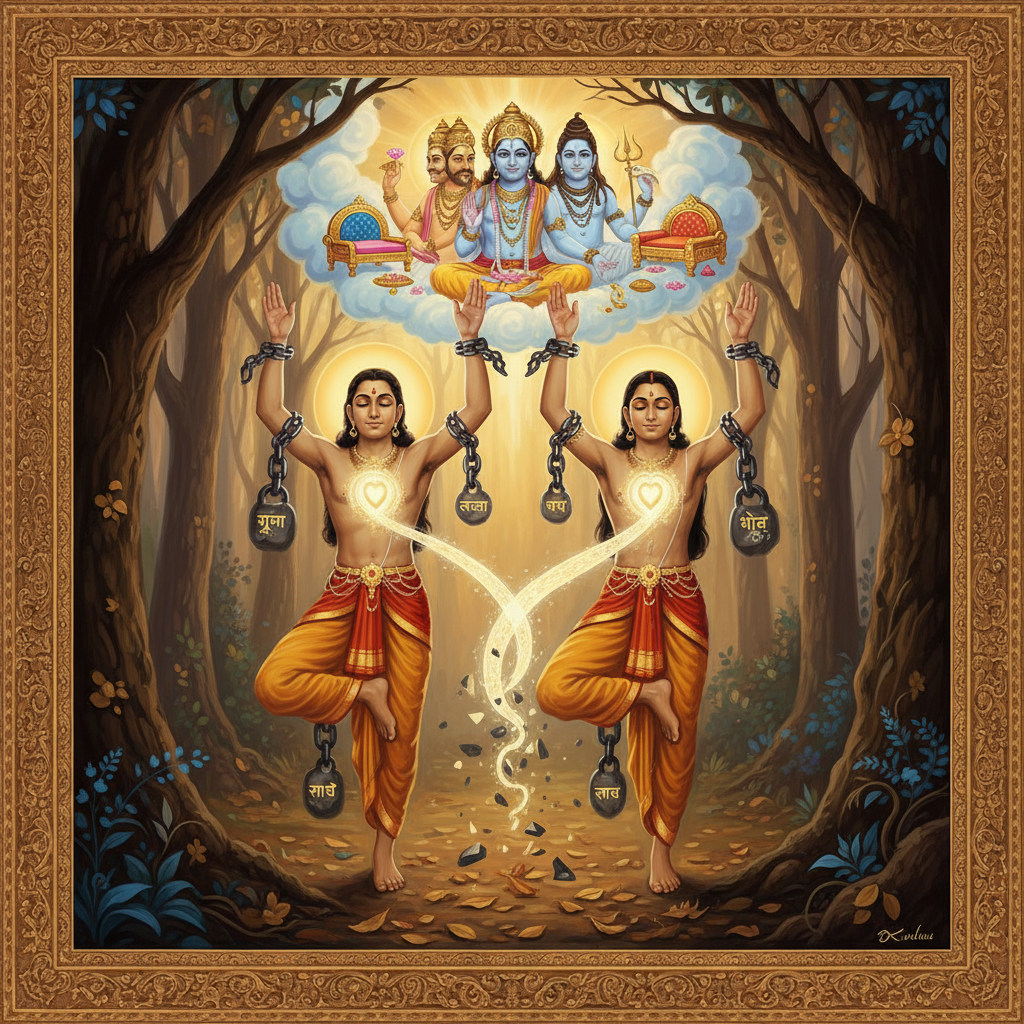
Manu, the primordial man, and his consort Śatarūpā represent the first embodied human consciousness. They perform profound tapasya (austerity) in the forest, standing on one leg, arms raised to the sky, for countless ages. When the Creator Brahmā appears to grant them a boon, they refuse the obvious requests: power, wealth, long life, heavenly pleasures. They have already seen through these illusions.
What makes this refusal so striking is that it comes from the very first humans. They had no scriptures to guide them, no teachers to instruct them. Yet their hearts had awakened to a deeper hunger. Sri Swami Jyotirmayananda explains that this hunger is viveka (discrimination), the innate capacity to distinguish between the real and the unreal, the permanent and the impermanent. Manu and Śatarūpā refused every finite gift because they had already tasted the infinite.
Manuṣya: What Makes Humans Different from Animals
The word manuṣya (human being) shares its root with Manu. To be human is to possess the capacity for discrimination and the potential for liberation. Animals live by instinct. They eat, sleep, mate, and defend. But a human being can ask: “Who am I? Where have I come from? What is the purpose of this life?”
Sri Swami Jyotirmayananda teaches that this questioning impulse is the defining feature of the human birth. It is the first stirring of spiritual evolution. When a person begins to feel restless with the endless cycle of pleasure and pain, when the heart turns toward the Eternal, that person is fulfilling the very purpose of manuṣya. The human body is not given for mere enjoyment. It is given as a rare vessel for liberation.
The Three Boons: Brahmā, Viṣṇu, Śiva
When Manu and Śatarūpā refuse the initial boon, Brahmā is pleased and offers a second. Again they refuse. A third time Brahmā appears, and still they stand silent in their resolve. Finally, the Trimūrti themselves manifest: Brahmā the Creator, Viṣṇu the Preserver, and Śiva the Destroyer. Each offers a boon, yet none offers mokṣa (final liberation).
This is a crucial teaching. Even the highest gods represent manifestations within the realm of name and form. Brahmā cannot grant liberation. Viṣṇu cannot grant liberation. Śiva cannot grant liberation. Liberation is not a transaction. It is not something one being gives to another. It is the recognition of one’s own true nature as Brahman. Sri Swami Jyotirmayananda explains that the Trimūrti are the cosmic functions of the one Reality, but they are not the Reality itself. To receive mokṣa, the seeker must go beyond all forms, even the most sublime.
Levels of Spiritual Evolution
Doha 145 maps a clear ladder of spiritual ascent. The seeker begins at the level of saguṇa sākāra (God with qualities and form). Here one worships a personal deity with a name, a face, and attributes. This is the stage of devotion to the Divine Mother, Lord Rāma, Lord Kṛṣṇa, or any chosen ideal. The heart relates to God as a loving person.
From there, the seeker rises to saguṇa nirākāra (God with qualities but without form). The sense of a personal relationship remains, but the image dissolves. One meditates on God as infinite love, infinite wisdom, infinite power, without picturing a human shape. Many advanced devotees remain here, experiencing the Divine as a boundless presence.
The final stage is nirguṇa brahman (the attributeless Absolute). Here all qualities drop away. There is no subject and no object. No worshipper and no worshipped. Only the one undivided Consciousness exists. This is the goal of the journey. This is what Manu and Śatarūpā, in their silent refusal, were pointing toward.
Ākāśavāṇī: When the Divine Voice Enters the Heart
At the climax of the story, the boons are finally granted through an ākāśavāṇī, a voice from the sky. Sri Swami Jyotirmayananda explains that this is not a literal voice in the clouds. Ākāśavāṇī is the divine intuition that arises from the akasha (space) of the purified heart. When the mind becomes still, when desires are burned away in the fire of tapasya, the Truth speaks of its own accord.
This is the inner guidance that every sincere seeker can access. It is not a miracle reserved for ancient sages. It is the natural result of profound concentration and surrender. When the noise of the ego falls silent, the voice of the Self becomes audible. Manu and Śatarūpā did not receive the teaching from outside. They received it from within, because they had made themselves ready.
The Eight Defects That Block Liberation
Sri Swami Jyotirmayananda identifies eight defects that prevent the Soul from realizing its true nature. These are the inner obstacles that Manu and Śatarūpā had to overcome through their austerity:
- Ghṛṇā (aversion or disgust) — turning away from certain people or experiences
- Lajjā (false shame) — social embarrassment that keeps the ego intact
- Bhaya (fear) — the primal fear of losing the separate self
- Śaṅkā (doubt) — constant mental wavering about the path
- Jugupsā (condemnation) — the habit of judging others
- Kula (pride of family or lineage) — identifying with social status
- Śīla (pride of character) — spiritual pride, the subtle ego of being good
- Jāti (pride of caste or identity) — any fixed label the mind clings to
Each of these defects is a chain binding the Soul to the illusion of separateness. True liberation requires their complete dissolution. As long as even one remains, the sense of a separate self persists, veiling the vision of Brahman.
Sulabha: God Is the Easiest Thing to Attain
The word sulabha means “easy to attain.” Sri Swami Jyotirmayananda gives a revolutionary teaching: God is the easiest thing to obtain for the one who is truly helpless. Why? Because the ego is the only barrier. When the ego is set aside, what remains is already God.
A person who tries to attain God through personal effort alone will struggle for lifetimes. But a person who surrenders completely, who becomes like a child or a beggar, finds that the Divine rushes to meet them. Manu and Śatarūpā illustrated this paradox. They performed severe austerity, yet they received liberation not as a reward for effort but as a gift of Grace. The outer austerity was only the preparation. The inner surrender was the key.
This is the essence of bhakti. God is not distant or difficult to reach. God is closer than the breath. Sulabha means that the journey is already complete. The seeker only needs to realize it.
Scholar’s Corner
The allegory of Manu and Śatarūpā finds support across the scriptural tradition.
From the Śvetāśvatara Upaniṣad (6.18): “One who realizes Brahman becomes Brahman. No one who knows the Self is ever reborn.”
From the Bhagavad Gita (8.15): “Having attained Me, the great souls are never again subject to rebirth in this fleeting world of sorrow. They have reached the highest perfection.”
From the Tulsi Ramayana (Bālakāṇḍa, Doha 145): “Manu and Śatarūpā, through their unshakable austerity and surrender, received the Grace that transcends all the boons of the Trimūrti.”
The consistent message across all scriptures is this: liberation is not earned through bargaining with the Divine. It is realized through the dissolution of the ego and the recognition of one’s identity with Brahman.
Glossary of Sanskrit Terms
- Saguṇa
- with qualities or attributes; referring to Brahman conceived as possessing form, name, and characteristics for the purpose of devotion
- Nirguṇa
- without qualities; referring to the Absolute beyond all attributes and conceptual categories
- Sākāra
- with form; the aspect of the Divine that can be seen, pictured, and related to as a personal presence
- Nirākāra
- without form; the formless aspect of the Divine, approached through meditation on pure consciousness
- Vairāgya
- dispassion or detachment; the turning away from worldly pleasures toward the Eternal
- Viveka
- discrimination; the faculty that distinguishes between the real and the unreal, the Self and the not-self
- Mokṣa
- final liberation or release from the cycle of birth and death; the realization of one’s identity with Brahman
- Bhāvanā
- contemplative feeling or devotional attitude; the inner disposition of the heart toward the Divine
- Manuṣya
- a human being; one who possesses the capacity for discrimination and the potential for liberation
- Daṇḍavat
- prostration; the full body bow expressing complete surrender and humility before God or the Guru
- Ākāśavāṇī
- a voice from the sky or ether; divine intuition that arises from the purified heart space
- Kalpavṛkṣa
- the wish-fulfilling tree; a symbol of the Divine that grants all desires to the sincere seeker
- Kāmadhenu
- the wish-fulfilling cow; a symbol of abundance and the infinite capacity of the Divine to provide
- Bhakta Vatsala
- the title of God meaning “one who is tenderly affectionate toward devotees”; the Divine as the loving parent of the surrendered soul
- Śrīvāstava
- the true identity or real nature of the Self; the eternal truth of the Atman
May the Grace of Sri Swami Jyotirmayananda guide you on the path from Manu to Brahman.
This study guide is drawn from the archived teachings of Sri Swami Jyotirmayananda.