

The Nightly Death of the Worlds
Every night, you go to bed. You cover yourself with a blanket. You go to sleep. And in that sleep, you lose all three worlds.
Not metaphorically. Actually.
The physical world disappears. The world of feelings disappears. The world of thoughts disappears. And yet, “your me was not upset at all.” That me, that I am, is your reality.
Swamiji opens this lesson with a simple, devastating observation: the three worlds you spend your entire day chasing are gone every night. You do not mourn them. You do not even notice they are gone. So who are you, really?
The Three Planes of Illusion
The Yoga Vasistha describes reality in three planes: Bhur (physical reality), Bhuvah (feeling-based reality), and Svah (intellectual reality). Swamiji dismantles each one:
Practical reality is not real because you cannot hold on to it. The Earth itself is a spacecraft hurtling through space. Nothing is permanent.
Feeling-based reality is not real either. How you felt five years back, you do not care for it. Your feelings change, shift, dissolve. They are not your identity.
Intellectual reality is the most deceptive. Even scientific views change with advancement. What civilization believed 500 years ago, we now call primitive. What we believe today will be revised again.
The reality goes beyond Bhur, Bhuvah, Svah.
Aham Brahmasmi: I Am Absolute
King Bali, through deep vichar (spiritual inquiry), discovered the ultimate: Aham Brahmasmi. I am absolute. I am Brahman.
Once you realize that, the world of practical reality becomes maya, illusion, a kind of leela, a sport. Swamiji compares this to waking up within a dream. You realize all that is happening in your dream does not really matter, but you can still watch your dream. You can be a bird and fly.
God or Brahman expresses in three planes: your practical reality, your sentimental reality, and your intellectual understanding. But the reality is beyond all this.
The Ego Under the Bed
Here is the image Swamiji gives: “You have placed your ego under the bed like sandals.”
All happens so naturally you hardly understand. But if you become thoughtful, then you begin to have a deeper movement within yourself: Who am I? What happens to me when all three have gone?
The ego is not destroyed. It is set aside. Recognized as unnecessary. Like sandals at the bedside, it is there, but it no longer defines you.
Vaman Avatar: Three Steps That Measured Everything
In the storyline, the gods approach Lord Vishnu with a plea: King Bali has gained control of all three worlds. He is not egoistic. He has realized the truth. And yet, the gods test him.
Lord Vishnu incarnates as a dwarf Brahmin. He approaches Bali during his sacrifice and asks for a piece of land measured by his three steps. Bali, generous beyond measure, agrees.
With one step, Vishnu measures the entire Bhur Loka (physical world). With the second step, he measures two lokas. With the third, he turns to Bali: “Did you not say I can measure three steps? What should I do with the third step?”
Bali says: “Here, put it on my head.”
Vamana places his foot on Bali’s head. And Bali becomes exceedingly glorified.
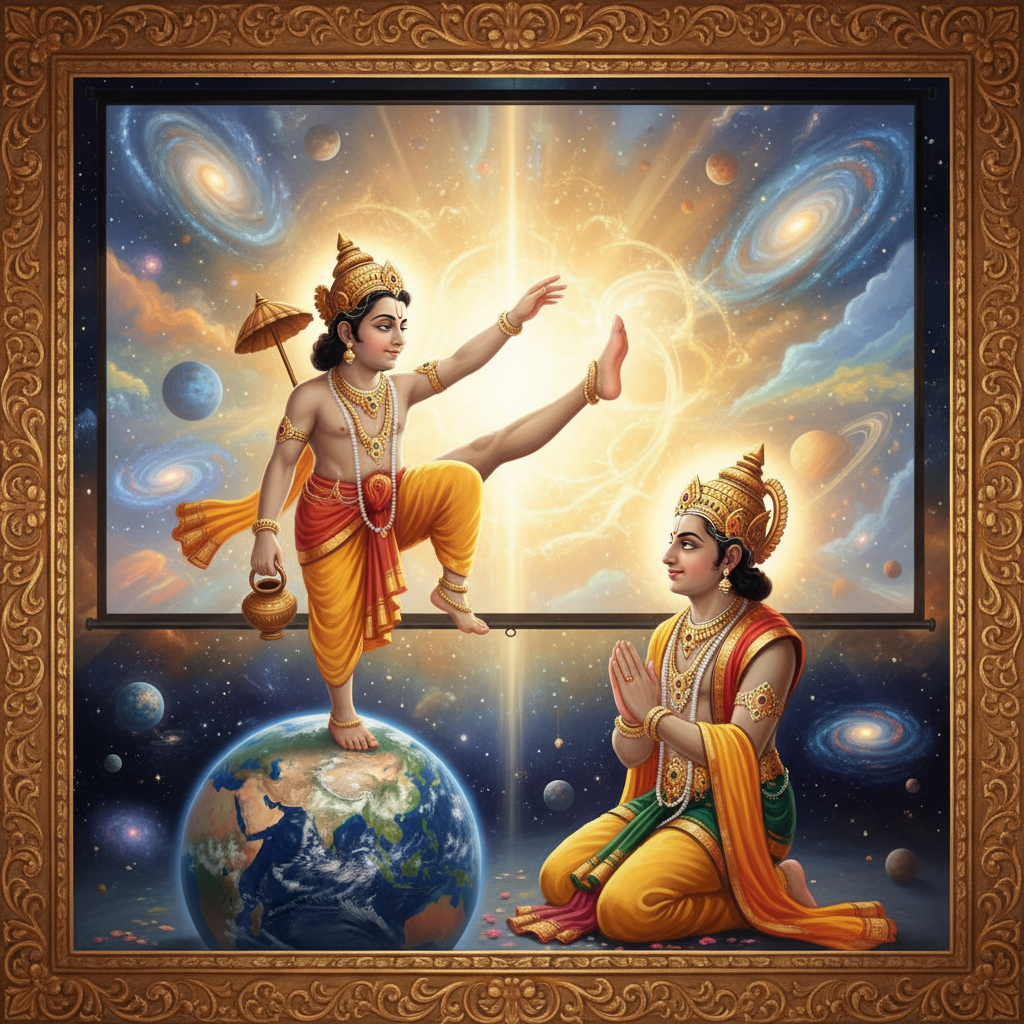
The three worlds for him are nothing. He has absolutely surrendered to the Divine Truth. God alone.
Renunciation by Experience, Not Initiation
This is a critical distinction. Bali did not renounce through a formal initiation. He renounced through actual experience.
“You do not have to do anything with the things that you have renounced,” Swamiji explains. “You have to understand in a different context.”
If you renounce, you become more expert in handling things. Not less. You handle your duties out of joyousness. Walking is a work. But you do it out of joy. Similarly, you handle your duties out of joy.
This is what we mean by “you have renounced the earth.” Not by running away from it. By understanding its illusory nature.
The Political Message: Ram Rajya
Having attained enlightenment, Bali continued to rule his country. Now he became a better ruler, the most elegant ruler possible.
“That actually is the political message,” Swamiji says. “The world is ruled by spiritually advanced personalities. That will be the greatest joy to the whole world.”
We have examples: Mahatma Gandhi in India, and other places also. Very spiritually advanced people when they ruled their country, that was most powerful, most peaceful, progressive.
A liberated sage, having attained liberation, now enriches the world around him by his spiritual presence, vibrations, touching different souls. Because he is a channel of the Divine source.
The Long Dream (Dirgha Sapna)
Every day, you are doing this. In dream, you attain everything, all three worlds. And get out of the dream. You lose them. While on bed you may miss a little, but then as you begin to wake up in day, you completely forget about it.
Gain and loss both meant nothing. What you gain, you gain the whole universe in your dream. But you lose all those.
Swamiji quotes Shankaracharya: Sadame Samatvam na Muktirna Bandha. “I am always the same. There is neither bondage nor relief for me.”
The state of enlightenment brings you to that level. The sun does not desire to be liberated. It is already full of light. When the cloud moves away, the sun was already there. Your prayer did not do anything. The sun was never involved in bondage.
The Cinema Screen
“Your mind is like a cinema show,” Swamiji says. All that you are seeing: life, death, gain, loss, positive, negative. They are projections. They are not reality.
The I am is the screen behind all the projection. That I am remains unaffected. No matter how the mind has played its drama.
The reality of you, the I am, is untouched, unscathed. No matter how the mind has played its drama.
This point has to be understood. If it is not there, there is no hope for liberation.
Spiritual Progress: Craving Fades, Fulfillment Grows
How do you know if you are progressing towards enlightenment? Not through fantastic experiences. Not light flashing out of your eyes.
Simple point: watch your craving. If your cravings are being diminished, and increasing internal fulfillment is developing, that is the characteristic of your spiritual progress.
Not fantastic things. A profound deeper fulfillment. Fulfillment of I am.
Your I am is always safe. Your I am is the only thing you love most. And that I am begins to develop stability. Stability by recognizing the I am does not need any support from the world.
More craving diminishes, and fulfillment increases. That is a characteristic of spiritual progress.
The Three Stages of Relationship with God
Swamiji describes three levels of spiritual movement:
First level: I am in the hands of God. So all your works go on, you are serving God. Bring a sacred attitude towards your activities.
Second level: I am a ray, and God is the sun. You are matching up with God. You become godly.
Third level: Nothing but God. I am that.
Bringing these three in your personality is the great ideal of all religions of the world.
The Seven Stages of Wisdom (Sapta Bhumikas)
- Shubheccha (शुभेच्छा) – Good Desire or Yearning for Truth: This is the initial stage where the aspirant develops a sincere desire to know the truth and begins the journey toward spiritual knowledge.
- Vicharana (विचारणा) – Enquiry: In this stage, the aspirant engages in self-enquiry and contemplation, seeking the deeper meaning of existence and the nature of the Self.
- Tanumanasi (तन्मनसा) – Subtle Mind: The aspirant’s mind becomes more subtle and focused. There is less attachment to worldly things, and the mind turns inward.
- Sattvapatti (सत्त्वापत्ति) – Attainment of Light: This is the stage where the aspirant attains the state of pure Sattva (purity). Here, the person has a clear understanding of the Self, and ignorance is diminished significantly.
- Asamsakti (असंसक्ति) – Non-attachment: The aspirant becomes free from attachment to worldly experiences and objects. There is no more clinging to material desires or emotions.
- Padartha Bhavana (पदार्थभावना) – Seeing Brahman Everywhere: The aspirant realizes that the Self (Atman) and Brahman are one and the same. Everything is perceived as an expression of Brahman.
- Turiya (तुर्या) – Transcendence: This is the final stage of enlightenment or realization. The aspirant reaches the highest state of consciousness, beyond the three states of waking, dreaming, and deep sleep, and abides in the state of absolute oneness with Brahman.
Scholar’s Corner
Purnamadah Purnamidam (Isha Upanishad invocation):
Oṃ pūrṇamadaḥ pūrṇamidaṃ pūrṇāt pūrṇamudacyate. pūrṇasya pūrṇamādāya pūrṇamevāvaśiṣyate. Oṃ śāntiḥ śāntiḥ śāntiḥ.
“That is whole. This is whole. From the whole, the whole arises. Taking the whole from the whole, the whole alone remains.”
Shankaracharya’s Vivekachudamani:
Sada me samatvam na muktir na bandhaḥ – “I am always the same. There is neither bondage nor liberation for me.”
Key terms:
- Aham Brahmasmi (I am Brahman)
- Sthitaprajna (rooted in wisdom)
- Sahaj Samadhi (spontaneous enlightenment)
- Vichar (self-inquiry)
- Nishcaya (firm conviction)
- Trishna (threefold craving)
- Shubheccha (yearning for truth)
- Vicharana (self-enquiry)
- Tanumanasi (subtle mind)
- Sattvapatti (attainment of light)
- Asamsakti (non-attachment)
- Padartha Bhavana (seeing Brahman everywhere)
- Turiya (transcendence)
- Leela (divine sport)
- Dirgha Sapna (the long dream)
Glossary
| Term | Meaning |
|---|---|
| Aham Brahmasmi | I am Brahman |
| Bhur Bhuvah Svah | The three worlds (physical, mental, intellectual) |
| Vichar | Self-inquiry, reflection |
| Nishcaya | Firm conviction |
| Sthitaprajna | One rooted in wisdom |
| Samadhi | Superconscious state |
| Sahaj Samadhi | Spontaneous, natural samadhi |
| Maya | Illusion |
| Leela | Divine sport |
| Dirgha Sapna | The long dream |
| Shubheccha | Good desire, yearning for truth |
| Vicharana | Self-enquiry, contemplation |
| Tanumanasi | Subtle mind turned inward |
| Sattvapatti | Attainment of pure light |
| Asamsakti | Freedom from attachment |
| Padartha Bhavana | Seeing Brahman everywhere |
| Turiya | Transcendental consciousness |
| Trishna | Threefold craving |
| Putreshana | Desire for progeny |
| Vitteshana | Desire for wealth |
| Lokeshana | Desire for fame |
Watch the Full Lecture
From a lecture by Sri Swami Jyotirmayananda. Watch the full Yoga Vasistha playlist: https://www.youtube.com/playlist?list=PLu4qbbM6vDP37–8UBT4vK7Z6sNU4jvHz
This study guide is drawn from the archived teachings of Sri Swami Jyotirmayananda.