

Sri Swami Jyotirmayananda continues his lecture series on the Ramcharitmanas (Tulsi Ramayana), Balakanda, Doha 192 onward, using the birth of Lord Rama to answer a question every sincere seeker eventually asks: if divine grace is boundless, why does it feel so unevenly received?
The Sun Shines the Same on Every Pot
Swamiji opens with a simple image. The sun shines with the same measure on a still, clear pot of water as it does on a cracked, muddy, or upside-down one. What changes is not the sun. What changes is the condition of the pot: how steady it is, how clear, how rightly turned toward the light.
Kripa, grace, works the same way. It showers constantly, like a waterfall that never stops falling. What a person experiences as “God is far from me” is almost never a withdrawal of grace. It is the condition of the receiving vessel, the mind, that determines how much of that constant shower is actually reflected back as felt experience.
This reframes a very old complaint. It is tempting to ask why God seems partial, generous to one person’s prayers and silent to another’s. Swamiji’s answer: partiality and impartiality do not apply to the sun, or to grace. The sun shines with full measure on every pot alike. The pot decides what shows up.
Din Dayala: Compassion for the Humble
The Ramcharitmanas calls God din dayala, compassionate to the humble, the poor. Din here does not mean poor in possessions. It means someone who has stopped depending on the world to complete them, someone who has begun to sense that everything belongs to the Whole, and nothing, finally, belongs to “me.”
This is the deeper meaning behind Isha vasyam idam sarvam, yat kincha jagatyam jagat: this entire universe is the dwelling place of God. In that light, no one can truly claim ownership of anything. “Me and mine” turns out to be a language of ignorance, useful for getting through a day, but ultimately a story the mind tells itself.
To the degree that a person feels this, releases the private claim on the world, that same degree measures how much grace becomes felt rather than merely believed. The mother’s care for a baby, always present, always sustaining, is the image Swamiji uses for how this support already surrounds every soul, whether or not the soul feels it yet.
Three Attitudes Every Soul Must Integrate
Hanuman’s answer to Rama supplies three attitudes for the spiritual life, and Swamiji is emphatic that all three, not just one, belong in a mature practice.
First, dasoham: as long as a person identifies with the body, the right attitude is “I am the servant,” a devoted servant of God, not a demanding one.
Second, the recognition that the self is a soul, not the body: a traveler who has moved from body to body, existence to existence. From this angle, the relationship shifts from servant to ray of light, with God as the sun. Since a ray is not separate in nature from its source, this attitude carries an intrinsic dignity: “I share the sun’s own capacity.”
Third, soham, the deepest recognition: I am That. Tvam eva aham, I am you; soham, I am that I am.
Swamiji’s instruction is practical rather than merely philosophical: don’t try to resolve these into one tidy formula. Let a person wake up in the morning as a servant of God, move through the day discovering the ray’s quiet dignity in ordinary work, and rest at night, however briefly, in the recognition of oneness. No conflict between the three is necessary. Each has its place.
Self-Effort Is How Free Will Grows
A common misunderstanding treats surrender and self-effort as opposites, as though trusting grace means doing less. Swamiji reverses this. Self-effort, applied rightly, is exactly what allows free will to expand. A weak will interprets years of unanswered prayer as evidence that effort doesn’t matter. A will that is being trained by right self-effort discovers, instead, that it can do far more than it assumed, and that its progress, once that inner strength takes hold, becomes very hard for outer circumstance to derail.
Angada’s Foot and the Skill Behind Devotion
The lecture turns to a well-known episode: Angada plants his foot in Ravana’s court and declares that if anyone can move it, Rama will withdraw without a fight. Read only as a story of a young warrior’s boast, it can sound almost reckless. Read as allegory, it points to something else: the fearless confidence that arises once a person has truly grasped, “I am not this body, I am spirit.” That confidence isn’t the shaky self-belief of the ego. It is what dawns naturally once the deeper identity is even glimpsed.
Kaushalya, Rama’s mother, gives the lecture its second major thread. Her name comes from kushal, skill. Swamiji reads this etymologically: when a person lives with genuine mystical skill, they begin to recognize the opportunities and resources already available to them, rather than letting these go to waste. In the language of the three queens, Kaushalya represents the sattvic quality within a personality, the very ground from which Rama, awakening itself, is born.
Vashishta’s Vision and the Ritual of Charity
When the sage Vashishta comes to see the newborn Rama, he beholds far more than an infant. He sees the abode of all beauty, all virtue, and, in the same glance, the cosmic form: God as the source from which every universe emanates. Swamiji borrows the Yoga Vasishtha’s image of a sunbeam through a crack in a window, filled with countless dancing dust particles, and asks the listener to imagine each speck as an entire universe. What Vashishta perceives in the child is this: from every pore, so to speak, universes arise and are sustained.
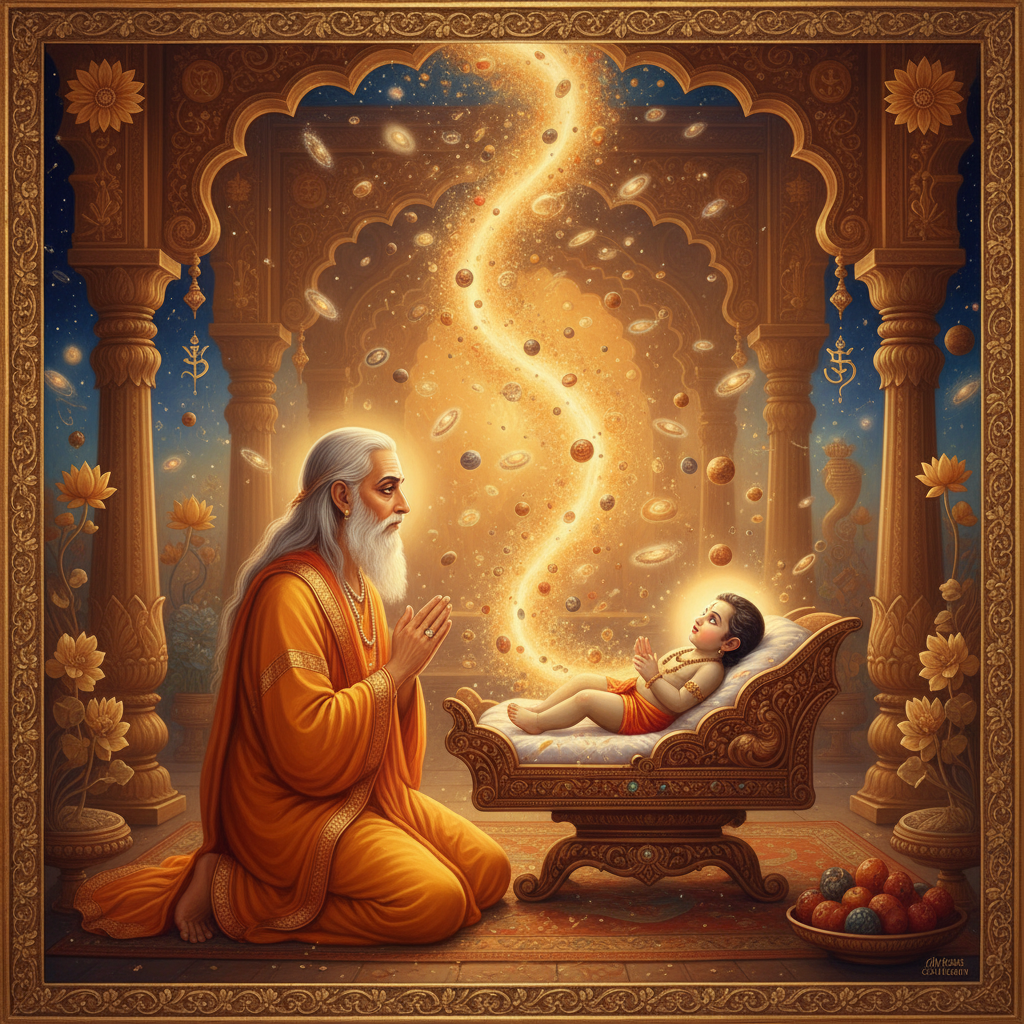
The chapter closes with a domestic detail that carries its own quiet teaching. After a birth in a traditional household, the family performs Nandi Mukh Shraddha, a rite whose name Swamiji unpacks as nanda, bliss, joined to a ritual of initiation, followed immediately by acts of charity. The instruction embedded here is simple and easy to overlook: let generosity enter every corner of a life, not kept in reserve, not hidden away, but let loose the moment gratitude arrives.
Reflect
Where in your life have you assumed that grace wasn’t there, when it was really your own pot, unsteady, clouded, or turned the wrong way, that needed straightening?
Scholar’s Corner
Ramcharitmanas (Tulsi Ramayana) of Goswami Tulsidas, Balakanda, Doha 192 onward: the birth of Rama and the surrounding verses on grace, devotion, and the divine child.
Isha Upanishad, verse 1: Isha vasyam idam sarvam, yat kincha jagatyam jagat, the entire universe as the dwelling place of the Divine.
Yoga Vasishtha: the simile of sunlit dust motes, each a universe, used to illustrate the scale of the cosmic form.
Glossary
- Kripa
- grace; the constant, unceasing shower of divine compassion.
- Din Dayala
- “compassionate to the humble,” an epithet for God describing tenderness toward those who have released worldly dependence.
- Dasoham
- “I am the servant,” the devotional attitude of a soul identified with serving God.
- Vatsalya Bhava
- the motherly attitude of love directed toward God, exemplified by Kaushalya.
- Soham
- “I am That,” the recognition of oneness with the Self.
- Kaushalya
- Rama’s mother; her name derives from kushal, skill, and represents the sattvic quality of nature.
- Nandi Mukh Shraddha
- a traditional post-birth ritual, from nanda (bliss), followed by acts of charity.
- Sharanagati
- taking refuge in God.
Watch the full lecture on the Tulsi Ramayana series below.
This study guide is drawn from the archived teachings of Sri Swami Jyotirmayananda.