
Sri Swami Jyotirmayananda continues the Bhagavad Gita, Chapter 6 (Atma Samyama Yoga — the yoga of self-control, the yoga that leads to enlightenment), covering verses 32 through 35. The chapter, Swamiji notes, gives the essence of Raja Yoga.
The Highest Yogi Feels Another’s Pain As His Own
Verse 32 describes the goal of yoga in a way most people don’t expect. The common assumption is that reaching the heights of yoga means something visibly unique develops in a person — a shining face, an aura, a kind of omniscience into what others think and do. Swamiji calls that expectation frustrating, because it isn’t what the verse actually promises.
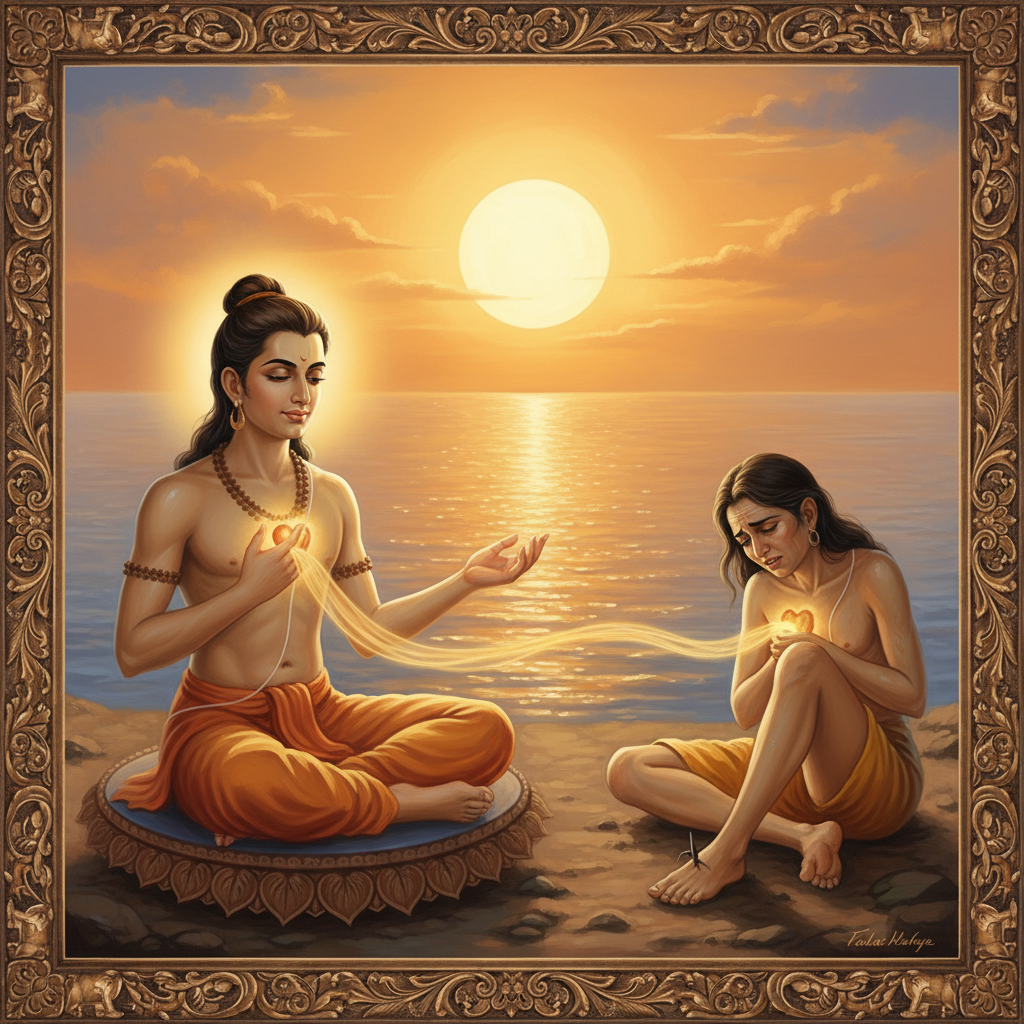
Instead, Krishna says the highest yogi is the one who feels for others, whether in pain or pleasure, even as he would feel for himself. If you see a thorn enter someone’s foot, your mind should go immediately to how it felt when you were pierced — not to the thought that the person deserved it through bad karma. Other people’s pain should never register as quiet satisfaction, and it should not register as cold indifference either. It should touch the heart immediately, and that touch should move you to help, whether through thought, word, or deed — even when a situation is too far away to act on directly, and all you can offer is an internal prayer or goodwill.
But — and this is the finer point — the heart should melt without the intellect becoming clouded. Swamiji’s image is an expert doctor: he loves the patient, his heart genuinely melts, but his clarity about how to treat that patient never wavers.
Swamiji resolves an apparent contradiction here. Realizing the Self carries two implications: “I am the Self of all” and, at the same time, “I alone am.” His illustration is the sun — ask the sun how many it is, and the answer is one. Yet that single sun creates millions of reflections, radiations, rainbows, every color of a dazzling world. In the same way, compassion for the world and the truth of your own singular Self are not in conflict. Swamiji ties this to the Bible’s own version of the same law: to love God with all your heart, and to love your neighbor as yourself.
The Two Demons Born From Not Listening
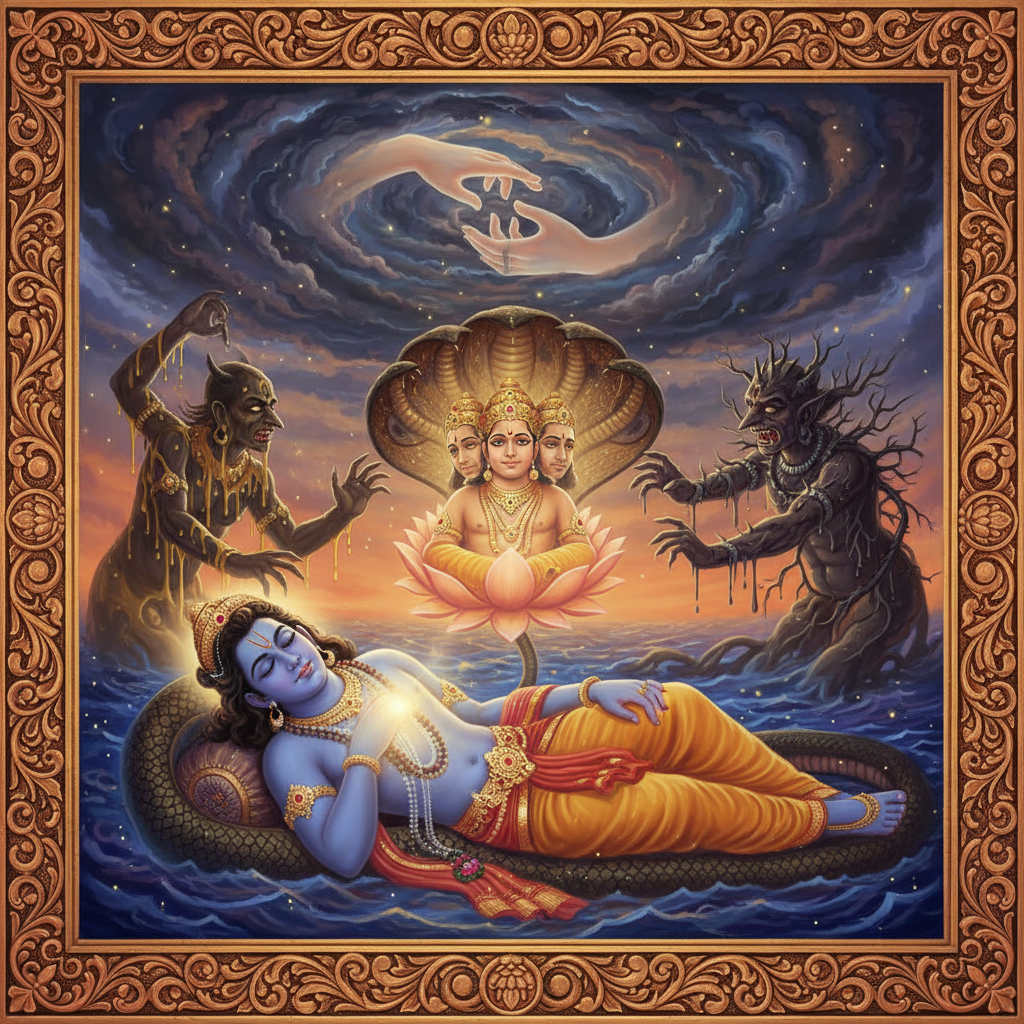
Verse 33 brings Arjuna’s honest doubt. He addresses Krishna as Madhusudhana, “destroyer of the demon Madhu,” and Swamiji unpacks the Puranic story behind that name. Lord Vishnu sleeps in the ocean, entirely untouched by the world. From his navel a lotus emerges, and from that lotus, Brahma, the creator. But before Brahma can begin his work, two demons — Madhu and Kaitabha — emerge and try to suffocate him.
The insight: every soul carries that same Vishnu potentiality, but it continues to sleep due to a lack of listening — satsanga. What obstructs the listening is raga-dvesha, attachment and aversion. Madhu, literally “honey,” is the sweetness of what pleases you; the mind becomes so absorbed in what it likes and dislikes that it swings back and forth like a pendulum between the two, and reality itself gets ignored. When Vishnu wakes and destroys these two demons, Brahma — creation, understanding — is finally free to proceed.
An Ever-Restless Mind
Arjuna’s doubt deepens: if the mind is constantly shaken by raga-dvesha, how can anyone maintain steady equanimity? Swamiji points to something everyone already knows — sleep. In deep sleep, the ego doesn’t overpower you, and the peace that results doesn’t depend on anything happening in the world. Sleep is God’s own compassionate hint that a rest like this is available even while awake. Just as the sky stays untouched behind every drifting cloud, a profound repose underlies every experience once it’s uncovered. That repose is self-realization: “I am that, am I.”
Verse 34 — Fickle, Impetuous, Powerful, Turbulent
Arjuna presses further: the mind is chanchala — fickle, impetuous, powerful, turbulent — and as hard to control as the wind. Ordinary air is gentle and life-sustaining, until motion turns it into wind, and enough turbulence turns it into a hurricane. Mind, Swamiji says plainly, is the cause of both bondage and release — the thoughts you allow it to sustain, day after day, are what shape it. Until a person has gone through real satsanga and sustained sadhana, the mind simply leads by whim, fancy, and dream.
Krishna’s Answer: Abhyasa and Vairagya
Verse 35 is Krishna’s direct reply: yes, the mind is restless and hard to control — but it can be brought under control through abhyasa, repeated practice, and vairagya, dispassion.
Drawing on the Raja Yoga Sutras, abhyasa becomes firmly grounded only when sustained over a long time, without interruption, and carried out with reverence.
Long time: sadhana should become as natural as eating or breathing, never a fixed-term trial abandoned after a week because results were slow.
Without interruption: don’t practice by mood — skipping a day, “making up” for it, then giving up the following week undoes the continuity the practice depends on.
With reverence: practice should carry gratitude — “how blessed am I that God gave me a tongue that repeats His name” — not resentment.
Swamiji frames the whole path as Integral Yoga: a blend of karma yoga (duty as offering), bhakti yoga (devotion), the will-and-patience of raja yoga, and the self-inquiry of jnana yoga. No one works equally on all four, so a person emphasizes the one suited to their temperament — but all four are interconnected. He closes with the Vedic prayer, “May everyone be blessed with good understanding” — the greatest change in a person happens when their understanding improves.
Vairagya grows alongside that practice as a mystical attachment to God paired with a mystical detachment from the world of illusion. Genuine vairagya doesn’t mean neglecting the body — you still keep it healthy — but you hold it without claiming it as your final identity: “I will not come back in the same body or similar body. Body is not me.” Swamiji, laughing at his own bluntness: before the world can disappoint you, let go of leaning on it first. Detach from the world of maya, attach to God.
The class ends here, mid-thought — Swamiji continues abhyasa and vairagya next time.
Reflect: Where in your own life is compassion still just a feeling, and where has it become an action?
Scholar’s Corner
Bhagavad Gita, Chapter 6 (Atma Samyama Yoga), verses 32-35. Yoga Sutras of Patanjali 1.13-14: tatra sthitau yatno ‘bhyasah. Puranic allegory of Vishnu, Brahma, and the demons Madhu and Kaitabha.
Glossary
- Atma Samyama Yoga
- the yoga of self-control.
- Madhusudhana
- “destroyer of the demon Madhu.”
- Raga-dvesha
- attachment and aversion.
- Chanchala
- fickle, restless.
- Abhyasa
- repeated, sustained practice.
- Vairagya
- dispassion.
- Chitta shuddhi
- purification of the heart through selfless action.
- Soham
- “I am That.”
Watch the full lecture: https://youtu.be/reoB9kKkx4U
URL Slug: wind-called-mind-abhyasa-vairagya-gita-72
This study guide is drawn from the archived teachings of Sri Swami Jyotirmayananda.