
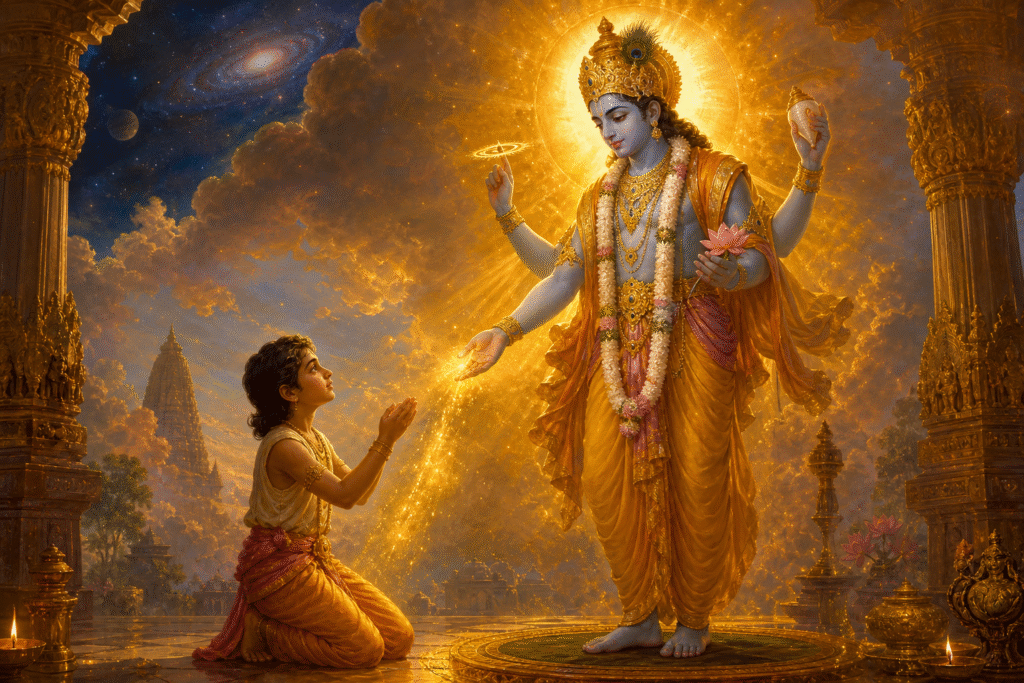
In this class on the Yoga Vasistha, Sri Swami Jyotirmayananda, a direct disciple of Swami Sivananda, continues his commentary on the Upashama Prakarana (Sections 33-34) with one of the most quietly radical moments in the entire text: the moment Lord Vishnu offers Prahlad any boon he desires, and Prahlad asks for almost nothing at all.
The Story So Far: Prahlad, Hiranyakashipu, and the Man-Lion
Swamiji opens by recalling the story of Prahlad rescued from his father, the demon king Hiranyakashipu, who wanted to kill his own devoted son. Hiranyakashipu is destroyed by God in the form of Narasimha, the man-lion avatar of Vishnu. Swamiji reads the allegory plainly: Hiranyakashipu represents ignorance itself, and the destruction of ignorance requires both self-effort (purushartha) and grace meeting at the right moment.
Ahamgraha Upasana: An Affirmation Before the Mind Understands
Before returning to Prahlad’s story, Swamiji teaches a specific practice for the moment ignorance feels overwhelming. “Start creating in your mind affirmation,” he says. “I am being led by God. Therefore all demoniac forces, they can’t touch me. I am light.” He calls this ahamgraha upasana, and makes a striking claim about how it works: “Even though your mind has not properly understood, but you are creating an affirmation… it works wonders.” The practice does not wait for intellectual conviction. Repetition itself begins to reshape the mind that will later come to understand.
The Boon Prahlad Didn’t Ask For
Returning to the story, Vishnu appears before Prahlad and says, “I am indeed pleased with your devotion. Choose any boon and it shall be given to you.” Swamiji pauses on this moment: the asking itself, he notes, is “a trial, a test.” Most people, given the chance, would ask from ego: wealth, recognition, an end to obscurity. Prahlad’s actual reply is different: “You are the giver of all desires. You are the indweller in the hearts of all. Nothing is hidden from you. Therefore grant me that which is best for me.” No specific request. No fixed picture of the outcome. Swamiji calls this the climax of surrender: a state where the devotee no longer holds any visualization of what he expects.

“Liberation Is Not Given”
Vishnu’s response carries the lecture’s central teaching. Prahlad receives the recognition of Aham Brahmasmi, “I am Brahman,” but liberation itself is not simply handed over. Vishnu tells him, “May you continue to maintain the process of spiritual inquiry.” Swamiji is direct about what this means: “Liberation is not given. Any other desired object, yes, can be given to you. But for liberation, you have to continue progressing until you blossom.” The boon, as Swamiji frames it, is not the destination but the durability of the path itself.
Section 34: The Self Declares Its Own Vastness
The lecture then moves into Section 34, where the text shifts from narrative into a long sequence of direct self-declaration: “I am the self underlying all names and forms… I am the interpenetrating reality.” Over the following verses the Self speaks in the first person as everything at once, widening what “I” is permitted to mean.
Scholar’s Corner
Citation: Yoga Vasistha, Upashama Prakarana, Sections 33-34. Swamiji states the citation directly in the lecture’s opening minute, and marks the transition into Section 34 by name partway through the class.
Aham Brahmasmi (“I am Brahman”) is one of the four Mahavakyas, the “great sayings” of the Upanishads that point directly to the identity of the individual self and the absolute.
Glossary of Spiritual Terms
- Ahamgraha Upasana: A practice of sustained mental affirmation that identifies the self with the divine, taught here as effective even before it is intellectually understood.
- Purushartha: Self-effort; human striving, the counterpart to grace in this lecture’s allegory.
- Vichara: Spiritual inquiry; the sustained investigation into the nature of the Self that Vishnu asks Prahlad to continue.
- Aham Brahmasmi: “I am Brahman,” one of the four Mahavakyas of Vedanta.
- Narasimha: The man-lion avatar of Vishnu, who destroys Hiranyakashipu to protect Prahlad.
Watch the Full Lecture
Watch the full lecture on YouTube.
Join the community for daily inspiration.
This study guide is drawn from the archived teachings of Sri Swami Jyotirmayananda.
Great content! Keep up the good work!