
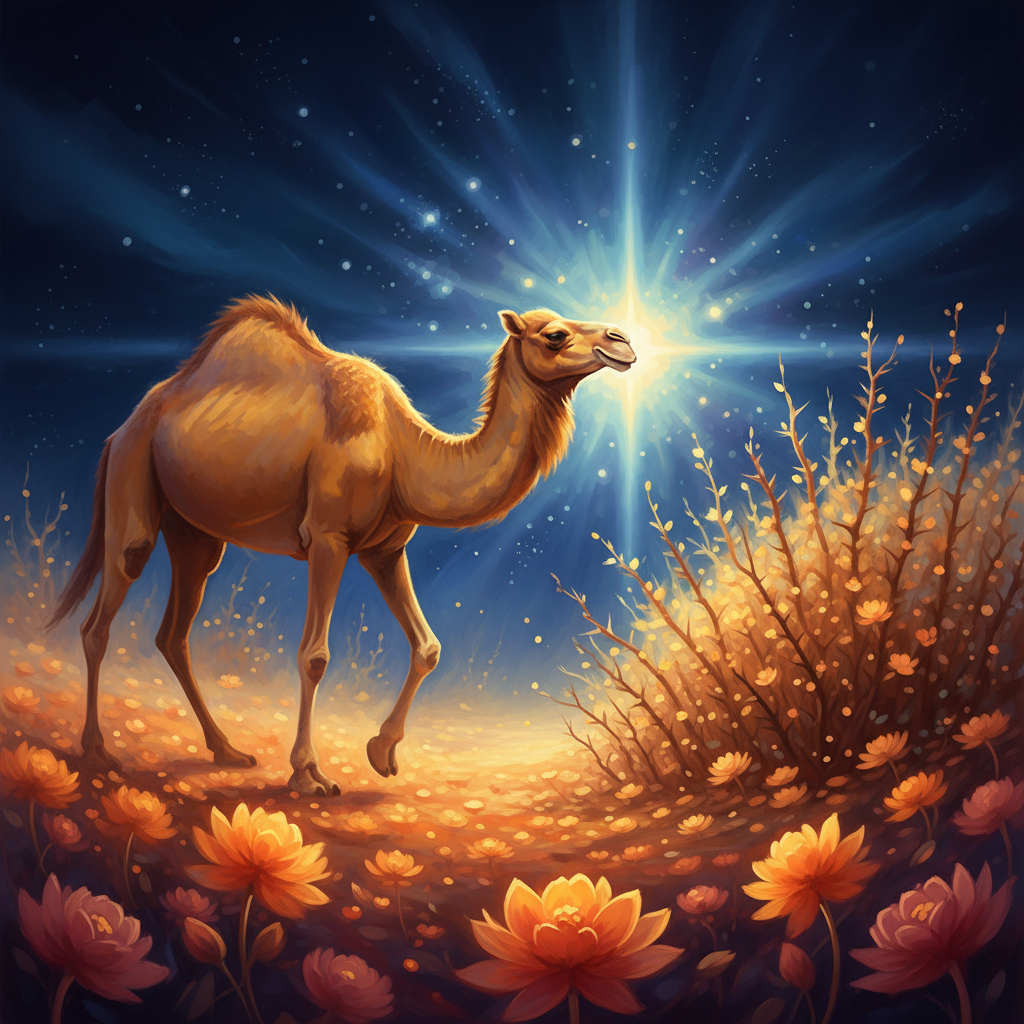
Show a camel a bed of tender flowers and a thicket of thorns, and it will walk straight past the flowers to eat the thorns, blood on its lips and all. It isn’t that the camel can’t feel the thorns. Its taste has simply changed — what should repel it now draws it in.

In this continuation of Section 34 of the Upasama Prakarana, Sri Swami Jyotirmayananda picks this up exactly where Lesson 173 left off: the devotee Prahalada, absorbed in unbroken reflection on the Self, modeling a settled conviction the sages call Nishchaya. Swamiji uses the camel the other way round — not as a warning, but as a description of what happens once the mind has tasted something higher. A person who has touched real inner sweetness doesn’t renounce the world by gritting their teeth. The world simply stops tasting like flowers. This is vairagya, dispassion, and Swamiji is careful to distinguish it from suppression: it isn’t willpower forcing itself past temptation, it’s a change in what the mind actually wants.
The Lottery You’ve Already Won
“If you look at your mind,” Swamiji says, “nothing is settled — everything is shaking.” The mind stays constantly busy, and in its busyness it manages to miss the one thing that was never in question: I am. Not as an idea to chase down, but as the ground already under every thought.
He calls it the profound lottery. Most people, offered the choice between hearing about liberation and hearing about a billion-dollar jackpot, will pick the jackpot every time — not because liberation is a lesser prize, but because the mind has never been shown that it already holds the winning ticket. “You are the winner of treasure of treasure,” Swamiji says. “Treasure beyond measure.” The work isn’t acquiring it. It’s noticing you already have it.
What Even Alexander Couldn’t Keep
To show how thoroughly the mind resists this, Swamiji turns to history’s ledger of everyone who tried to secure permanence in the world instead. Great kings, owning enough to reshape nations, departed taking nothing. “Millions of Alexanders have come with the wind.” Even your money in the bank, he adds — practical, necessary, and still no answer to the question underneath it.
None of this is a case against practical life. Swamiji is explicit: handle your responsibilities with precision, use common sense, consult experts when a situation calls for it. The point isn’t that the practical world is fake. It’s that the practical world was never going to be the place where the search ends.
Sarvam Dukham Vivekinam — All Pleasure Is Pain to the Wise
This is the hinge of the lecture, and Swamiji builds it with a run of similes rather than a single argument. Who abandons the sweetness of sugarcane for the bitterness of neem leaves? Who turns from a heavenly garden to live in a burning desert, when both plots of land are equally available? Framed as a straightforward choice, nobody would pick the thorns, the neem, the desert. And yet this is exactly the trade the untrained mind keeps making, life after life, without noticing it’s a choice at all.
Vairagya, Swamiji says, is what happens when that choice finally becomes visible. Having tasted the sweetness of divine bliss even once, “the pleasures of the world have become bitter and senseless” — not because the pleasures changed, but because the palate did. Sarvam dukham vivekinam: to the one who discriminates, all worldly pleasure is recognized as pain, because it’s the very thing keeping the mind’s attention pointed away from God.
Three Worlds, One Brahman
Swamiji then names something almost everyone assumes without examining: that “the kingdom of the three worlds” refers to planets, or realms above and below this one. It doesn’t. The three worlds are the world of your physical senses, the world of your feelings, and the world of your understanding — and you are always standing in all three at once. Every kind of power a person chases, whether control over the physical world, fulfillment of the emotional world, or thrill in the intellectual world, is a bid for mastery within one of these three.
And behind all three, in every case, is the same single reality. “These locas are not real,” Swamiji says, in a line half-teaching and half-joke. “God behind them is the reality — and there, Brahman is your own very self.” Attain everything available in all three worlds, and — like the emperor who rules gloriously in a dream and then wakes up — you have actually gained nothing at all.
The Source Behind Every Ordinary Thing
From there Swamiji turns practical: how does an aspirant actually train the mind to see through the three worlds to what’s behind them? Not through renunciation of the senses, but through what he calls a penetrating vision — a habit of tracing anything luminous, anything that moves you, back to its source.
Water sustains every living thing and doesn’t know it. A sudden wonderful thought arrives in your mind, and you didn’t “connect to Google” to get it. A flower blossoms with a beauty it never worked to produce. In each case, Swamiji says, the glory belongs to what’s behind the thing, not the thing itself — and turning that recognition into a habit converts ordinary life into what he calls a powerful satsanga, whether or not another person is anywhere near you.
Slave, Part, and Identity: Three Stages of the Godward Relationship
The lecture’s most structured teaching comes near the end, when Swamiji lays out three stages of relationship with God that map onto three stages of a life.
In the first, bodily stage, you are a channel of God’s will — “a slave, God is the master,” Swamiji clarifies quickly, not in the degraded sense the world uses that word, but as a relationship of trust: you act with full precision and common sense, and whatever the outcome, you recognize it as God working through you, or God protecting you from a mistake you couldn’t yet see.
In the second stage, tadaan shaka, you recognize yourself as a literal part of God — “if God is sun, I am his ray of the sun” — and the relationship shifts from obedience to something more like a shared undertaking: developing divine qualities not because you’re told to, but because you’re now, in Swamiji’s phrase, competing with God to see how much of that light you can carry.
The third and highest stage collapses the distance entirely: Aham Brahmasmi, “I am God,” with no difference left between the reflected sun and the sun itself. Swamiji is careful here, softening a teaching that could sound like arrogance with a joke about not being upset if this feels presumptuous — “he also listens to it” — before returning to the real weight of the claim: in a deep, quiet mind, this is simply what settles.
The Bird and the Fowler
Swamiji closes with an image as stark as the camel that opened the lecture. Life in this world, for those who have not attained the intuitive vision of the Self, is like a bird already caught in a net — the fowler is death, and the catch has already happened whether or not the bird has noticed. The bondage isn’t imposed from outside. It’s built continuously, out of the very desires and attachments that promised freedom.
And yet even the setting is generous, Swamiji points out — a beautiful universe, filled with beings who could turn toward the one thing that matters and mostly don’t. “Beautiful universe has worms, countless worms,” he says, half in humor, describing minds absorbed in a magnificent world with no interest in what’s actually behind it.
The lecture doesn’t resolve into an instruction so much as a question, left open on purpose: what is the one thing your mind has been missing, day after day, while it runs after what it can never keep?
Scholar’s Corner
This lesson continues directly from Lesson 173, where Swamiji stated the citation aloud at the section’s opening: “Yoga Vashishta, Upshamprakarana, section 34” — following the transition made at the close of 173 (“next section, Prahlad attains enlightenment, section 34”).
Key terms invoked across the lecture:
- Nishchaya — the settled, unshaking conviction of who one is, contrasted with the ordinary mind’s constant agitation
- Sarvam dukham vivekinam — “all [worldly pleasure] is pain to the one who discriminates,” the lecture’s central teaching on vairagya
- Aham Brahmasmi — “I am Brahman,” the Upanishadic declaration Swamiji cites as the common thread beneath every religion’s core teaching
- Shivoham, Satchidananda Swarupoham — “I am Shiva,” “I am of the nature of existence-knowledge-bliss absolute,” the declaration associated with the highest of the three stages of the Godward relationship
- Tadaan shaka — the intermediate stage of recognizing oneself as a literal part (amsha) of the Divine
The Ramayana and Bhagavad Gita are not directly cited in this lesson (unlike Lesson 172’s Hiranyakashipu material); the teaching here draws on the continuing Prahalada narrative internal to the Upasama Prakarana itself, plus similes (the camel, the sugarcane and neem, the garden and desert, the bird and fowler) that are Swamiji’s own illustrative additions rather quoted verses.
Glossary
- Nishchaya
- Settled conviction; unshaking certainty of the Self
- Vairagya
- Dispassion; freedom from thirst for worldly objects, born of direct experience rather than force
- Sarvam dukham vivekinam
- “All [pleasure] is pain to the discriminating one” — the lecture’s central teaching
- Brahman
- The Absolute; the one reality behind all three worlds
- Jiva
- The individual soul, identified with mind and body
- Tadaan shaka
- The stage of recognizing oneself as a literal part of the Divine
- Shivoham
- “I am Shiva” — a declaration of identity with the Absolute
- Satchidananda
- Existence-Consciousness-Bliss; the nature of Brahman
- Aham Brahmasmi
- “I am Brahman” — the Upanishadic declaration of non-dual identity
- Prahalada
- The devotee whose continuing reflection frames this section of the Upasama Prakarana
Watch the Full Lecture
From a lecture by Sri Swami Jyotirmayananda. Watch the full Yoga Vasistha series on our channel, and join us for the nightly premiere.
This study guide is drawn from the archived teachings of Sri Swami Jyotirmayananda.