

Rowing Without Untying the Boat
Three priests in old India heard that a wealthy household across the river was giving a great feast. They were poor and hungry for good food, and unwilling to pay the boatman’s fare. So they waited until dark, slipped into an unattended boat, and rowed. All night they rowed, certain the far shore was drawing near.
When dawn broke, they saw the same bank, the same steps, the same people they had left behind. They had never untied the boat from its post.
In this sixth lecture in his Raja Yoga Sutras series, Sri Swami Jyotirmayananda uses this old story to unlock one of the most practical verses in Patanjali’s system, Sutra 1.12: abhyasa-vairagyabhyam tan-nirodhah. The mind’s thought-waves are stilled by two things together, repeated practice and dispassion. Practice without release is the priests’ boat. You can row all night and go nowhere.
What True Practice Requires
Sutra 1.13 defines abhyasa itself: the effort to remain steadily established in that stillness. Sutra 1.14 adds the conditions that make it firm: practiced for a long time, without interruption, and with devoted, wholehearted attention.
Swamiji is careful about what this does not mean. Sadhana is not sacrifice. It should not become an inner ledger where you remind yourself, and others, of how much you have given up. He describes people who take up a discipline the way a doctor prescribes a diet, quietly deciding “I will do this for two months and then stop.” True practice carries no such time limit. It grows more interesting and enriching the longer it continues, the way a health habit becomes effortless once you feel its benefit in your own body.
The Mastery of Vairagya
Sutra 1.15 gives the definition of the sutra’s other half: vairagya is the mastery, vashikara, that arises when thirst for anything seen or promised has ended.
Swamiji distinguishes two levels. Apara-vairagya, the lower dispassion, develops in stages. It begins simply, by seeing that the things people chase, wealth, friendships, fame, are transient, and that real gain lies in the inner quality of the heart, not in outer accumulation. A person with fame and fortune enough to fill a lifetime gains nothing without vairagya, and a person with very little loses nothing once the heart has turned inward.
At a further stage, this same dispassion extends even to anushravika objects, the powers and higher worlds promised by scripture and tradition, the siddhis, the celestial realms. Swamiji calls the fascination with these a childish fantasy, no different from a child imagining himself flying among the clouds. Even if such powers were real, chasing them was never the goal.
The King Who Traded His Age for Youth
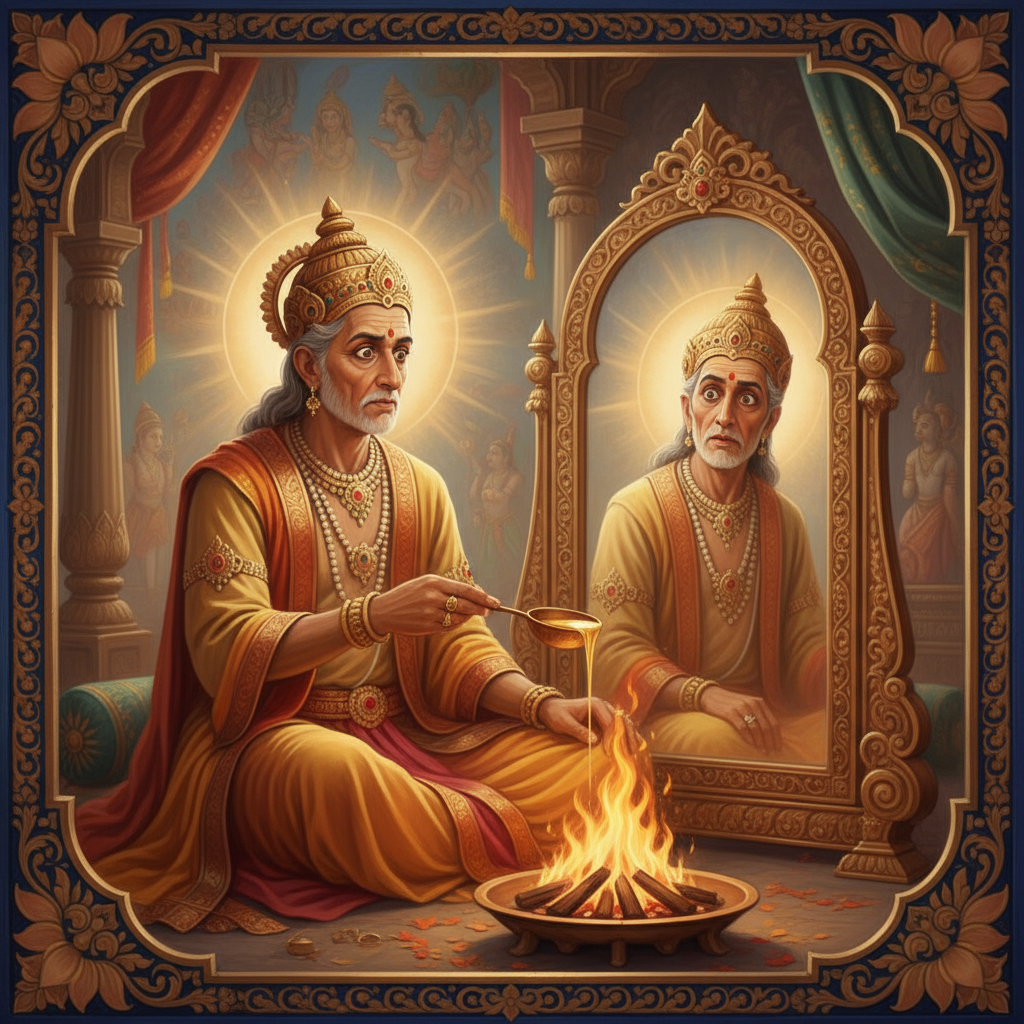
To show where unchecked desire leads, Swamiji tells the story of King Yayati. Catching sight of his own greying hair in a mirror, Yayati was struck by the loss of his youth and the pleasures that went with it. He persuaded one of his sons to exchange ages with him, and lived a second youth of undiminished pleasure.
It ended exactly as the first had. Age returned, and Yayati arrived at the same realization: desire is like pouring ghee into a fire. Feed it and it only burns brighter, never toward satisfaction. Place a person for a hundred years inside the very situation their mind has fixed upon as “if only I had this, I would be happy,” and they will still be miserable.
Beyond the Gunas
The lecture closes with the highest form of dispassion, para-vairagya, defined in Sutra 1.16. This supreme dispassion is thirstlessness even for the three gunas, sattva, rajas, and tamas, and it comes only through direct knowledge of the Purusha, the Self.
Swamiji draws on the Bhagavad Gita, where Arjuna asks Krishna how one recognizes a person who has gone beyond the gunas. Whatever guna happens to be operating, Krishna answers, such a person simply watches, like the sky watching its clouds. The cloud is dark, fine. It is calm, fine. The one who has crossed the gunas is touched by none of it.
Swamiji points to the same truth in the Ramayana. Vibhishana, Kumbhakarna, and Ravana stand for sattva, tamas, and rajas within a single household. Each mode of nature serves the soul’s evolution. Sattva even helps Rama toward His kingdom. But once the goal is reached, even sattva, in the figure of Vibhishana, steps aside. The gunas are a ladder, not the destination.
Scholar’s Corner
The Sutras of this lesson (Samadhi Pada, Chapter 1):
- 1.12 — abhyāsa-vairāgyābhyāṃ tan-nirodhaḥ — “These [thought-waves] are stilled by practice and dispassion.”
- 1.13 — tatra sthitau yatno ‘bhyāsaḥ — “Practice is the effort toward steadiness in that [stillness].”
- 1.14 — sa tu dīrgha-kāla-nairantarya-satkārāsevito dṛḍha-bhūmiḥ — “That practice becomes firmly grounded when pursued for a long time, without break, and with devoted attention.”
- 1.15 — dṛṣṭānuśravika-viṣaya-vitṛṣṇasya vaśīkāra-saṃjñā vairāgyam — “Dispassion is the mastery of one free from thirst for objects seen or promised by tradition.”
- 1.16 — tat-paraṃ puruṣa-khyāter guṇa-vaitṛṣṇyam — “The supreme dispassion is thirstlessness even for the gunas, through knowledge of the Purusha.”
On the gunas (Bhagavad Gita, Chapter 14):
Arjuna asks Krishna how to recognize one who has transcended sattva, rajas, and tamas. Krishna’s answer: such a soul remains unmoved, like the sky watching its clouds, whichever guna passes through.
The Ramayana’s three brothers:
Ravana (rajas), Kumbhakarna (tamas), and Vibhishana (sattva) stand together as a single teaching on how the three gunas operate, and on how even sattva must finally be transcended once it has served its purpose.
Glossary
| Term | Meaning |
|---|---|
| Abhyasa | Repeated practice; steady effort |
| Vairagya | Dispassion; freedom from thirst for objects |
| Apara-vairagya | Lower, progressive dispassion |
| Para-vairagya | Supreme dispassion, beyond the gunas |
| Trishna | Thirst; craving |
| Vashikara | Mastery; the state of having subdued |
| Anushravika | Related to scriptural or traditional promise |
| Siddhi | A supernormal power or attainment |
| Sattva, Rajas, Tamas | The three gunas: purity, activity, inertia |
| Gunatita | One who has gone beyond the three gunas |
| Purusha | The Self; pure consciousness |
| Sadhana | Spiritual discipline; practice |
| Samadhi Pada | The first chapter of Patanjali’s Yoga Sutras |
Watch the Full Lecture
From a lecture by Sri Swami Jyotirmayananda. Watch the full Raja Yoga Sutras series on our channel, and join us for the nightly premiere.
This study guide is drawn from the archived teachings of Sri Swami Jyotirmayananda.