
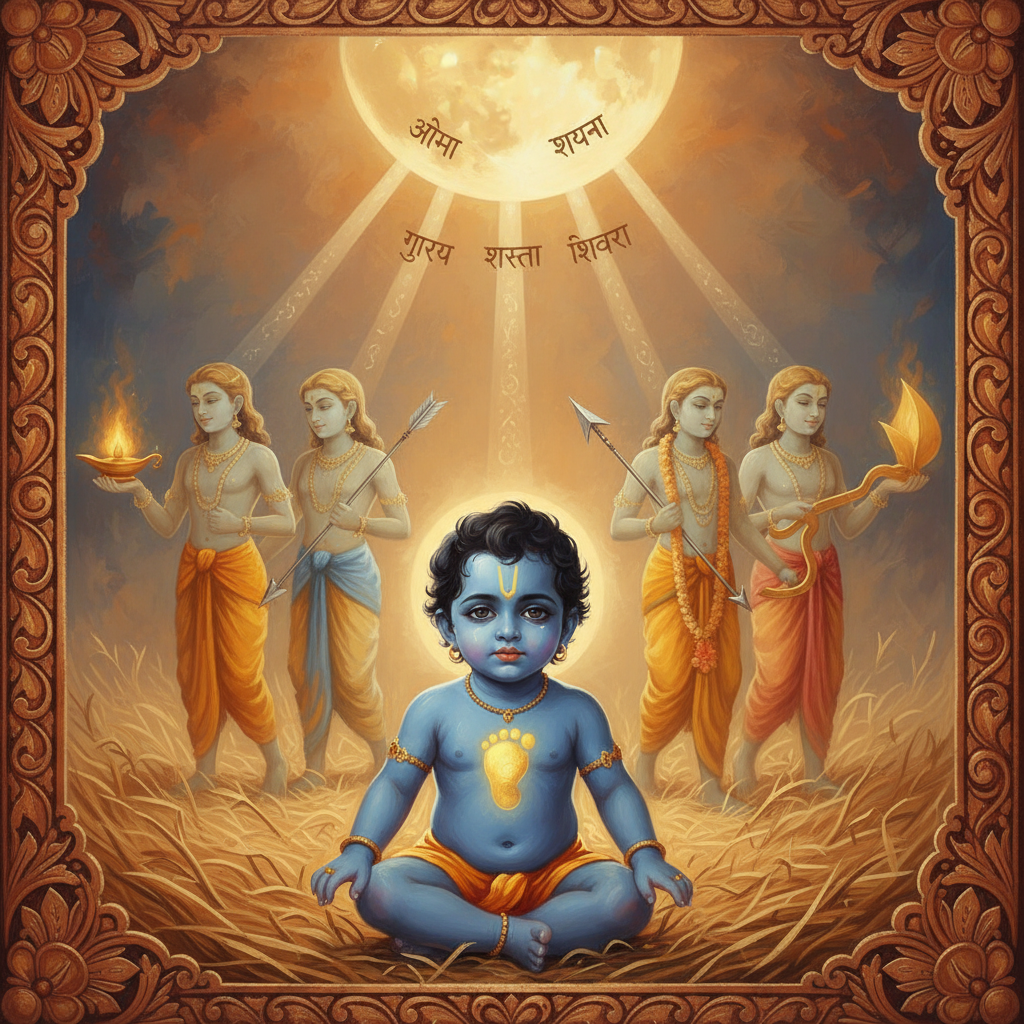
Tulsidas spends most of this section of the Ramcharitmanas describing a baby. The four sons of Dasharatha have been born, Sage Vasishtha has come to name them, and from Doha 197 through Doha 200 the poem does very little except look at the child Rama: his complexion, the moon of grace in his heart, the soles of his feet, the three lines on his stomach, the curl of his hair, the way his voice has not yet come clear. On the surface it is a devotional set piece, the kind of passage a reader in a hurry skips.
Swami Jyotirmayananda does not let it stay a set piece. At 45:59 he stops on a single detail that Tulsidas mentions almost in passing: among the ornaments on the baby’s chest there is a mark, and the mark is a footprint. It belongs to the sage Bhrigu. In the story behind it, Bhrigu set out to settle which of the three great Gods was greatest, provoked each of them in turn, and finally walked in on Lord Vishnu and kicked him in the chest to see what he would do. Vishnu woke, took the sage’s foot in his hands, and apologised for the injury his own hard chest had caused the sage’s tender foot. Swamiji names what that story is for, and it is the distinction the whole lesson turns on: greatness is not a large ego. It is natimanita, absolute humility, and Tulsidas leaves the evidence of it printed permanently on the chest of God.
The other half of the lesson comes earlier and is quieter. When Vasishtha names the four boys, he is not choosing pleasant sounds. Swamiji reads the four brothers as four movements of one awakening soul — Rama as jnana, wisdom at its highest; Lakshmana as dhyana, the undistracted mind without which wisdom cannot arise; Bharata as bhakti, devotion; and Shatrughna as karma yoga, the action that clears the six inner enemies out of the way. They are not four boys. They are four things that have to grow in one person, and the poem’s insistence that the brothers pair off and never separate is a statement about how they grow: not one at a time.
Where This Lesson Sits
- 00:00 The insult Vishnu answered with a massage
- 01:01 Invocation, and Balkanda Doha 197
- 02:15 Vasishtha names the four brothers
- 07:09 Rama as jnana, Lakshmana as dhyana
- 09:00 Arjuna and the eye of the bird
- 11:54 Bharata as bhakti, Shatrughna and the six enemies
- 16:15 Doha 198: syama, gaura, and the rise of sattva
- 20:24 The moon of grace and the four kripas
- 24:52 Breaking the straw against the evil eye
- 27:29 Doha 199: a mother’s arms as worship
- 32:24 Brahman beyond the gunas, in Kausalya’s lap
- 34:54 The marks on the feet, the three lines, the navel
- 45:59 The footprint of Bhrigu on Rama’s chest
- 48:55 Greatness is absolute humility
- 50:00 Doha 200: the crawling child beyond all words
Four Names, Four Movements of One Soul
Doha 197 says that Vasishtha, with his profound understanding of the four Vedas, considered the matter in his heart and gave the four boys their names. Swamiji takes the line seriously in a specific way: the essence of the Vedas expressed itself in the form of four children. The naming is not a ceremony attached to the story. It is the story compressed.
Rama is jnana, wisdom at its highest. Lakshmana is dhyana, and the etymology carries the argument: lakshana means good qualities, and the everyday Hindi phrase for a person of fine character — bahut acche lakshan hain — is the same word. Lakshmana is the one who highlights the glory of Rama, which is to say that the qualities that develop in a person are what reveal how closely that person is related to the wisdom already within. Bharata is bhakti, devotion. And Shatrughna is the destroyer of shatru, enemies — not external ones, but the six impurities of the mind that every school of Indian philosophy lists in the same order: kama, perverted desire; krodha, anger; lobha, greed; moha, infatuation and delusion; mada, pride; matsarya, jealousy.
What matters more than the four labels is the way the poem pairs them. Lakshmana attaches himself to Rama from infancy; Shatrughna attaches himself to Bharata. Two pairs, and they do not come apart. Swamiji reads the pairing as a claim about sequence and dependence. Wisdom is not available to a mind that is scattered, so Rama and Lakshmana travel together. Devotion does not become dynamic while the mind is full of the six enemies, so Bharata and Shatrughna travel together. And the two pairs are themselves interrelated: as karma yoga goes on purifying the mind, devotion goes on developing; as devotion expands, meditation becomes unique; and only then does the movement of wisdom cut down Ravana, who is ignorance itself, in a part of the story still far ahead.
This is the argument against picking one path and neglecting the rest. The four brothers are the four yogas of integral yoga, and the Ramayana’s refusal to let them separate is the teaching.
The Eye of the Bird
To show what dhyana actually means, Swamiji leaves the Ramayana for a few minutes and goes to the Mahabharata, to Dronacharya testing his students. A target is placed on a tree. Before anyone shoots there is a verbal examination: what do you see?
One student answers expansively — I see everything, I see you, I see the others, I see the sandals you are wearing. Dronacharya tells him he is not fit for it. Then Arjuna comes. Do you see me? No. Do you see these people? No. The others laugh at him. Do you see the tree? No, Gurudev. Do you see the bird? No. Now the laughter is louder; he seems a complete fool. What do you see, then? Only the eye. The target, nothing else.
Swamiji is direct about why the story is told: all these allegorical stories are meant to give you a message. The message is that meditation is not the suppression of a busy mind but a change in what the mind counts as existing. He extends the image past archery. If the mind is highly purified, the only reality in the world is Brahman; your own soul becomes the arrow and Brahman becomes the target, and nothing else exists. There is a homelier version of the same point later in the lesson: rather than going after so many waves of the ocean, go after the ocean. Meditation of that kind does not fight objects one at a time, because at that depth the objects have stopped competing for the field.
Syama and Gaura
Doha 198 begins the description of the children, and the first detail is complexion: the dark and the fair, moving together in two beautiful pairs, while the mothers watch and break a straw to ward off the evil eye.
Swamiji reads the colours rather than admiring them. Syama is the blue of the sky, and the sky is the image of a reality with no limits — so the dark complexion is boundlessness. Fairness is sattva guna, and the whiteness of Lakshmana and Shatrughna is the snowy white of purification: Lakshmana moving toward vichara shuddhi and buddhi shuddhi, purity of reflection and intellect, and Shatrughna toward bhava samshuddhi, purity of feeling. Rama and Bharata are syama; Lakshmana and Shatrughna are fair. The pairing puts boundlessness and purification side by side in each pair, which is the same structural point the names made.
Then he issues a warning about imagination. It is perfectly good, he says, to picture the children and to let the delight of that image work on you. But your imagination should not be confined to a limited reality. When the picture of Rama arrives in the mind, go beyond the picture, beyond the form that has arrived — because what you are seeing is a symbol, the way what you see when you look toward the sun is a symbol of what the sun actually is.
The Moon of Grace, and Four Kinds of It
Doha 198 continues: in their hearts the moon of grace shines, and its rays come out through their lips as a charming smile. The line is easy to read past. Swamiji stops on it and asks what the deeper meaning of a baby’s smile could be, and answers: kripa, grace.
Then he divides it, and the division is the most practically useful passage in the lesson. Ishvara kripa is grace itself, God’s grace. But when it operates in a person it appears first as atma kripa — the grace of one’s own soul, which shows up as nothing more dramatic than the thought that somehow satsanga will give me my answer, let me go. That very desire came from your own heart, and it was already grace at work. As involvement deepens and a person seeks a teacher’s guidance, it is guru kripa. And the scriptures that once only filled the mind with words begin, at some point, to flutter their swan-like feathers in the heart and become a source of inspiration: shastra kripa.
The reason this matters is that it removes the waiting. Grace is not a rescue that either arrives or does not. The wish to sit down and listen at all is the first of the four, already present, already operating.
Breaking the Straw
The mothers, seeing the babies, break a straw to avert the evil eye. Swamiji gives the custom its plain reading and then turns it.
When you see the beauty of Rama, the entire world and all its pleasures become straw. That is the deeper breaking. He supports it with the ordinary experience of waking: all the beauty and all the wealth you acquire in a dream have no meaning once you are awake, and the loss costs you nothing. The straw was broken in the waking, not by an act of renunciation.
This is the lesson’s characteristic move. A folk gesture is not explained away and not merely tolerated. It is left intact at its own level and read again at another.
A Mother’s Arms
Doha 199 turns domestic. Sometimes the child is in his mother’s lap, sometimes in a fine cradle; the mother fondles him and calls him darling. Swamiji spends time on utsanga, the word behind uchanga — ut meaning a kind of exuberance, sphurti, thrill. When a mother holds a baby with great love her arms are not steady; they shake, and the shaking is itself delightful to the child. It is a small observation, and it is doing work: the poem is describing a real thing, not a symbol only.
From there comes the moral, and it is broader than the nursery. Let that type of love emerge when you deal with the children and family in front of you, because the reality to be learned is that everyone shines with the light of God, and every soul is a ray of God. A mother nourishing a child is, from a strictly worldly vantage, worshipping God through motherly sentiment. And the principle generalises: any act of charity, any love directed to another person, is being directed to God, and is invoking God’s love. At the highest level the entire world becomes the peace of your own heart — which is where sarve bhavantu sukhinah comes from, may all be happy, with no one excluded.
The Marks on the Feet
From 34:54 the lesson becomes an inventory, and each item is read.
The soles of the feet are reddish, red being the mystical colour of love; the nails shine like dew drops on lotus petals. On the feet are three marks. The vajra, the thunderbolt, means that the inspiration drawn from those feet gives the strength Indra has in his weapon, and that if you stay firm the thunderbolt force drives negativity away. The dhvaja, the flag of victory, carries the maxim yato dharmas tato jayah — where dharma is, there is victory — so wherever that foot goes, victory follows. The ankusha is the goad used to control an elephant, and it means the divine feet control the asuri vrittis, the demonic tendencies. Then the nupura dhvani, the tinkling of the anklets, at which the minds of sages become intoxicated.
Around the waist, tiny bells; on the stomach, three lines. The three lines are the three lokas — the world of practical reality, the world of feelings, the world of understanding and insight — the three worlds the soul wanders through in the course of evolution, all of them held within the body of the child. The navel is deep, which is a sign of health and, spiritually, the seat of kriya shakti at the manipura chakra: when that centre is awakened, dynamic spiritual movement begins.
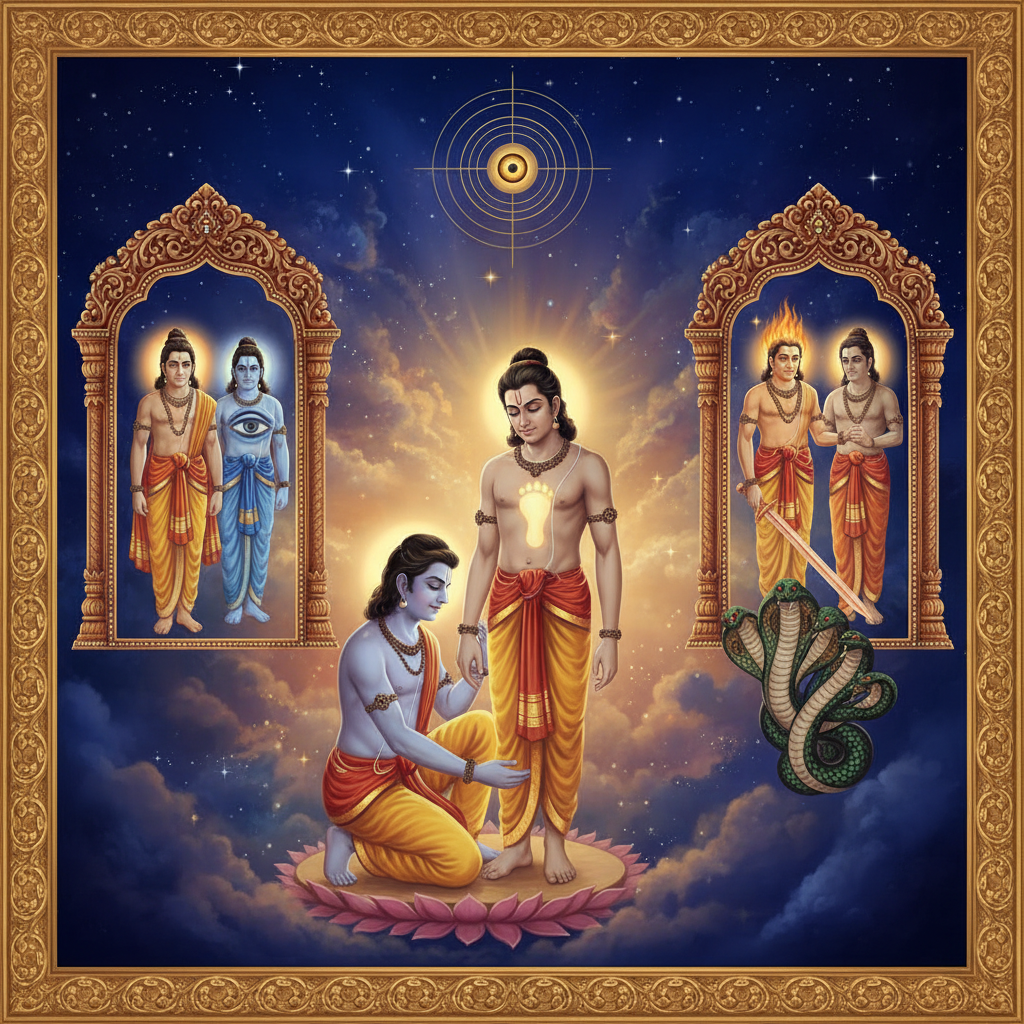
The arms are described as large enough that the whole world comes within them, which Swamiji handles by pointing at the sun. You see the sun as small and know that it is immense, and the two do not contradict each other. And on the chest, tiger’s nails as an ornament — the tiger and the lion are called hari, and when the lion roars all the other animals fall quiet, which makes the lion the symbol of the energy of truth. When truth roars, the voices of ignorance are blown away.
The Footprint, and What It Is For
Also on the chest is the footprint, and this is where the lesson lands.
The story Swamiji tells is old and, as he says himself, gross in the telling. When the laws of creation were still being prepared the question arose which God should be considered greatest, and Bhrigu took on the task of finding out. He behaved deliberately badly. He walked past Brahma abruptly, and Brahma reached for his kamandalu to curse him until Saraswati intervened. He went to Shiva, whose eyebrows began to work, until Parvati stopped him. Then he went to Vishnu, who — knowing already what was coming — pretended to be asleep. The gatekeepers told the sage the Lord was sleeping. He insisted, went in, and kicked Vishnu in the chest.
There is no worse insult available. And Vishnu woke, took the sage’s foot in his hands, and began to massage it, saying that the sage’s tender lotus feet had been injured by his own stony chest, and asking whether the sage would ever forgive him.
Swamiji’s comment is short: this is the ideal of greatness. Greatness is not in developing a big ego, but in absolute humility. In order to attain God-realisation one must develop divine qualities, and the greatest of them is natimanita, absolute humility. Then he closes the loop back to the description he has been working through for twenty minutes — that even while the baby is being described, the footprint is the detail being highlighted on his chest.
Brahman in Kausalya’s Lap
Doha 200 finishes the description and then does something else with it. The face shines with the beauty of countless cupids; two teeth have come in; the ears are beautiful because all prayers go to them and he picks up the smallest feeling anyone has; the voice is still stammering, because it takes time for children; the hair is soft; there are yellow garments, and arms long enough that the hands touch the knees as he crawls.
And then the closing doha states what has been true the whole time. He is the abode of happiness, beyond delusion, transcending intellectual knowledge, transcending words and senses, beyond speech and mind and thought. That is Brahman — all-pervading, taintless, beyond the three gunas, unborn. And that Brahman has been made captive by Kausalya’s love, and is crawling in front of her, looking up at her face, waiting to be appreciated.
Swamiji makes one clarification along the way that is worth carrying out of the lesson. The word lila is usually softened into “play”, and people then interpret it as God making sport of us, making us suffer for amusement. He rejects that reading flatly. God is not joking. Everything experienced has a divine plan, and the slightest occurrence in a life is not an accident, no matter how slight. Vigata vinoda — beyond sport. Which leaves the closing image standing without irony: the Absolute, beyond all description, held in a woman’s arms because she loved him. Such is the power of love.
Terms Used in This Lesson
- jnana : wisdom, direct knowledge of reality
- dhyana : meditation; the undistracted mind
- bhakti : devotion
- karma yoga : action performed as yoga, which purifies the mind
- shatru : enemy; here the six inner impurities
- kama, krodha, lobha, moha, mada, matsarya : desire, anger, greed, delusion, pride, jealousy
- syama : dark, the colour of the sky and of boundlessness
- sattva guna : the quality of purity, clarity and light
- kripa : grace, in its four forms of ishvara, atma, guru and shastra
- natimanita : absolute humility
- vajra, dhvaja, ankusha : thunderbolt, flag of victory, goad — the marks on Rama’s feet
- manipura chakra : the navel centre, seat of kriya shakti
- lila : divine play, which Swamiji insists is purposeful and never a joke
Questions to Sit With
- Of the four brothers — wisdom, meditation, devotion, purifying action — which is weakest in you right now, and which have you been treating as optional?
- Arjuna could see only the eye of the bird. What is still in your field of view when you sit to meditate?
- If the wish to seek at all is already atma kripa, what have you been waiting for that has in fact already arrived?
- Where in an ordinary day this week could an act of love be recognised as worship without changing anything about the act itself?
Provenance
Tulsi Ramayana (Sri Ramcharitmanas of Goswami Tulsidas), Balkanda, Doha 197 to Doha 200. Lecture 88 by Sri Swami Jyotirmayananda, Yoga Research Foundation.
The complete archive of Swamiji’s teachings is free to listen to at yogaresearchfoundation.org.
This study guide is drawn from the archived teachings of Sri Swami Jyotirmayananda.