
Two verses open this lecture, and both of them sound, at first hearing, like something a scripture should not say. One declares that a certain kind of person deserves to die. The other declares that a certain kind of person will never really die at all. Swami Jyotirmayananda spends the first six minutes making sure nobody mistakes either line for cruelty or for flattery, because the whole of sections 39 and 40 of the Upaśama Prakaraṇa rests on the distinction they draw.
The setting is the close of Lord Viṣṇu’s teaching to the devotee Prahlāda. Swamiji does not retell the narasiṃha story at length, but he does stop to unlock it: “Man movement is self-effort. Lion movement is grace” (at 2:34). The half-man, half-lion form is not a curiosity of mythology. It is a diagram. When self-effort and grace arrive together, something incarnates that neither could produce alone, and the devotee is carried to the success of his devotion.
From there the lecture turns to its real subject, which is what the words life and death actually refer to. The ordinary definition is stated plainly at 11:24: people in this world take life to be the perpetuation of the body, and death to be its relinquishment. Lord Viṣṇu tells Prahlāda that this is not the view of the enlightened. You are not the body, and therefore the questions of when you were born and when you will die do not arise about you.
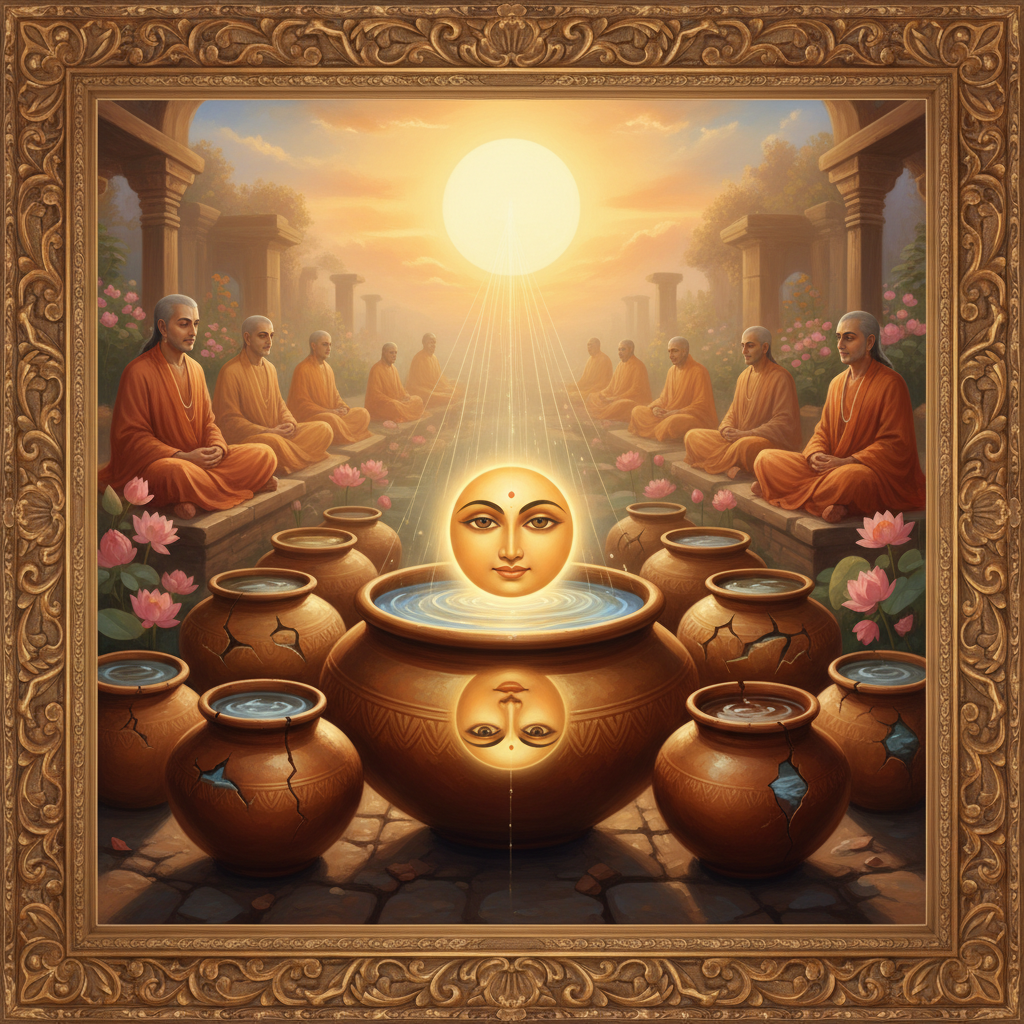
The image Swamiji uses to make that liveable, rather than merely true, is the one the lecture is remembered for: many pots of water, each holding a reflected sun. And the line that lands hardest arrives at 32:28, after fifty minutes of careful argument, with no machinery around it at all: “Your real I Am has never suffered.”
Passage index
| Timestamp | Passage |
| 0:00 | Cold open: the I Am that has never suffered |
| 1:29 | Upaśama Prakaraṇa, section 39 |
| 3:26 | Maraṇaṃ tasya rājate: whose death is a blessing |
| 6:03 | Dharma, artha, kāma and mokṣa as the purpose of life |
| 11:12 | Section 40: Lord Viṣṇu instructs Prahlāda |
| 12:26 | Reflected suns in many pots |
| 14:26 | The sky that nothing stains |
| 17:29 | The short dream and the long dream |
| 25:28 | Integral yoga: bringing the four into accord |
| 32:28 | Who am I? The I Am that is not faithful for a day |
| 38:36 | The seven steps of wisdom |
| 45:18 | Sañcita, kriyamāṇa and āgāmī karma |
The verse that says a person deserves to die
The first verse Swamiji quotes from the original is āśāpāśanibaddho ya itastataśca nīyate | yo vilolamanovṛttyā maraṇaṃ tasya rājate, at 3:41. He glosses it slowly. Those who are fettered by the ropes of desires and are driven back and forth by them: “pleasure, pain, prosperity, adversity.” And “good one day, bad another day, back and forth by the fickle whims of the mind” (4:18). For that person, he says, death is a blessing.
The reason is not punitive, and Swamiji closes the gap immediately: “Therefore, die means their death is for their evolution” (4:33). The alternative is worse. “And if you don’t die, it is a miserable thing. Your soul has no possibility to go through” (4:42). A soul locked permanently into one body and one set of conditions would have no further schooling available to it. Death, in this reading, is not the end of a life but the turning of a page, “just like body changing body, changing clothes” (4:52).
Notice what has quietly happened here. The verse appears to be about death, and it turns out to be about mobility. What is being called a blessing is not extinction but the removal of a limit. The person described in the verse is not being condemned for having desires; he is being described as stuck, dragged from one pole to the other by a mind that changes its own mind. If nothing can move him, then something has to move around him.
The verse that says a person will never die
The second verse, at 5:17, is its mirror: śuklapakṣasya śuddhasya haṃsaughasaraso yathā | yasmādguṇaugho niryāti jīvitaṃ tasya śobhate. Swamiji’s rendering is one of the most beautiful sentences in the lecture: “He who is like a placid lake, abounding with the swans of divine virtues” (5:30). For him, “there is no death; his life shines with divine glory” (5:43). And then, flatly: “The question of death does not arise; his life shines on.”
Two images sit inside that verse and both matter. The lake is placid, which is to say the surface is not being churned by the back-and-forth of the first verse. And the swans are many: virtues in the plural, arriving in a flock rather than one cultivated trait held up for inspection. What the verse measures is not achievement but overflow. Virtue is niryāti, going forth, radiating outward from someone who has stopped guarding the water.
Swamiji connects this to the purpose of life at 6:03, running through dharma as ethical value laid down as the foundation, artha as material value pursued on that basis, kāma as vital value expressed in genuine interaction and service (“Helping each other. Be good, do good.” at 7:06), and finally mokṣa, “the infinite value of life, liberation.” When that purpose is awake in the heart, he says, the mind stops interpreting how long it has left. “The ‘I’ in you has no limit” (7:45). Then, characteristically, he catches his own absolute and gives it back with a smile: “No limit? Yes, there is a limit: it’s infinity, that’s the limit.”
Reflected suns in many pots
Section 40 begins at 11:12, and its central teaching is delivered as an allegory that Swamiji builds carefully, “for easier understanding” (12:26). Think of many pots filled with water. Each one holds a reflected sun. That reflection is the jīva, the individual soul.
Everything then follows from what the reflection believes about its pot. If it takes the pot for its reality, its whole existence becomes maintenance: keep the water still, keep the vessel from cracking, avoid whatever might disturb either. Swamiji describes the resulting life at 30:56: in order to maintain your comfort you must avoid whatever might disturb the water, and guard against the breakage that may occur in the pot. “You have to be constantly concerned.” And beyond your own vessel there are all the other vessels to worry about, each with its own troubles.
The alternative is not to escape the pot but to recognize what is being reflected in it. “Reflected sun comes to realize I am the sun” (13:44). And because this is allegory rather than physics, Swamiji lets the reflection do what a reflection cannot: it raises its head out of the jar, and gives comfort to the other reflected suns, telling them “that you are not confined to the jar” (14:06). The realization does not end in private relief. It turns immediately outward and becomes teaching.
At 31:21 he draws the practical consequence in one stroke: “But when you gain, aham brahmāsmi, I am the sun.” Then possess that sun-like vision for a moment. “Where is the problem?” (31:32). And the answer, precisely stated: “Reflections are in a problematic state, but not the sun” (31:37).
The sky that nothing stains
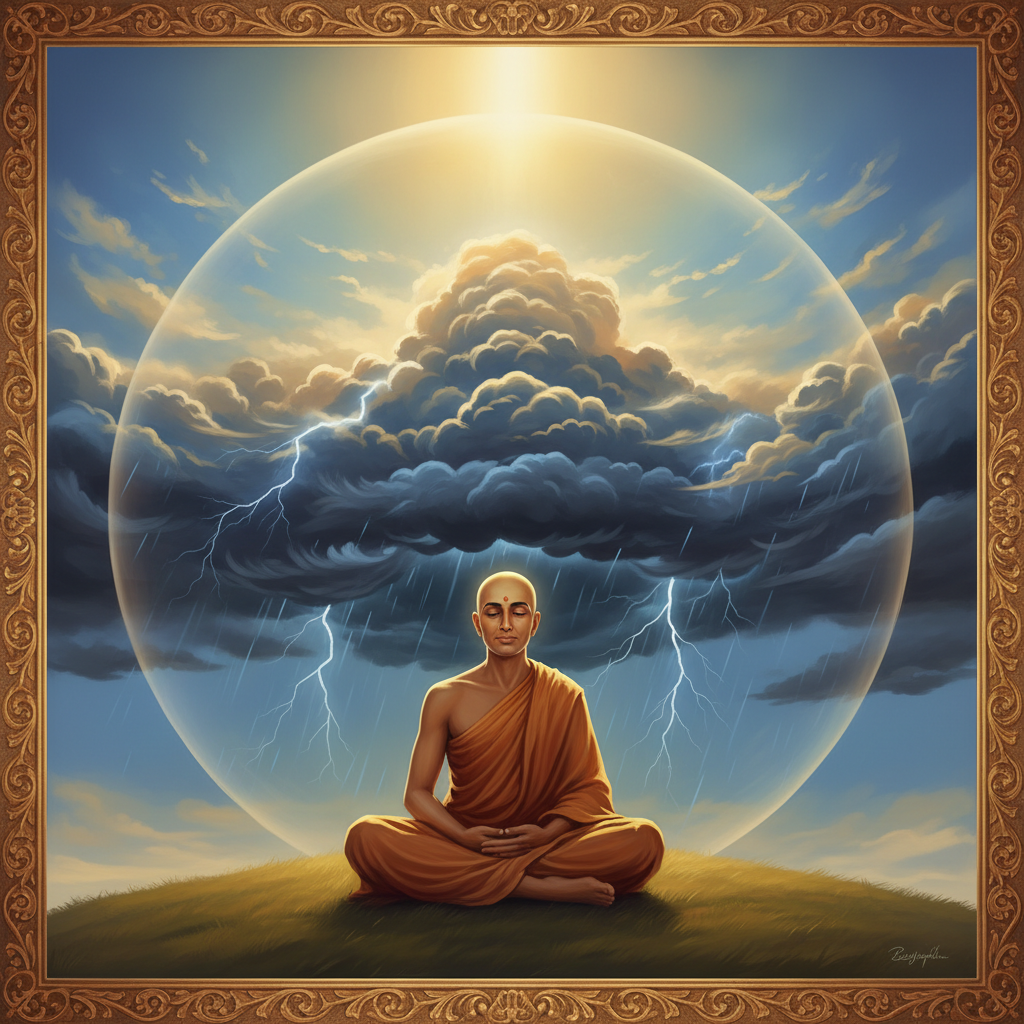
Alongside the pots runs a second image, gagana-sadṛśam, sky-like, the phrase the invocation itself uses of the sadguru. Space provides room for trees and objects to grow, “But in itself, remains detached and unaffected” (14:38). “All things happen in space. But the space remains untouched” (14:45).
Swamiji then gives it the version that makes it memorable: “All clouds move in the sky. They do lots of drama” (14:53). “The sky remains unscathed, untainted.” In exactly the same manner, he says, the Self gives space for the existence, growth and operation of the whole human personality, and remains completely untouched by any of it.
He tests the image against dream, which is the one place everyone has first-hand evidence. Your own consciousness gives space for an entire dream world, of a size you could not imagine it holding. Everything that happens in the dream happens inside that space, and behind all of it consciousness is the reality. Then the turn: “Waking consciousness is also like a dream” (16:58). Two dreams, therefore: “short dreams that you don’t worry about, you wake up from it.” And the long dream, a life lived in the world through repeated cycles of birth and death.
What he offers next is not the demand that you wake up on command. It is a middle position, available now. Even while dreaming, “A subtle sense develops, it is a dream” (18:42), and once it does, “the dream experience becomes a līlā” (18:49). You go through it. You climb the ladder or you fall off it, good dream or bad dream. “But you are watching it, which is smile” (19:11). This is the first stage, jīvanmukti: you keep the body, the mind and everything else, and from your side the world is a dream.
The news, and what the enlightened do about the world
Between the two great images sits the most contemporary passage in the lecture, and it earns its place. The sage is unaffected by the shifting conditions of the world, which raises the obvious objection: is that not indifference?
Swamiji answers by examining what our concern actually consists of. “Every day you are concerned with how things are happening” (22:18). “News go on breaking” (22:25), “but it also cracks your head” (22:28). Then the observation anyone can verify: “One news early in the morning can spoil your whole day” (22:42). Meanwhile the reality within five feet of you goes unexamined. “Human beings are always with problems. There isn’t a family that is not having shocking problems” (23:23). Your own locality could supply all the news you can absorb. “They don’t need to go anywhere else.” But the mind does not want that news; it wants the news from Alaska, far away, and handles it “as if that’s the world.” His verdict is severe and worth sitting with: “That type of attitude to help the world is not a real attitude at all” (24:13).
The positive instruction follows. If there are problems in the world, “It is His business, He created it” (24:32), and He is not in need of your anxiety on His behalf. “If at all you want to help, surrender to God. Be led by His will” (24:49), becoming an instrument, nimitta mātram. And then Swamiji forecloses the misreading before anyone can reach for it: this does not mean saying the world has all the problems, I have nothing to do with it, I will find a corner in the Himalayas and settle myself. “That’s not the meaning behind” (25:24). The meaning is to get involved with integral yoga.
Integral yoga: how discord becomes melody
The instruction at 25:33 is put as a question: “Bring harmony. How do you get out of discordant sounds?” By melody. Not by silencing the instruments, but by bringing them into accord.
The four are named and each is given its work: karma, action; emotion, which becomes devotion; will, which requires meditation; and understanding, the intellectual insights that become jñāna, wisdom. “They must be in accord” (26:23). As they come into accord, a progressive movement occurs in the personality, an experience of divine grace and of the inspiring presence of God, and this is what actually develops the divine virtues, the swans of the second verse. “With harmonious accord, you develop virtues” (27:14).
Disharmony is described just as concretely, and anyone who has done it will recognize it: “You want to say the best thing according to your own mind, but you use words that will hurt people terribly” (27:35). The intention and the effect come apart, because the four are not in accord.
Then a distinction that keeps this from tipping into body-denial. The Self is not destroyed when the body is destroyed and does not prosper when the body prospers, and yet: “But in the state of sādhana, your body, from a practical point of view, your body matters” (28:56). Maintain bodily health as a means to spiritual advance. Deho devālayaḥ proktaḥ, the body is called a temple, and worship begins there.
Who am I? The seven steps and the three karmas
The last third of the lecture is structural, and it answers the question the cold open raises. “Therefore, who am I?” (33:12), which Swamiji calls a profound question for spiritual inquiry.
His diagnosis of what stands in the way is rāga and dveṣa, attachment and its shadow. You attach to what you take for a source of happiness and recoil from what you take for a source of annoyance, but “your mind is not very settled. What you like in the morning by evening you may not like” (33:59). Impressions accumulate, karma carries the soul from one embodiment to another, and the effort continues in the wrong direction because the mind was never corrected: “Your concept of what is good for you is wrong, what is bad for you is also wrong” (34:57). Understanding that movement is what he calls vairāgya. What follows is not numbness but ease: even while engaged in daily activities, the sage “enjoys a peaceful state, similar to the state of profound sleep” (35:22), and it is that internal experience, not any external mark, that differentiates a sage from anyone else.
The seven steps of wisdom are then reiterated from 38:36: śubhecchā, where desire has matured into aspiration and stopped chasing mirages; vicāraṇā, working on the mind and clearing what distorts and refracts understanding; tanumānasā, where the mind that was full of garbage becomes thin; sattvāpatti, where light begins to enter the mental world, and from which, he notes, “you cannot go backward” (40:18); asaṃsakti, living in the world without sticking to it, hands oiled so that nothing adheres, “Karmas don’t stick to him” (41:47); padārthābhāvanā; and turīya, the transcendental state. His counsel about the ladder is as practical as the ladder is lofty: do not worry about when you will reach which step. Attain the fourth, and the rest matures on its own.
Karma is then sorted at 45:18 into sañcita, what has already accumulated; kriyamāṇa, what you are working out day by day; and āgāmī, what is coming. Prārabdha, the portion allotted to this body, he compares to the outline of a book: the contents written in a page or two, then developed across the whole volume. And prārabdha unfolds in three ways, svecchā, where you make a plan and it succeeds; parecchā, where the plan arrives from the people around you; and anicchā, where it arrives whether or not you want it, “Hurricanes come in, storms come in” (49:53).
For the unenlightened, fulfilment breeds fresh desire, so prārabdha exhausts itself while laying the foundation for future karma. “In the case of a sage, it is not so” (50:52). “Past karmas finished, future karmas will not be formed” (50:56). Only prārabdha runs its course, and then “leaves nothing behind” (51:07).
Which returns us to where the lecture began. The I Am you have been defending is not the one that was never touched. “Whenever you go to sleep, your ego I Am slips away along with your slippers” (0:20), and climbs back on when you wake. What was there before it left, and there while it was gone, has never suffered anything.
Yoga Vāsiṣṭha, Upaśama Prakaraṇa, sections 39 and 40. Lecture 181 by Swami Jyotirmayananda, senior-most living direct disciple of Swami Sivananda, Yoga Research Foundation. The complete archive of these lectures is free to all.
This study guide is drawn from the archived teachings of Sri Swami Jyotirmayananda.