

Sage Uddalaka is not yet realized when this section of the Yoga Vasistha finds him. That is the point of reading him. Swami Jyotirmayananda presents what follows as a sample of how inquiry is actually practiced by someone still on the way, and he is plain about its subject. The inquiry is not into the world, or into scripture, or into other people. It is into nobody else but yourself. This is lecture 193 of the Yoga Vasistha series, taken from Section 52 of the Upasama Prakarana. The lecture opens on the line that gives it its shape: “I have examined this body from head to foot. I have not found the ‘I’ anywhere in it.” Everything after it is an account of how a person could arrive at that sentence honestly, rather than repeat it. The lecture turns on one distinction. The mind can hold ideas about the Self, some of them exalted, but the Self is not an idea and cannot be held by the mind at all. Swamiji makes the point with the sun reflected in a jar of water, an elephant that will not fit into a small hole, a cinema screen that never moves, and a cloud that hovers over a mountain and claims to be the mountain. It lands somewhere practical. The ego does not vanish on the spiritual path. It is purified, level by level, until it is transparent, and in daily life that transparency looks like humility. The final image is a warning about what makes the ego swell, and a short program for keeping it from doing so.
Passages
- 00:00 I Have Not Found the I Anywhere in It
- 02:13 Section 52: Uddalaka Begins His Inquiry
- 03:33 The Sun Reflected in a Jar of Water
- 05:08 Vichara Is Not Stressful Thinking
- 08:33 An Elephant Cannot Fit in a Small Hole
- 11:17 The Ego That Can Never Be Pleased
- 13:53 The Dark Well of the World Process
- 23:07 Examining the Body From Head to Foot
- 32:10 The Screen Behind Every Projection
- 35:53 The Fawn and the Thief of Wisdom
- 39:30 A Passing Cloud Over the Mountain
- 47:23 The Transparent Ego and Humility
The Sun in a Jar of Water
Before the text itself, Swamiji gives one image to hold the whole lecture. “Countless souls in the realm of illusion are like reflected suns in so many jars of water.” The personality is the jar. The mind is the water inside it. The reflection in the water is what each of us takes ourselves to be. “It is the mind that brings you your identity.” Look into a mirror and what shows up is a reflected sun. That reflection is essentially the sun, because there is no other light for it to be made of. But it is not the sun in appearance, and compared with the sun it is nothing much. The image does a great deal of work later on. When the water is calm, the reflection looks steady and the soul feels wonderful. When the water is agitated, so is the reflection. When the water is muddy, there is no healthy revelation of who you are at all. A soul that takes its definition from the water will rise and fall with it forever.
Vichara Is Not Stressful Thinking
The word for the practice is vichara, translated as inquiry. Swamiji’s first correction is to what people usually mean by thinking. When a problem arrives, you sit down and think hard about how to resolve it. “That thinking hard is not vicāra.” That kind of thinking lives in the realm of ignorance. It is supported by ignorance, and it strengthens it. “Real vicāra, firstly, becomes possible as you promote calmness in your mind.” The mind needs a meditative atmosphere, and a practitioner skilled in concentration and meditation already has one. Within that calm there are two possibilities. The mind can go on meditating and pass into superconsciousness, or it can capture a profound understanding. In practice, Swamiji says, the second happens spontaneously. Two impurities have to be kept from dominating. Mala is gross impurity. Vikshepa is the restlessness of a mind shaking and turning in many directions. Where neither rules, what becomes highlighted is a keen interest in one question: who am I? He does not ask for perfection first. However limited your mind may be, and however imperfect your inquiry, you should not be discouraged. You start introducing these words into your mind. “And when the mind begins to taste it, it wants to move away from distractions and go after that taste.”
Why the Mind Cannot Hold the Self
Then the text. “Just as an elephant cannot be confined in a small hole, in the same way, I, who am the pure Self, cannot be confined in the limited confines of the mind.” Swamiji draws the consequence directly. The entire mind cannot capture who you are. Whatever the mind captures becomes worldly knowledge, worldly feeling and worldly involvement. It can imagine great things, including great things about liberation. “The mind can imagine great things, but imagination—capturing the imagination is just capturing the sky in water, and it is not a complete capture.” So liberation cannot be fully comprehended within the mind, because it transcends the mind. The way vichara becomes effective is manonasha, the dissolution of the mind, which he describes here in gentle terms. The mind moves away from its habit of likes and dislikes and develops a mystical hobby of calmness and stillness. In that stillness the real understanding of who you are can progress. “Until then, your mind is dealing with a fictitious ‘I’.” However wonderful it makes you look or feel, your real I am is not involved. The ego that is being pleased has two legs, raga and dvesha, attachment and hatred, and the more it is pleased the tighter its grip. It cannot be pleased for long, and one pleasure follows another. Swamiji’s advice is to remember that you are its master, and then to go higher still and see that it does not exist at all. You alone are, and somehow you fell into a little dream.
The Dark Well and What Lives in It
Uddalaka now addresses his own mind. “It is indeed regrettable, O mind, that you have taken your abode in the dark well of the world-process” abounding with snakes, scorpions and evil spirits in the form of anger, greed, passion and other impurities. Therefore, he says, I am bent upon abandoning you. Swamiji reads it as a dramatization of the jar. Picture the real sun speaking to the little pot of water and asking what it has done, sinking the sun into this water. “The Sun is ever free; the reflected sun is ever in a state of agitation.” The complaint is the reflection’s, and the freedom is the sun’s. Each creature in the well is a kind of thought. The snakes are worrisome ideas that enter through the cracks. “They look so cozy and comfortable as they glide in, but they are so venomous.” The scorpions are the thoughts that are terrible from beginning to end, with a sting to match. The evil spirits, pishachas, are the devilish possession of anger, hate, greed and passion. Without the protection of satsanga and sadhana, the world keeps impacting the mind and more of these creatures sneak in. Seeing both sides at once, that you are the sun and that the reflection is suffering in the water, is where vichara begins. The verse goes further. The mind has given rise to the deluded notion that this perishable body is the Self, and so has become the basis for the ego sense. Every notion and every emotion is part of the mind, and the mind supports this one too. “This ego sense is considered as a reality only by those who are immature in their understanding.” The wise consider it an illusory appearance. His illustration is a mother entertaining a small child. She sets a dish of water in the open, the sun reflects in it, and she tells the child she has brought down the sun. The child is delighted and sees no problem at all. Growing up means seeing that whatever the mind brings is not the real one, while recognising that it still points toward the highest.
Examining the Body From Head to Foot
Here the opening line returns, and Swamiji turns it into a practice anyone can begin tonight. Start with your toes. Suppose the toe is injured by a small knock and you say, I am injured. Then ask whether you are in the toe, and whether you are the toe. “You are not the toe. You are using the toe like a new instrument.” Go the same way through the whole body, from the toes to the head. Nowhere will you find yourself. You are using the body the way a person uses a cloth. Which leaves the question the verse is built to leave: then who are you, and where are you? The answer the text gives is that the real I am is the essence behind the three worlds. The sun illuminates the earth; allegorically, the real I am is the Sun of the sun, the Light of lights, unconditioned by time, space and causation. That I am has to be brought into vision, instead of holding on to a limited little I and letting the mind fill with scorpions, snakes and demonic impurities. He plays on the word turmoil. Instead of all that turmoil, have a holy oil. The sacred oil is added by a particular kind of thinking. “By this type of thinking: ‘I am the embodiment of pure consciousness.'” Turn to awareness. “Awareness is the basis of all your experiences.” Awareness is like a vast, calm ocean, and all experiences are reflections in it, telling boundless stories about themselves while the ocean has nothing to do with them. He is careful here. This is not my consciousness or their consciousness. It is the consciousness, and multiplicity is a reflection within it. “Aham brahmāsmi—when you discover, ‘I am Brahman.'” That Brahman is the reality behind the entire universe in every detail.
The Witness and the Screen
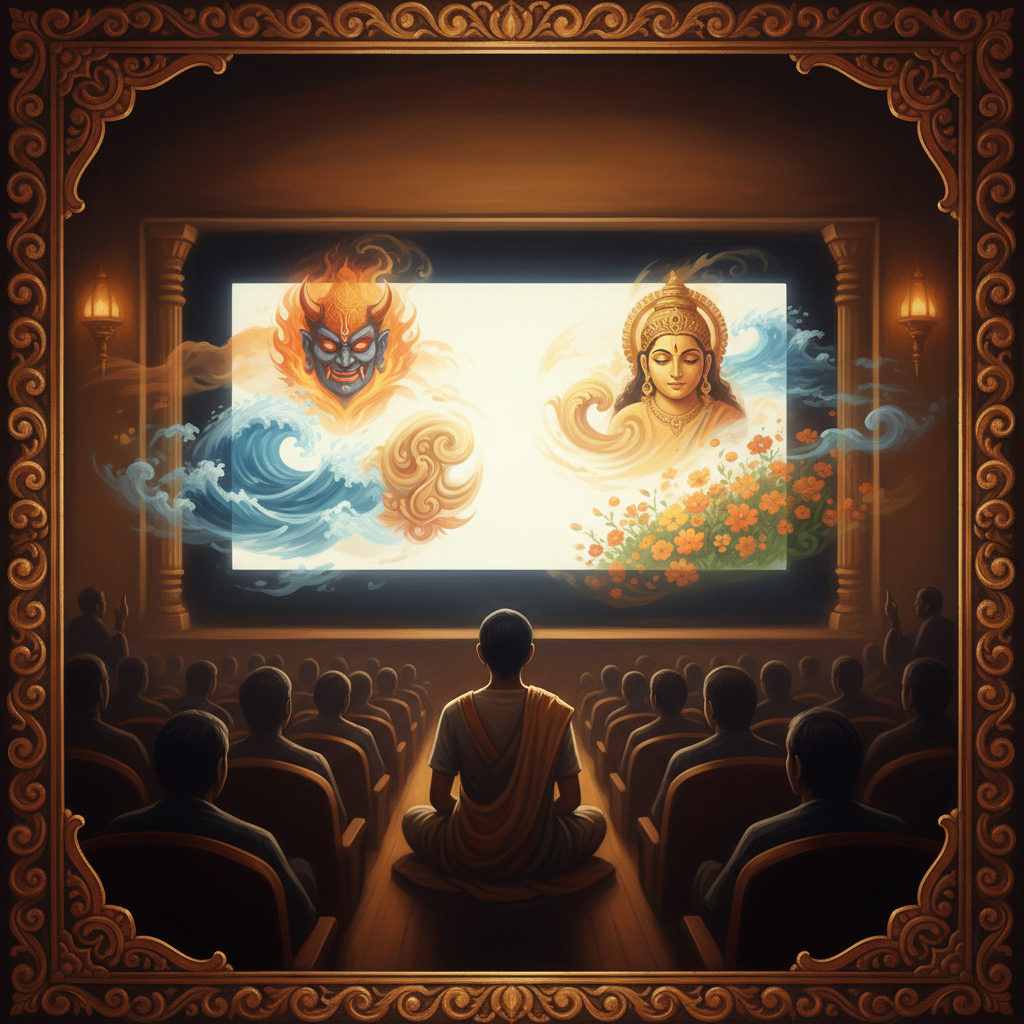
The text’s next line names the stance. “I am a mere witness to the illusory presence of the drifting mind.” The I am goes on playing its role through the conditioned mind and ego, but it is a witness. You can remember how things were in childhood, how egoistic you once were, how you became humbler. There is a play. Watch over all of it and stay aloof. “From the state of bondage to the state of mokṣa, the entire story is the realm of māyā.” Even the story of bondage and release is told by the mind. Swamiji brings it home with a tablet computer. With one finger you can call up the stars, geology, physics and chemistry, one folder within another, and set it aside when you are done. The whole universe of knowledge arrives through a small device, a brain and a nervous system, and a conditioned mind operating them. Even the idea of your embodiment is one more folder. “Space and time are being experienced by your mind.” The text then gives the mind two aspects. The vibratory aspect belongs to prana. The knowledge aspect belongs to the Self. The cinema makes it simple. Everything on the screen is a projection, and the projection process is mental. Projections are constantly changing and require energy that vibrates, resonates and pulsates. The screen does not pulsate and is not part of the story it carries. “Screen alone is underlying all projected stories.” Every face, demonic or divine, every ugly thing and every good thing, has nothing behind it but the screen. In devotional language: behind every name and form, God alone. He gives the classical terms. Bhava pratyaya is the presence of projection, the world experienced as it is projected. Pratyaya abhava is the absence of projection, when the film is over and the projection itself is negated. Both movements start through the mind, the movement into involvement and the movement toward awakening.
The Fawn, the Thief and the Cloud
The text now turns to three images in quick succession. The first is a fawn. So long, Uddalaka says, I have been overpowered by the cunning of ignorance, tortured the way a fawn is kept in fright by a ferocious beast in the forest. Swamiji lingers on the fawn: a baby deer, childlike, lending grace and beauty to the whole forest. That is the soul in itself. Ignorance is what spoils the scene. The second is a thief. “Now fortunately I have discovered the thief.” It had stolen the precious treasure of wisdom. “That thief is a mind.” The same mind that raises problems and then scolds you to find the solutions. Swamiji puts it pointedly: you are trying to get all your relief through a thief. The resolution in the text is that this thief will no longer be welcomed. The third is a cloud hovering over a mountain summit, which does not belong to the mountain. “In the same way, the mind does not belong to me.” The real I am is the mountain. Egoism is the cloud that asserts, by hovering over it, that it is the mountain. People sometimes look at the cloud and not at the mountain, but the mountain is the reality behind it. “So ego is a drifting cloud. Your real I am is a mountain.” Moving from the unreal I to the real I is moving from shaky, unstable status to immutable status. “With ego, you are mutable, shaky, constantly changing.” With enlightenment you are the mountain of mountains, unshaken. The text adds that the Self abides in the body and is all-pervasive, eternal and non-dual. Swamiji explains the apparent contradiction. At one level you start looking for the Self through the body, mind and intellect, the way you might first find the sun in the pot. At another level the Self is everywhere and the body does not exist. “Since the ego is unreal, all relationships sustained by it are also illusory.” A stone and an iron nail may lie in contact without ever blending, and in the same way the body, senses, mind and consciousness seem to touch while being completely distinct. The ego says this belongs to me and that belongs to someone else. In reality the Self alone is. “When the knowledge of the self rises in the firmament of one’s heart, the mist of delusion disappears.”
The Transparent Ego and Humility
Uddalaka’s aspiration is a state in which the ego sense is forgotten forever. Swamiji gives it an ordinary reference point. After deep sleep there is a short moment on waking when you are looking for your ego, and then it jumps back in, and the whole tablet opens again with memories of past, present and future. Let that ego go away forever, he says, because whatever it brings is illusion. Fulfillment is not in the realm of ego but in its effacement. That, he says, is the meaning behind namah in the mantras, which he glosses as neither me nor mine, and behind sharanagati, surrender to God. Then he raises the difficulty every sincere seeker eventually meets. “How will you know you are moving away from ego? Whoever is telling you are moving away is ego.” His answer is that ego plays its role at three levels, sattvika, rajasika and tamasika. As the tamasic and rajasic are sublimated, controlled and transcended, the ego grows purer, and a purer ego brings out the reality of I am. You will still have an ego, but a transparent one. “So transparent that ego itself has no identity.” “In practical world, it will express in the form of humility.” The more you know and the more you blossom, the more profound the humility. There is no need to announce what you have done, and no need for anyone’s appreciation or recognition. The ego flourishes through identification with the body and its relationships, and Swamiji notices exactly where it wakes up. “If you simply say this is me, ego is quiet.” It becomes active when the mind extends itself: that person I love better than myself, those foods without which I will not be happy. The whole world of value, positive or negative, relates back to that I am. “Ego builds up multiplicity.” It creates a whole world of dreams, and behind the entire dream is your real nature. “You wake up from the dream of the world.” And you are not on your bed but in Brahman, the Absolute. The section closes on one more cloud. When the cloud of ego swells with the waters of impure vasanas and rains on the fields of the heart, the tree of the body is decked with blossoms of defects and diseases. The body meant here is threefold, physical, subtle and causal, and it holds virtues and vices alike. “Moral is don’t let the cloud of ego swell.” The program Swamiji ends with is short. Control the mind. Work on purifying the vasanas. Allow the intellect to become intuitional. Those three answer the three levels of obstacle, mala, vikshepa and avarana, and with that the lecture concludes.
Terms
- vichara — inquiry into the nature of the Self; possible only in a calm mind, and distinct from anxious thinking about problems.
- mala — gross impurity of the mind, the first of the three obstacles.
- vikshepa — restlessness; a mind shaking and turning in many directions.
- avarana — the veil of ignorance, the third obstacle, removed as the intellect becomes intuitional.
- manonasha — the dissolution of the mind; here, the mind turning from likes and dislikes to stillness.
- raga dvesha — attachment and hatred, the two legs on which the ego grips.
- pishacha — an evil spirit; in the text, the possession of the mind by anger, greed and passion.
- aham brahmasmi — I am Brahman; the discovery that the real I am is the reality behind the universe.
- bhava pratyaya — the presence of projection; the world as it is experienced through the mind.
- pratyaya abhava — the absence of projection, when the film ends and projection is negated.
- sharanagati — surrender to God, one of the names for the effacement of ego.
- sattvika rajasika tamasika — the three levels at which the ego plays its role, from purest to densest.
- vasana — a subtle desire in the unconscious; impure vasanas are what make the cloud of ego swell.
Three Questions
- When a pain or an insult arrives and you say, I am hurt, where exactly do you locate the one who is hurt, and does it survive the question Swamiji asks of the toe?
- Which of your thoughts glide in cozy and comfortable, and only later show themselves to be venomous?
- Where does your ego wake up most readily in your relationships, and what would a more transparent version of it look like in a single ordinary day?
Yoga Vasistha, Upasama Prakarana, Section 52. Lecture 193 by Swami Jyotirmayananda, Yoga Research Foundation. The complete archive of Swami Jyotirmayananda’s teachings is free.
This study guide is drawn from the archived teachings of Sri Swami Jyotirmayananda.