
Nothing large happens in this lecture. A girl wanders ahead of her companions into a garden, sees two princes, and runs back to tell her friend. Sita goes to look. Rama, picking flowers for his teacher’s worship, hears her bangles before he sees her, and when he does see her, his eyes stop blinking. That is the whole of the storyline across these verses of the Balakanda, from verse 228 onward. Swami Jyotirmayananda reads it on two levels at once, and asks the listener to keep both in view: the story, which is entertaining to the heart and the mind, and the mystical meaning beneath it. The mystical meaning turns on one distinction. Everything the mind knows, it knows through vrittis, thought waves, one after another, like the frames of a film. Between two frames there is only the screen. Between two thought waves, Swamiji says, there is the Reality, and it has never gone anywhere. The lecture reaches that point twice: once early, almost in passing, and once late, through the old story of King Nimi, who gave up his body and chose to live in human eyelids instead. Around that distinction the lecture gathers the teaching it needs. The friend in the garden cannot describe what she saw, because the eyes that saw have no tongue and the tongue that speaks has no eyes. Narada’s old prophecy becomes the voice of satsanga. Madana, the god of desire, turns out to mean the one who intoxicates the mind, and the love of God turns out to be the one love that does not. Sita becomes the beauty behind all that is beautiful, and then the lamp without which a palace full of jewels cannot even be seen. It lands on a soldier’s word. Rama tells Lakshmana that his line, the Raghu race, never runs from the field of battle, and Swamiji names the field. The battlefield is sadhana, and there are two ways to desert it.
Passages
- 00:00 Eyes That See Have No Tongue
- 01:47 Balakanda, Verse 228: The Friend in the Garden
- 04:02 Rama, Lakshmana and Viveka Buddhi
- 06:17 The Screen Between the Thought Waves
- 11:00 Speech Has No Eyes, Eyes Have No Speech
- 18:39 Love That Is Older Than Time
- 20:35 Narada’s Words: What Satsanga Has Foretold
- 23:08 Madana, the Intoxicator of the Mind
- 31:13 King Nimi Dwells in the Eyelids
- 37:30 The Beauty Behind All That Is Beautiful
- 41:01 A Palace of Beauty With No Lamp
- 49:10 The Hero Who Never Runs From Battle
The Garden as a Mystical Setting
Rama and Lakshmana have gone into King Janaka’s gardens to collect flowers. Sita, at the same hour, is on her way to the temple of the goddess Girija, who is Uma and Parvati, to receive blessings. One of her friends leaves the company and goes ahead to look at the orchard, sees the two brothers, and is completely overpowered. Before he goes further into the scene, Swamiji gives its key. “Rāma is the soul within you.” Lakshmana is the meditative movement, the willpower that allows the soul to discover its glory and be awakened to its essential nature. And Sita is viveka buddhi, the intuitive intellect. The two brothers have come to the stage of having a glimpse of her, and of becoming related to her. Then he shows how the poet handles the meeting. Each sees the other through a garden crowded with flowers, and the flowers stop mattering. “So, when Sītā looks at Rāma, she looks through many beautiful flowers. But those beautiful flowers move away from her mind. Rāma becomes the ultimate flower.” Rama, looking through the same flowers and decorations, sees Sita shine before him while everything else moves away. Love at its climax, Swamiji says, and the sign of it is small. Even their eyes do not wink.
The Screen Between the Thought Waves
That small sign is where the mystical reading begins, long before the lecture gets to Nimi. When the soul has a glimpse of viveka buddhi, it has a glimpse of what lies behind the thought waves of the mind. “Thought waves of your mind are represented by your winking of the eyes.” He uses the cinema to make the point. In between the frames of pictures projected on the screen, there is the screen. In between the thought waves of your mind, there is the Reality. “The Reality, God, is never gone from you. You don’t have to go far and wide to have darśana.” So the instruction is to dive into the space between thought waves, and Swamiji is careful about how. It is an art, and it has to be learned. All the sadhana of integral yoga is meant to bring the mind to that stillness, where it no longer moves on the basis of vrittis. A mind that moves on vrittis is always thinking of the past or the future. It has no stability, because the world it experiences is built from thought waves. That world, he says, enables the soul to evolve. It is a world of maya, and it is not a reality.
The Friend Who Could Not Describe What She Saw
The friend comes back to give the news, and the news is not simple news. When you carry joyous news like that, Swamiji says, your whole body flutters. He draws a plain message from it. All the joyous situations a person meets in the world are as nothing beside one particular joy. “They are nothing compared to the mind being sensitive to allow viveka-buddhi to blossom, to express.” All the lights you enjoy during the night are as nothing once the sun begins to rise. Then the friend tries to describe the princes, and the verse gives her the riddle Swamiji opens the class with. Two princes have come into the garden, youthful and extremely handsome, one dark and bluish, one fair like jasmine. How can she describe them? The one who saw has no tongue, and the one who is speaking has no sight. The tongue that speaks has no eyes. “And eyes that see have no tongue in them.” Swamiji takes this as a statement about every human description of anything. What the eyes bring, the tongue tries to interpret, and the result depends on vocabulary, on the tongue, and on the mood of the mind. “What you see is another thing. What you speak is modified.” That is the limitation of the human concept of describing something, and he widens it into a limitation of human reality. “Things that are considered real, they’re not really as real as you think.”
Janakapuri and the Love Older Than Time
A second friend has already heard about the princes. These, she says, are the two who came with Sage Vishvamitra, and their form is so enchanting that every man and woman of Janakapuri has been charmed by it. Swamiji pauses on the city. Philosophically, Janakapuri is the aspect of your unconscious filled with shubha vasanas, divine impressions, and it is in that atmosphere that viveka buddhi rises. The whole setting becomes fascinated by Rama, because the whole of creation has been presented for one purpose: to bring the soul close to viveka buddhi. Sita hears the news and her eyes grow restless to see. The friend who saw Rama leads, and Sita and the others follow. Tulsidas adds a phrase that Swamiji stops on: no one else could see the ancient love that had awakened in Sita’s heart. He explains what ancient means here. “Old means timeless.” It points to a time before time was born. The Puranas are called ancient scriptures for the same reason. “Purāṇa is old. But that old has nothing to do with time.” It refers to the teaching that reveals the truth, and the truth is the most ancient thing there is.
What Satsanga Has Already Told You
Sita remembers the words of the sage Narada, who had foretold that she would marry a divine incarnation. The mystical meaning is direct. Narada represents satsanga. The intuitive knowledge that lies potential within you is awakened by satsanga, and what satsanga tells you is that you already have within you a type of understanding that will lead to liberation. “So you have been already foretold. Nothing new is going to happen.” The prophecy is not news from outside. It is a description of what was always there.
Madana, the Intoxicator of the Mind
The scene turns to Rama. He hears the sound of Sita’s bangles, the small bells at her wrists and ankles and waist, before he sees her face. He tells Lakshmana that it sounds as if Kama, the god of desire, has taken a resolve to conquer the entire universe and is beating his drum in those bangles and trinkets. Swamiji reads the sound as a description of viveka buddhi, who arrives decked with divine virtues. Even before those virtues have entered your personality, even from a distance, they have an amazing effect on it, like a sound that foretells a miraculous future. Then he stops on the name of the god. “The literal meaning of Madana is ‘that which intoxicates your mind.'” Follow that intoxication without culture or direction and you lose your rationality, and the mind goes restlessly after things without aim or purpose. That is a waste of mental energy. Living in the world, he says, you need to control Madana and allow your reason to work. People sometimes conclude from this that spirituality has no love in it. Swamiji’s answer is the reverse. Love of a worldly object, outside the path of dharma, intoxicates the mind and leads it astray. “And therefore there will be no intoxication in your mind if you love God.” Love of intuitional knowledge does not intoxicate. It is the Madana in which the intoxication is negated, and he points to the story of Shiva, who marries Parvati only after destroying Kama.
King Nimi Dwells in the Eyelids
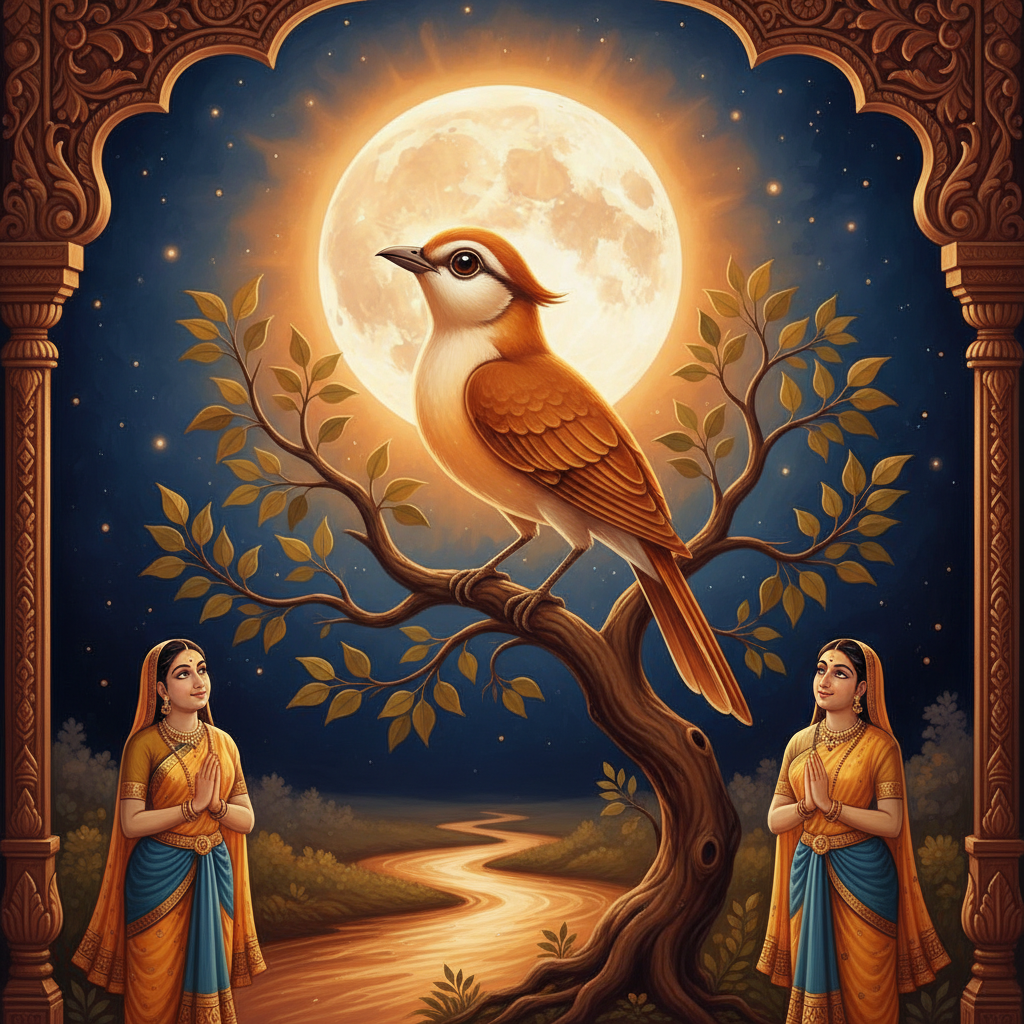
Rama turns his eyes back to Sita, and her face appears like a full moon without blemishes. His eyes become still, like the chakora bird, which sees the moon and cannot move. Then Swamiji promises a poetic simile with a philosophical insight inside it. There was a great king named Nimi, an ancestor of King Janaka and so of Sita. Through austerity, sadhana and sacrifice he became bodiless. The people loved him so much that even the gods wanted him to return to his body, and he refused, with a better offer. “He said I will not get back to my body, but I can do better. I’ll get back to their eyes.” “Nimi is the deity of human eyes.” From his name comes nimesh, the moment between a wink and the opening of the eye. Every blink, by this story, is possible because Nimi is sitting there. And the blink stands for the thought wave. If Nimi abides in the eyelids, then between the thought waves there is God’s vision, exactly as between two frames projected on the screen there is nothing but the screen. Swamiji presses the cinema image further. A film is interesting only because your eyes cannot detect the changes between frames. With enough subtlety to see between the thought waves, the whole show would have no reality, and only the screen would shine. And it is not only the film that is fragmented. You may say you looked at someone for an hour, and you would be wrong, because your eyes were blinking. “What you saw was a fragmented vision, not a real vision.” “Your eyes fragmented your vision a thousand times.” Philosophically, all human experience through mind, intellect and senses rests on vrittis. Where the thought waves subside is the knowledge of the Self, atmajnana. Raja Yoga calls world experience bhava pratyaya, the life of the mind involved with its vrittis, and the whole story of a soul from life to life is built from it. Liberation is where the vrittis are rolled out, and the experience based on them becomes extinct. And the storyline puts it with a smile. When Rama and Sita were gazing at each other, Nimi, Sita’s ancestor, did not want to stay. A great grandfather does not read over the shoulder of a young woman in love. Out of courtesy and shyness he moved away, and the eyes simply went on looking, without blinking.
The Beauty Behind All That Is Beautiful
Rama sees Sita’s beauty, is deeply delighted, and cannot bring his admiration into words. Swamiji describes that beauty as the culmination of all the artistry of Brahma, the creator. Everything Brahma has fashioned, mind, intellect, senses, feelings, understanding, reaches its climax in one thing, the intuitive intellect. “Once you have developed that, you are no longer trapped by creation.” If the mind turns toward even a touch of it, the whole world and all its glory are understood to be a straw, alpam, a small thing. The verse says Sita’s beauty has made the beautiful things beautiful. Swamiji turns that into a test of how a person admires. A really healthy admirer of beauty finds that every perception of beauty turns the mind toward its Source, which is God. “Because it is that Source that has given beauty its beauty.” Sita is that Source, viveka buddhi is that Source, and when viveka buddhi develops you see the beauty of God in all things, a beauty that does not drag the mind into attachment. “In other words, Sītā is the beauty behind all that is beautiful.”
A Palace of Beauty With No Lamp
A second simile follows. In a palace of beauty, Sita is the flame of light. Imagine a whole palace decked with ornaments and pearls and crystals, and no light in it. How could anyone enjoy the palace? “In other words, you have everything, but you don’t have viveka-buddhi.” Then you remain deluded, driven by karma from body to body, and Swamiji calls that a miserable predicament however wonderful the present life may have been, if it has not paved the way to liberation. Nothing in the world can be compared to that beauty, the poet says, and Swamiji agrees with a little humor. People are invited to so many fascinating experiences, a wonderful dinner, a rasgulla. A mind that has become spiritually sensitive finds them less fascinating than they look, a pushing of the nervous system from one place to another. He is careful not to dismiss them. To many people these experiences are necessary and important for their evolution. But ultimately all of it must move away, viveka buddhi has to be attained, and he warns against settling for a likeness of it. Rama, having praised her, looks at his own fluttering heart and decides to talk about something else. He tells Lakshmana that she is the daughter of King Janaka, and that the bow sacrifice was held for her sake. Swamiji calls it simple psychology. He recalls what the bow means: the pull of the world process, which holds the soul down as long as there are desires for objects, the way gravity holds anything on the earth until it reaches outer space. Whoever breaks that pull marries Sita. “Rāma is one, and this one is the Absolute.”
The Hero Who Never Runs From Battle
Rama explains that this love is not ordinary love. The hearts of his line do not go after anything immoral, and even in a dream his mind does not turn to another man’s wife. Swamiji gives the word nari a deeper reading here. It refers to consciousness conditioned by three illusions, the seer, the seen and the sight, as in a dream where the dreamer, the dream world and the pleasures and pains are all unreal. That triad is not the Self, and Rama’s mind does not go after it. Then the line that gives the lecture its close. I am of that Raghu race, Rama says, who never run away from enemies. “And the battlefield means sādhana.” A mature understanding never runs away, however the situation develops, and Swamiji names the two ways a person deserts. If prosperity makes you vain and too relaxed, sure you have attained what you wanted, you have run from the battle. If adversity makes you desolate, sure that everything you did was in vain and that the God you worked for does not exist, you have run from it too. “No matter what the situation is, you are always connected with God; you are a ray of God.” Such heroes are few, Tulsidas says, and Swamiji will not let that discourage anyone. In any university the students who come first are few, and that does not make the university bad. The rare few are the competition. “Follow the example of sages and saints; awaken saintliness.” The last verse goes back to the garden. Rama is chatting with his brother, and all the while he is absorbed in Sita’s presence. “And His mind has become like a bee, and Sītā has become a blossom.”
Terms
- viveka buddhi — intuitive intellect, the discriminating understanding that leads to liberation; Sita in the allegory.
- vritti — a thought wave; the unit of all experience through mind, intellect and senses.
- nimesh — the moment between a blink and the opening of the eye, named for King Nimi.
- darshana — the sight or vision of the Divine.
- sadhana — spiritual practice; in this lecture, the battlefield the hero never leaves.
- maya — the world as experienced through thought waves, which helps the soul evolve and is not the reality.
- shubha vasana — a pure or divine impression in the unconscious; Janakapuri is the field of them.
- satsanga — the company of truth; represented by the sage Narada and his prophecy.
- Madana — a name of Kama, the god of desire, meaning that which intoxicates the mind.
- atmajnana — knowledge of the Self, where the thought waves subside.
- bhava pratyaya — Raja Yoga’s term for experience bound to the vrittis of the mind.
- alpam — small or trifling; how the world appears once intuitive intellect is touched.
- sakhi — a female companion; the friends of Sita who carry the news through the garden.
- dhanusha yajna — the bow sacrifice, in which whoever breaks Shiva’s bow marries Sita.
Three Questions
- When you last tried to tell someone about an experience that mattered to you, how much of it actually reached your words?
- Which kind of desertion do you find more tempting, the vanity that comes when practice is going well or the discouragement that comes when it is not?
- What beautiful thing in your ordinary day could serve as a reminder of its Source rather than as a pull toward attachment?
Tulsi Ramayana (Sri Ramcharitmanas of Goswami Tulsidas), Balakanda, from verse 228. Lecture 95 by Swami Jyotirmayananda, Yoga Research Foundation. The complete archive of Swami Jyotirmayananda’s teachings is free.
This study guide is drawn from the archived teachings of Sri Swami Jyotirmayananda.
This is very helpful. Thank you for the work. Om namah shivaya