
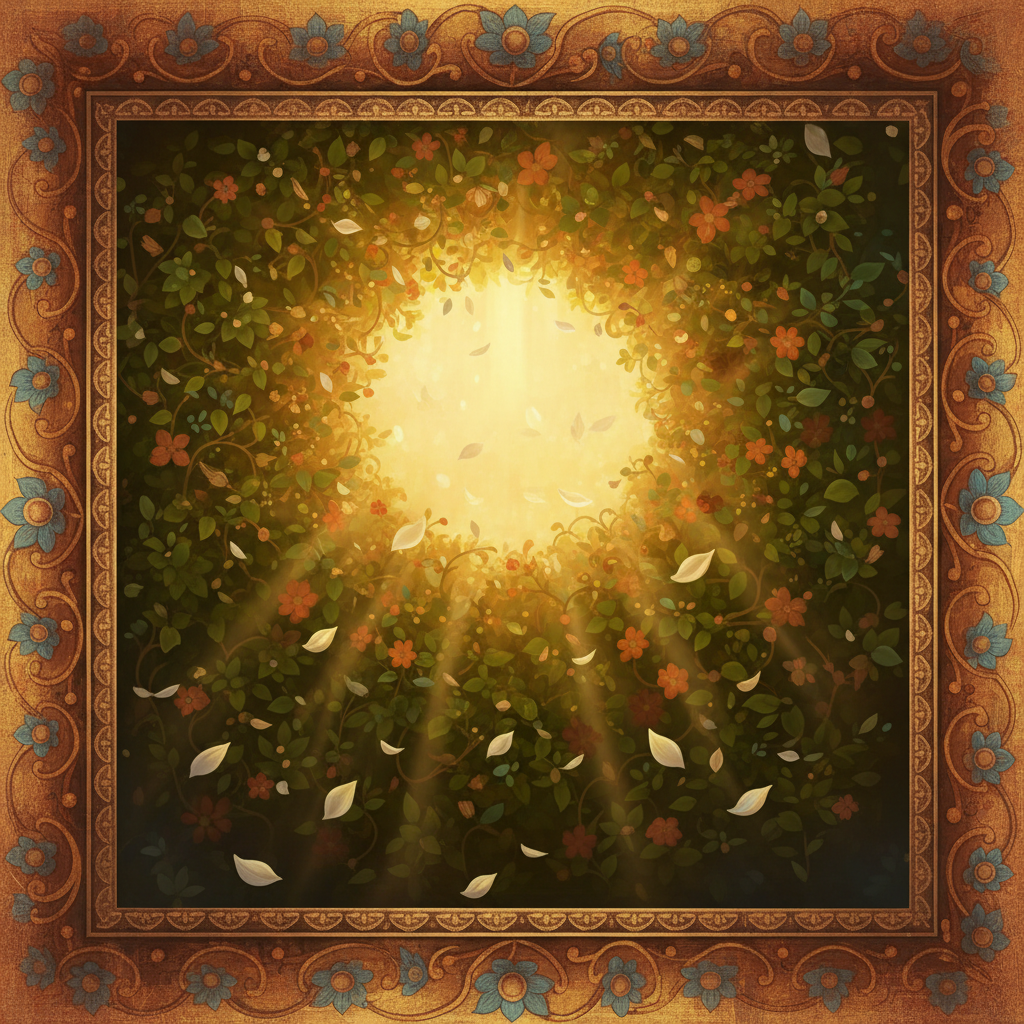
Rama has come into King Janaka’s garden to pick flowers for the worship of his teacher, Vishwamitra. Sita has come into the same garden on her way to worship Goddess Parvati. Between them stands a dense hedge of branches, creepers and blossoms, and through all of it, for the first time, they catch sight of each other. Tulsidas could have told this as a plain romance, and on the surface he does. Swamiji tells it too, with evident pleasure in the scene, and then stops on the ordinary phrase for what happens next. “They don’t fall in love, they rise in love.” That correction is the key to the whole lecture. Nothing in this garden is a descent. Every detail Tulsidas gives, from the direction of Sita’s glance to the drops of perspiration on Rama’s forehead, describes a soul moving upward toward its own nature. The allegory is the one that has run through these Balakanda lessons. Rama is the soul. Sita is viveka buddhi, intuitive understanding. The garden is a layer of the subconscious that has been purified, and the flowers are the pure impressions that have gathered there. When the two see each other, the soul has caught its first real glimpse of the understanding that can lead it home. From there the lecture moves through three movements. First, what that understanding does to the way the world looks. Second, a portrait of Rama and Lakshmana given feature by feature, in which every feature turns out to be a teaching. Third, the obstacle that still stands between this first glimpse and the marriage the story is moving toward, which is Shiva’s bow. If you want one thread to follow, follow the eyes: Sita’s eyes that rain lotuses, eyes that forget how to blink, lotus eyes that see without being caught, and Sita’s closed eyes, which her friend has to coax open.
Where each passage begins
- 00:00 Seen Through the Flowers
- 00:57 Invocation to Rama
- 01:32 Balakanda, Verse 231: The First Glimpse
- 03:26 The Soul Meets Viveka Buddhi
- 07:55 Wherever Understanding Casts Its Gaze
- 10:12 Sita’s Friends, the Pure Feelings
- 12:16 Forgetting How to Blink
- 19:03 Two Moons Emerge From the Clouds
- 26:43 Lotus Eyes and Detachment
- 33:25 Beyond Every Cupid: The Eternal Marriage
- 35:08 Bhuma and Alpa: Infinite Joy, Little Joys
- 46:14 Shiva’s Bow, the Pull of the World
The hedge between the soul and its understanding
Swamiji’s first question is a practical one. What makes the soul discover its essential nature, its Ramatva, the fact that it is the Absolute Self? His answer is a glimpse of viveka buddhi, intuitive knowledge. Not a doctrine and not an argument, but a glimpse. Between the soul and that glimpse there has always been a hedge. In the language of Vedanta it is mala and vikshepa: gross impurity, and the restless distraction of the mind. In the story the hedge is literal, a whole thicket of trees and creepers between Rama on one side and Sita on the other. But the situation has changed by this point in the Ramayana. Rama has already destroyed the demons who disturbed the sages’ worship, and Swamiji reads those demons as impurities. The soul has already won a certain qualification. It is free of the grossest of its obstacles, and so the hedge is no longer only an obstacle. Through it, the soul can see. And what is it looking through? Flowers. These are shubha vasanas, positive impressions that have gathered in the subconscious. Swamiji is careful about the proportion here. To the extent that change occurs in the subconscious, from gross to subtle and from impure to pure, to that extent a person experiences an inner joy that has no outer cause. That joy is a blend of two things: the soul discovering who it is, and the means of that discovery, intuitive intellect, coming into view. Soul and sanmati, good understanding, look at each other.
Wherever understanding casts its gaze
Rama disappears behind the hedge, and Sita looks everywhere for him. Her eyes are compared to the eyes of a young deer, and Tulsidas gives them a remarkable quality. Wherever she turns her gaze, rows of snowy white lotuses seem to rain down. Swamiji asks the listener to figure out what that means, and then helps. Sita is good understanding, and “Good understanding is allegorically speaking, not at rest until it brings about realization of the self.” Those restless fawn eyes are your own understanding, searching. And wherever understanding looks, there is nothing but soft flowers. The opposite case is stated just as plainly. “It’s a misunderstanding that makes you see misery in the world.” Misunderstanding looks out and sees vultures circling and ravens craving for filth. The same world, seen by viveka buddhi, is not a situation of adversity at all. It is a divine possibility, an auspicious situation. This is not an instruction to pretend things are pleasant. It is a claim about where misery is produced. The circumstances that misunderstanding reads as threat are the same circumstances that understanding reads as opportunity, and the difference lies in the one who is looking.
The friends who turn her head
From a distance, in a garden full of growth, Sita cannot find Rama on her own. Her friends have to turn her gaze and point: look, that way. Swamiji identifies the friends precisely. They are the pure feelings in the heart, the tender impressions left by kindness, generosity, humility and charity. These are the friends of intuitive understanding. When understanding cannot see its way, they are the ones who pat it on the back and say, there is Rama. It is a gentle and practical teaching. The ordinary good actions of a life are not separate from the pursuit of wisdom. They are what direct its attention. And the more Sita looks, the more thrilled her eyes become, as though she has discovered a treasure beyond measure.
Forgetting how to blink
Having had the darshan of Rama, Sita’s eyes forget how to blink. Swamiji has explained the subtler meaning in the previous lesson, and he gives it again briefly here, because it carries the whole psychology of the scene. All experience in the world is carried by vrittis, thought waves that rise and fall. A film works the same way: one frame subsides, another rises, and between them there is nothing but the screen. The show depends on the screen, and yet attention never goes to it, because the gap is too brief. That suits the viewer, Swamiji says with a smile, since the show is what you paid for, and in philosophical terms you paid for the world experience with your karma. As the impressions of the subconscious become positive, a progressive movement begins toward the unwinking state, toward a vision not defined by vrittis. This is the long project of concentration, meditation and samadhi. And as it advances, two things happen together. “Your fascination for the world begins to diminish.” The pressure the world exerts becomes lighter as well, because a person begins to understand that it is a show. The screen is the point. “Screen is always safe and sound supporting all, transcending all.” And Swamiji names it directly: “That screen-like state is you, a pure consciousness.” That is the Rama toward which the soul is evolving. He finds a pun in the English word for the scene. Amorous, he says, can be heard as amara rasa, the taste of immortality. The movement toward the goal begins with this attraction, and its taste is the taste of the deathless. Sita is like the chakori bird, so fascinated by the moon that it gazes until it falls back still looking. Then Sita draws the image of Rama into her heart and closes the doors of her eyelids on it. Her friends see what has happened to her and cannot say anything. They are spiritually intrigued, and shy.
Two moons from the clouds
While that suspense hangs over Sita and her friends, Rama and Lakshmana emerge from the creepers, as the moon emerges from clouds, except that here two moons emerge at once. What follows is one of Tulsidas’s portraits, and Swamiji reads it detail by detail. Rama is blue, the color of expansion and of space. Lakshmana is fair, the color of purity. On their heads, among curly hair, are peacock feathers, and the peacock is a symbol of daivi sampad, the divine virtues. Tucked among the feathers are small buds of flowers, and these are the virtues that lead somewhere. Virtue becomes beautiful when its aim is enlightenment. Without that aim, Swamiji says, there is only an ordinary peacock. On their foreheads is the tilaka, and around it are small drops of perspiration. Perspiration is self-effort. These brothers are not slacking in the performance of any duty. And behind that perspiration is the red mark of inspiration. Perspiration on the face does not matter, because the mark still shines through. “Faith has double beauty.” The eyebrows are slightly curved, bikata, a mark of heroic control and terrible to demoniac forces. The curly hair gets a joke: a mind without intuitive insight is a head of straight hair, while insight curls it. And the word mathematics, he says, can be read as the head full of little creatures that make it itch. The heads in this garden itch in a different way, with insight.
Lotus eyes and the art of detachment
Rama’s eyes are like red lotuses. Red is the color of divine love, and the lotus is the classic symbol of detachment, a flower that sits in water and is not wetted by it. Then Swamiji turns the image on the listener’s own eyes. The eyes are the best teachers of detachment, he says. “You see so many things, but you do not get your eyes stuck to them.” The day the eyes stopped behaving that way, a person could no longer see at all. The mind is another matter. A mind ruled by ego wants to see things and then lets its vision drown in what it has seen. It stops being objective. The higher stage, the goal, is the reverse: whatever you see, you see better, because you are not attached and you are not running everything through the ego’s evaluation. Do not look at things in terms of raga and dvesha, attachment and hatred. That is why great souls are described with lotus eyes. It is not only picturesque. It points to an advanced state in which a person feels like the sky, untouched by everything that comes through the mind and senses. To the extent that develops, Swamiji says, you have lotus eyes. The other features follow. The nose relates to vasana, which literally means a kind of smell; people touch their nose to say, I know what is going on. The chin shows the condition of the personality, sunk low in misery and lifted when one feels well. The forehead is the ajna chakra, where knowledge shines through. Every detail is pointing at the same thing: when divine potential begins to rise in the heart, Rama rises, and a person experiences joy and thrill drop by drop, enough to keep life going with strength and purpose.
A marriage that leads beyond marriage
Rama’s face outshines countless Cupids, and Swamiji explains why the comparison is chosen. Cupid brings people together and matches them in marriage. “But every marriage is not a good carriage.” Rama’s face leads the soul not to a worldly marriage but to union with God, the eternal marriage. He gives the simple frame the scriptures use. There is bhuma, the infinite, and alpa, the little. All the enjoyments of the world are little, and even the little is not quite real, like the joys of a dream. If dream joys became the goal, you would never get out of bed. God-realization is infinite joy, and that is the goal to keep in view. Keeping it in view changes the little joys rather than abolishing them. “All your happiness is not coming from you, not coming from objects, it’s coming from God within you.” So the right response to happiness is devotion rather than inflation. “So your happiness should not make you hoppy.” Painful experiences too are preparation, making a person deserve the happiness that leads to greater happiness. The portrait closes with Rama’s chest and throat and arms. The garland of jewels is pearls of wisdom. The throat like a conch is the declaration that rouses the forces of light against the forces of darkness, and, in the language of kundalini yoga, the throat center opening into a happiness that cannot come from anywhere else. The arms are strong and tender at once, strength that is not terrifying but cosmic love. Whoever is protected by those arms has nothing to fear. Sita’s friends are so overcome that they forget who they are. Rama is called the ornament of the solar race, and Swamiji reads that too: the soul’s journey on the northern path, through dispassion, discrimination, selfless action and the waxing moon of feeling, until it blends with the sun.
Shiva’s bow and the pull of the world
One of Sita’s friends gathers her courage, takes Sita’s hand and tells her to open her eyes. She can meditate on Goddess Parvati later. Rama is right here. Sita opens her eyes shyly and sees both brothers in front of her, and at the same moment remembers her father’s pledge. Only the one who breaks Shiva’s bow may marry her. Swamiji draws the lesson without softening it. Fascination with Rama is not itself the goal and will not by itself produce the result. Its work is to awaken a strength that breaks the knot of desire. The bow is bhava chapa, the pull of the world, and as long as desire for worldly enjoyment remains, the soul is held by that pull. The power that breaks it is the opposite of what one might expect. “The power that breaks Śiva’s bow is not physical power.” It is not many heads and many arms and a gigantic body; those are descriptions of demons. “It is gentleness in your personality.” It is “A vision, a heart that sees the whole world as friends.” He gives a modern image for it. “Then you have to have a device that breaks gravitational pull.” A craft that is still held by gravity cannot even be imagined in space. Only when that pull has been transcended can it rise. In the same way, when the soul is no longer pulled by worldly desires, and the deeper vision of the heart for liberation has matured, the bow is broken and Rama in you will marry Sita in spite of every difficulty. And then a final warning against reading the story as a fairy tale. “But don’t think they’re going to live happily ever after.” The wedding is not the end of the Ramayana. “The marriage is a beginning of the most profound attainment.” It is the start of victory over all negative forces, and a victory not for a short time but forever.
Terms in this lecture
- viveka buddhi — intuitive understanding, the faculty that discriminates the real from the unreal; allegorically, Sita
- sanmati — good understanding; another name for the same faculty in this lesson
- Ramatva — Rama-ness, the soul’s essential nature as the Absolute Self
- mala — gross impurity of the mind
- vikshepa — restless distraction of the mind
- shubha vasana — a pure subtle impression in the subconscious; the flowers of Janaka’s garden
- vritti — a thought wave; the rise and fall that carries every experience
- amara rasa — the taste of immortality, Swamiji’s reading of the word amorous
- daivi sampad — the wealth of divine virtues; the peacock feathers in Rama’s hair
- raga and dvesha — attachment and hatred, the ego’s two ways of evaluating what it sees
- bhuma — the infinite, and the infinite joy of God-realization
- alpa — the little; the small and passing enjoyments of the world
- bhava chapa — the bow of the world process; the pull of worldly desire that must be broken
Questions for reflection
- Think of a situation you have recently read as misery. What would it look like if understanding, rather than misunderstanding, were doing the looking?
- Which of your ordinary habits of kindness or humility have turned your attention toward something higher when you could not find it yourself?
- What is the strongest pull of the world on you right now, and what would it mean to meet it with gentleness rather than force?
Tulsi Ramayana (Sri Ramcharitmanas of Goswami Tulsidas), Balakanda, from verse 231. Lecture 96 by Swami Jyotirmayananda, Yoga Research Foundation. The complete archive of Swamiji’s teachings is free to listen to at yogaresearchfoundation.org.
This study guide is drawn from the archived teachings of Sri Swami Jyotirmayananda.