
The lecture opens on a complaint that no ocean could make. A surf breaks with a roaring cry, and the ocean says it has been lost. It once rose with a whole family of waves, and now it does not know where to go. Swami Jyotirmayananda reads the verse behind that picture before anything else: “How can the ocean, having ignored its unbounded vastness, become confined to a single wave, saying this transient wave I am” That, he says, is the predicament of every individual. This is lecture 194 of the Yoga Vasistha series, continuing Section 52 of the Upasama Prakarana. Sage Uddalaka, a seeker who will later become a sage, goes on practicing reflection. Swamiji describes that reflection as a movement which begins only when the mind is really calm, and then turns toward the most important fact of existence: who am I? The verses in this section are a run of images, and Swamiji takes each one slowly: rain clouds gathering on a mountain peak, a Garuda bird driving a black cobra out of a tree, a wave that believes it is separate from the ocean, a dreamer slain in a dream, an actor who forgets he is acting, a deer chasing a mirage. Two practical threads run beneath the images. The first is how the ego is to be handled: not abolished overnight, but purified until it is transparent. The second is how attachment and hatred are to be handled: attachment redirected toward God, hatred dissolved by understanding. The lecture closes with a warning against seeking enlightenment by stopping all activity, and a short map of four stages on the Godward path.
Passages
- 00:00 The Ocean That Cries It Is Lost
- 02:25 Section 52: Uddalaka Asks Who Am I
- 04:34 Reflected Suns in Jars of Water
- 08:15 Affirmations That Melt Into Revelation
- 11:51 Misery Through Many Embodiments
- 16:17 Clouds on the Mountain of Ego
- 19:08 The Transparent Sattvic Ego
- 23:39 Garuda and the Cobra of Craving
- 30:06 Wave or Ocean: The Real I Am
- 35:55 The Long Dream of the World Process
- 41:10 Actor, Director and the World Drama
- 48:07 From Terrified Deer to Roaring Lion
Reflected Suns and the Search for I Am
Swamiji restates the image that carried the previous lecture. “For easier understanding, all souls are like reflected suns in so many jars and pits of water.” The trouble with a reflection is that it shares every disturbance of the water it lives in. “And reflected suns are always in turmoil.” He asks where they can find real fulfillment and steadiness, and gives the answer in four words: “Answer is in the sun.” As long as a person is defined by the water, which is the mind, there is no rest. When the mind becomes calm and relaxed, the reflected sun and the real sun can both be seen, and their alikeness becomes plain. With that calm, meditation takes another stage, the stage of reflection, in which the mind is quietly inquiring. In the world, by contrast, a person is led by raga and dvesha, attachment and hatred, in the service of the ego. “Ego is like a monkey; rāga and dveṣa are the legs of the monkey, entwining your neck.” Thinking about what must be acquired brings stress and cinta, worry, which never runs out of material: solve your own problems and you turn to international ones, then to the stars. The search for who am I is of a different order. “It’s a kind of a gliding movement.” It is not stress.
Affirmations That Melt Into Revelation
To begin that gliding movement, Swamiji recommends the Vedantic affirmations, and recites one: “Satat śuddho ‘si, buddho ‘si, nirañjano ‘si.” You are ever pure, ever enlightened, ever free of stain. The idea is to allow yourself to understand: not the body, not the mind, not the intellect, not the perishable personality. “I’m absolutely untouched by the world.” Any positive affirmation serves, including one that grows in the image of Jesus, of Buddha, or of God. At first you are visualizing through the mind. Then the stage of visualization simply melts away. “And what remains now is a revelation.” His illustration is a cloud before the sun that lets the light pass through, so that in spite of the cloud you see the beauty of the sun. The more the affirmation succeeds, the more the cloud dissolves. “So, your goal is reached once the cloud has become not obstructive but appreciative.” Swamiji calls that stage liberation: full understanding that nothing belongs to me, and a movement from the world of relativity into Brahman. “It’s a joyous swimming in the ocean of joy.”
Misery Through Many Embodiments
The next verse is sober. “The misery of life persists until death. And the affliction of death continues through numerous embodiments.” Swamiji observes that people rarely reflect on this because they are too busy. One is engrossed in the history of one’s own self, yet that history covers a single embodiment, and of the one before it there is no memory at all. A previous embodiment may have been lived a few miles away; a medical student may unknowingly study the skeleton he wore in a former birth. One life is enough to bring the whole world crashing down on a person’s head, and there is no end to embodiment unless something is done about it: becoming a yogi and turning to integral yoga, or becoming a truly religious person. “The objects of enjoyment in every embodiment are subject to the defect of perishability.” Promised a powerful, admired next birth, Swamiji asks how long it will take, and whether, when that personality dies, the predicament of the soul will end. The final goal comes by liberation, not by being carried along by karma from one embodiment to the next. The way out is quiet. As the mind practices vichara, it loses interest in attachment and hatred and comes to enjoy serenity, and “that becomes a gateway to liberation.”
Clouds on the Mountain of Ego
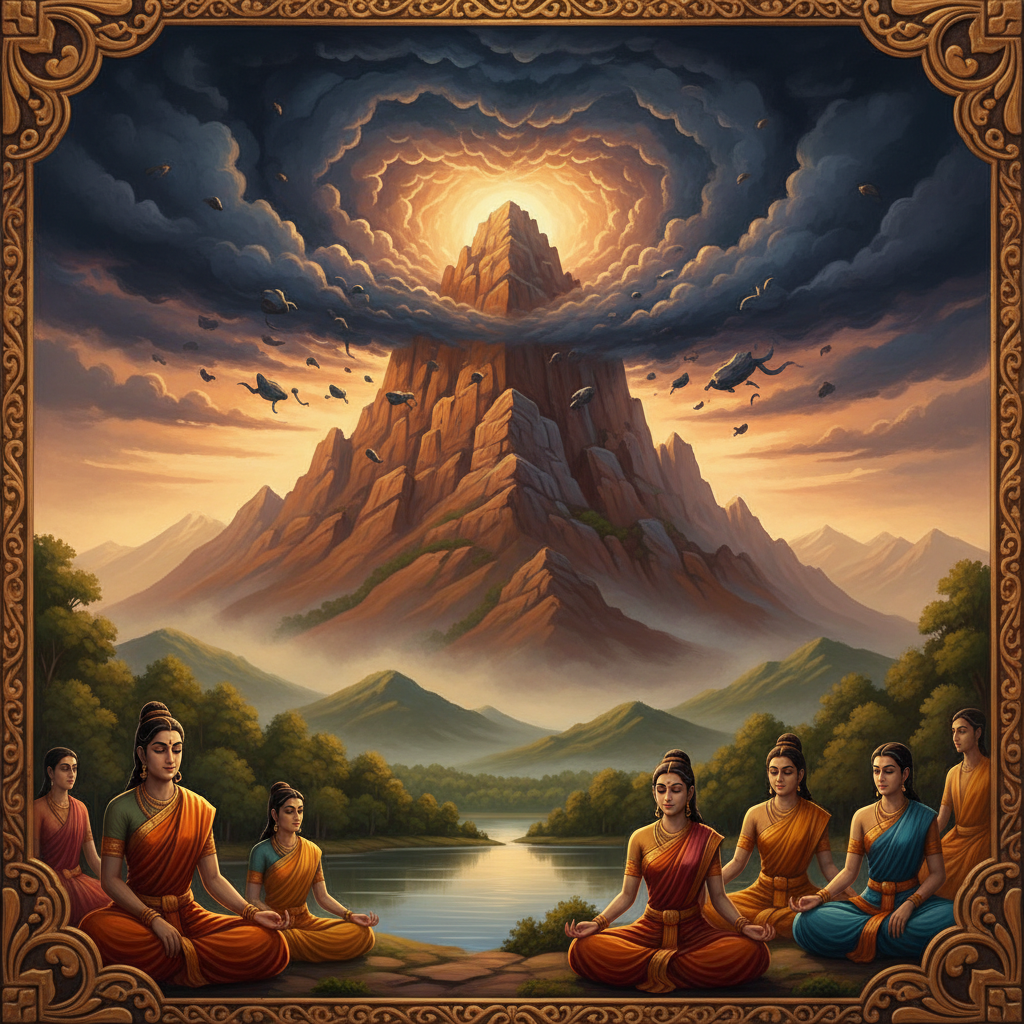
The text now gives the image that names the lecture’s center. “Just as rain clouds are attracted to the lofty peaks of mountains, in the same way the clouds of impure mentations, worries, and anxieties are drawn to the high-rising illusions of the ego-sense.” As the ego rises like a mountain, all impurities gather there and become, in Swamiji’s phrase, the crowning glory of the ego. “So the rising of the ego is not to be promoted.” He is careful about what this does not mean. The message is not to get out of the ego suddenly, because that cannot be done. The ego plays three roles, led by the gunas, the modes of nature. The tamasic ego, the one interested in hurting others to secure its own happiness, must be completely sublimated. What changes with understanding is who is in charge. Rajas and tamas come under control and begin to serve rather than restrict. “Tamas gives you rest”, and in a healthy movement rajas gathers energy from different sources.
The Transparent Sattvic Ego
The sattvika ego is the one that does not obstruct the understanding that I am not the ego. Swamiji is precise: realizing that you are not the ego does not mean that you have no ego. “You have transparent ego.” It is nowhere to be seen, yet steadier and more powerful than one could imagine, “and it is more jewel-like, stronger than before.” With that kind of ego the mountain no longer swells. “Ego becomes humble.” The clouds that gather over its head are simply sublimated. The text adds a second image: when the ego sense is destroyed, “The tree of the world process begins to wither away. It is no longer nourished by the waters of attachment and hatred.” Since the ego swells where attachment and hatred leave no serenity, Swamiji turns to how each is sublimated. “Rāga is sublimated by devotion to God.” “Now, change your vision: anything loving, instead of getting attached to the object, be attached to God who made it loving.” This is not withdrawal. “From practical point of view, love more than ever before.” The love is simply no longer limited to material, mundane pleasure. Dvesha is the reaction to anything that gives pain, the wish that it go away. Swamiji points out the hidden cost of wishing someone ill: in condemning an enemy, you send yourself along to keep watch over him. “Watching your enemy is worse than hell, but you don’t realize it.” When the mind becomes wise, raga gives way to devotion and dvesha gives way to the Vedantic understanding that all this is illusion. The two together are bhakti and jnana.
Garuda and the Cobra of Craving
The verse that follows is Uddalaka speaking to himself at a deeper level. Because of the advent of the Garuda bird of spiritual inquiry, the “black cobra of craving which had made its residence in the hollow of the tree” has fled to an unknown land. When the mind stops spending its energy on attachment and hatred, a mystic door opens and a deeper search for who am I begins in the heart. “You begin to see the I am, like you see the pole star.” The traditional words are manana, nididhyasana, cintana and vichara, though words cannot give the real meaning. Inquiry reveals the role of craving. A person may gain everything dreamed of, health, happiness and a prosperous house, and then one little bite takes it all away. “What’s the name of the cobra? Craving.” The cure is the mystical bird. “The mystical bird Garuḍa eats up cobras; it’s His favorite food.” Garuda does not come alone. “Garuḍa is a vehicle for Lord Viṣṇu and Lakṣmī Devī.” Vishnu is the sustaining Reality, the indwelling Self, and Swamiji reads His names from the Gita: upadrashta, the one watching over you; anumanta, the one who encourages and inspires; bharta, the support who never goes away. The response to devotion is out of all proportion to it: “you love only one ounce and response comes one ton.” Finally the I and God are seen to be one, and Swamiji returns to the jar. “All throughout all its existence, it is supported by the sun. And in reality, it is nothing but the sun.”
Wave or Ocean: The Real I Am
“This body existence is as momentary as the rising of a wave in the ocean.” Swamiji asks the listener to picture the ocean caught in a strange emotion, believing it is only a wave or a little whirlpool, and complaining that the ocean will not keep it safe but tosses it from one place to another. That is the relationship many people develop with God. When clarity comes, the sense of separate I-ness moves away, and you are always the ocean. “Every wave is in reality the ocean, doesn’t have any existence of its own.” Different whirlpools may be given different names, but they are nothing but the ocean. The text is blunt about the alternative. “He who imposes the sense of I-ness on this transient body is indeed dull-witted.” Intelligence, success and popularity do not change the verdict, Swamiji explains, without devotion to God and a movement toward enlightenment. The ocean holds even the imagined troubles of the mind. “That ocean is you, that’s the real I am.” Deep sleep offers a clue. Whatever karmas people are passing through, “when they are in deep sleep, they are exactly in the same equal status.” The troubles return on waking unless one is enlightened. The revelation is the movement from this transient wave I am to I am the surging ocean.
The Long Dream of the World Process
The next verses take up the dream. “During dream, one may see oneself being slain.” While dreaming, steps break, thorns scratch, and nothing announces that nothing is happening. Swamiji describes the switch that changes it. A devotee remembers the name of God and recognizes that nothing is truly happening, that it is all God’s play, and the tragic experience is soothed even while the dream goes on. “One may see tigers, thieves, and other objects, and become affected by them as if they were real.” In the same way, though the objects of the world are unreal, “When caught in the dream of the world process, the soul continues to experience pleasure and pain through them.” Saying the world is unreal is not enough. “But that doesn’t resolve your problems. You have to wake up from your dream.” The verse marks the difference between the two dreams. “While an ordinary dream ceases, when a person wakes up, this long dream of the world process comes to an end only when a person attains enlightenment.” From an ordinary dream one wakes only to dream again. From the long dream there is no going back.

Actor, Director and the World Drama
“I’m merely an actor in the drama of the world process.” A life is a series of roles: a baby actor, an angry personality, a gracious one. “Soul goes on playing different roles led by conditioned mind.” With an enlightened mind the roles continue, but the soul’s status is totally different. “That is, God is playing all the roles.” He quotes the line from Tulsidas “sīya rāmamaya saba jaga jānī.” Your personality is divine, the personalities of others come from the same divine source, and what everyone experiences has one reality. The text says that having assumed the role of ego, the same soul, at another level, becomes the instructor of that ego. Swamiji extends the image to a drama manager who teaches the actor what to play and how. “He’s the Controller and the Director of the world drama,” and yet that is not the highest statement. The highest is that “the drama-based reality is not reality at all, and there is no drama. God alone is.” The sun seems to play a daily drama of sunrise, lightning and rainbows, but to an advanced mind it is putting on no show. The verse completes the thought. “By assuming the role of the senses, I perceive the objects of the world. And by identification with the body, I sit or walk or move. But in reality, I am the Self, wherein the ego sense is absolutely negated.” “Brahman alone is.”
From Terrified Deer to Roaring Lion
Uddalaka’s lament comes next. “Alas, like a deer lost in a dreary desert. I have been wandering in the world process for a long, long time.” Swamiji pauses on the deer: terrified, going after a mirage to quench its thirst. Then the turn. “But I have now discovered the falsity of the ego sense. I am no longer subjected to the repeated cycles of birth and death.” “So you are not that terrified deer. You are a roaring lion”, Swamiji says, adding at once that the roar is not meant literally. The text then searches the senses for the ego. “The sense of touch perceives softness or hardness. The tongue tastes, the nostrils smell fragrance, and the ears hear.” Where is the ego in all of that? “Look for it. Catch it by the ears.” “Indeed, it has appeared even like a mirage in a desert.” When the ego sense is negated, the verse says, “Although the activities of the body continue, they do not give rise to karmic entanglements.” Enlightenment, Swamiji says, does not depend on withdrawing from activity; stopping everything in the name of nirvana leads to havoc instead. The alternative is a flower, busy sending out fragrance without ego concern. “But keeping all active, purposefully active.” He closes with four stages of the Godward movement. “First stage your life was based on perspiration. Everything required tension.” “Second stage you get inspiration coming giving you a cool breeze.” “Third stage you get grace, miracle of grace.” “Fourth state: the miracle of the power of enlightenment.” And with that, “You wake up as it were from the dream of the world process.”
Terms
- vichara — inquiry into the Self; a calm, gliding movement of the mind rather than stressful thinking.
- cinta — worry; the anxious thinking bound up with acquiring things in the world.
- raga dvesha — attachment and hatred, the two legs of the monkey of ego.
- tamasika rajasika sattvika — the three roles of the ego, led by the gunas; the sattvic ego is transparent.
- guna — a mode of nature: sattva, rajas or tamas.
- bhakti — devotion; here, the sublimation of attachment by redirecting it to God.
- jnana — knowledge; here, the understanding that dissolves hatred.
- Garuda — the mystical bird, vehicle of Vishnu and Lakshmi, that eats the cobra of craving.
- manana nididhyasana — reflection and deep contemplation, deeper stages of inquiry.
- upadrashta — the one who watches over; a name of God in the Gita.
- anumanta — the one who permits and encourages; God as inner inspiration.
- bharta — the supporter; God as the support that never goes away.
- nirvana — liberation; not attained by stopping all activity.
Three Questions
- When Swamiji says the affirmation succeeds once the cloud becomes appreciative rather than obstructive, what is the cloud in his image, and why is it not simply removed?
- In the section on the mountain of ego, which ego is to be completely sublimated, and why does he insist the sattvic ego remains, only transparent?
- The verse distinguishes the ordinary dream from the long dream of the world process: what ends each one, and why can the second not begin again?
Yoga Vasistha, Upasama Prakarana, Section 52. Lecture 194 by Swami Jyotirmayananda, Yoga Research Foundation. The complete archive of Swami Jyotirmayananda’s teachings is free.
This study guide is drawn from the archived teachings of Sri Swami Jyotirmayananda.