
From the Archives of Swami Jyotirmayananda
Introduction
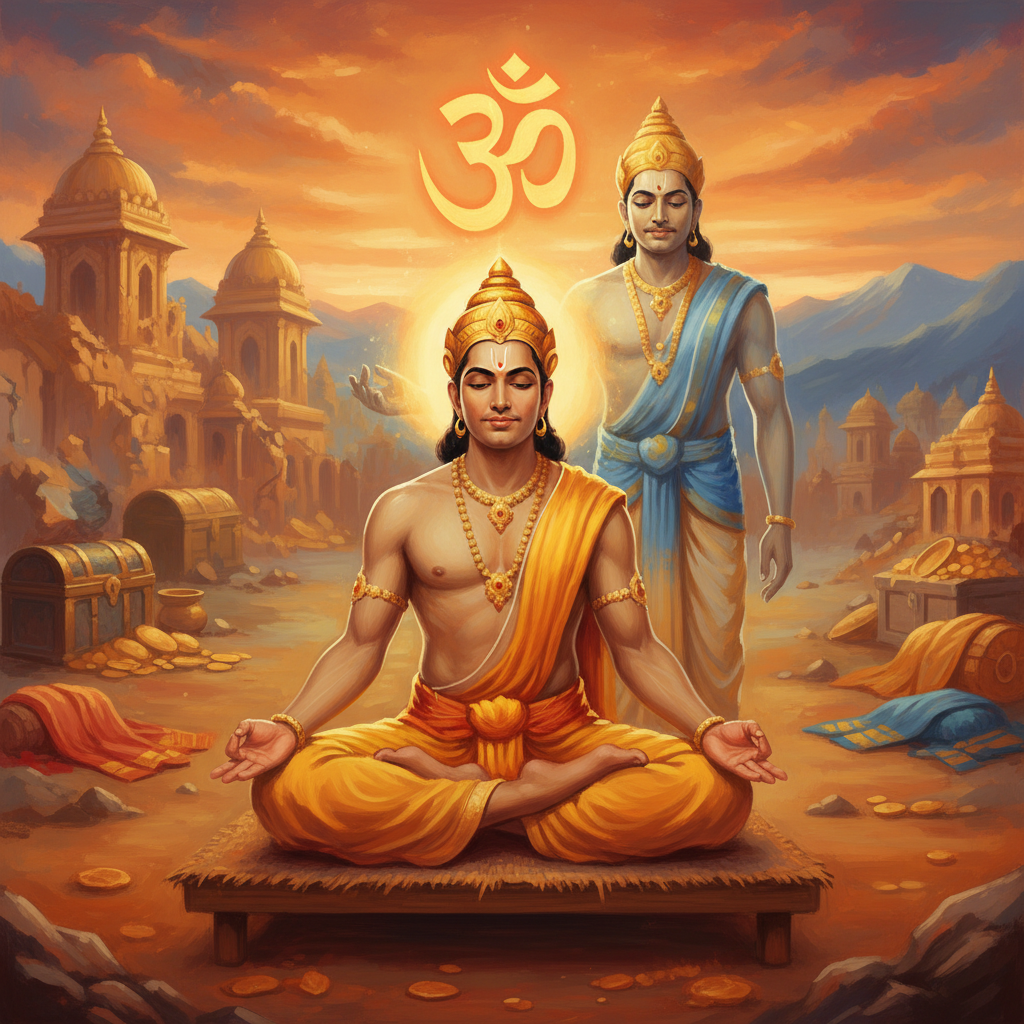
What happens when you achieve everything the world can offer — and discover it’s still not enough? In the Yoga Vasistha, King Bali becomes ruler of the three worlds, yet instead of satisfaction, he finds himself face to face with a deeper question: “Who am I?”
Sri Swami Jyotirmayananda, a direct disciple of Swami Sivananda, continues this timeless teaching in Lesson 167 of the Yoga Vasistha, Upashama Prakarana, Section 27. He walks us through Aum Upasana — the three-stage meditation on Om that carries the aspirant from body-awareness to the transcendental state of Turiya.
King Bali: The Highest of Attainments
The allegorical story of King Bali continues from the previous sections. Bali gained immense power and became the ruler of the three worlds — yet he soon became fed up with the world, because the world gives you the same thing again and again. Recognizing that absolute fulfillment is not possible in the world of time, space, and causation — the world of birth and death — Bali began to practice profound meditation, guided by his guru Shukracharya.
Vichar: The Practice of Self-Inquiry
Swamiji introduces the practice of Vichar (reflection). The first stage is for your mind to become quiet, free of the pressures of Rajas (distraction) and Tamas (dullness). Allow Sattva (purity and harmony). When calmness comes profoundly, switch your attention to what is the greatest — what is that which you love most?
The answer lies in the Upanishadic declaration: Atmanastu kamaya sarvam priyam bhavati — For the sake of the Atma (the Self), all things become dear. If the “I am” is not there, what is the use of anything? The “I am” must first be understood by you. And if you understand it, there is nothing else to understand.
Nishcaya: Firm Conviction Through Affirmation
When the mind has become relaxed and is in a sattvic environment, it begins to understand with firmness. This firm conviction is called Nishcaya. Through affirmation — “I am not the body, I am not the mind… I am Satchitananda, absolute reality, pure consciousness, bliss” — a firm conviction grows deep in the unconscious mind. If your Nishcaya about yourself is shaky, no matter what you attain, all attainments will be of no use.
The mind allows you to see yourself in the physical plane. It allows you to see yourself in your dream, where you do not have the body. It allows you to understand that in deep sleep, the mind seems to move away — but you are not at a loss, not an inch of you. So the mind itself allows you to understand that you are underlying the three states: waking, dream, and deep sleep. These states are variables. Your I AM is the invariable reality.
The Cloud and the Sun: Mind as Both Bondage and Liberation
The mind that creates the drama of bondage is the same mind that, through practice and sadhana, allows the feeling to be purified. Like a dark cloud that hides the sun, the mind gripped by ignorance creates bondage. But as rays of the sun begin to pass through the cloud, the same cloud that was hiding the sun now seems to praise it — it shines, and the sunlight becomes a rainbow. Ultimately, the cloud simply moves away. Reality alone exists. Brahma Satyam Jagat Mithya — Brahman alone is real, the world is illusory.
Aum Upasana: The Threefold Meditation on Om
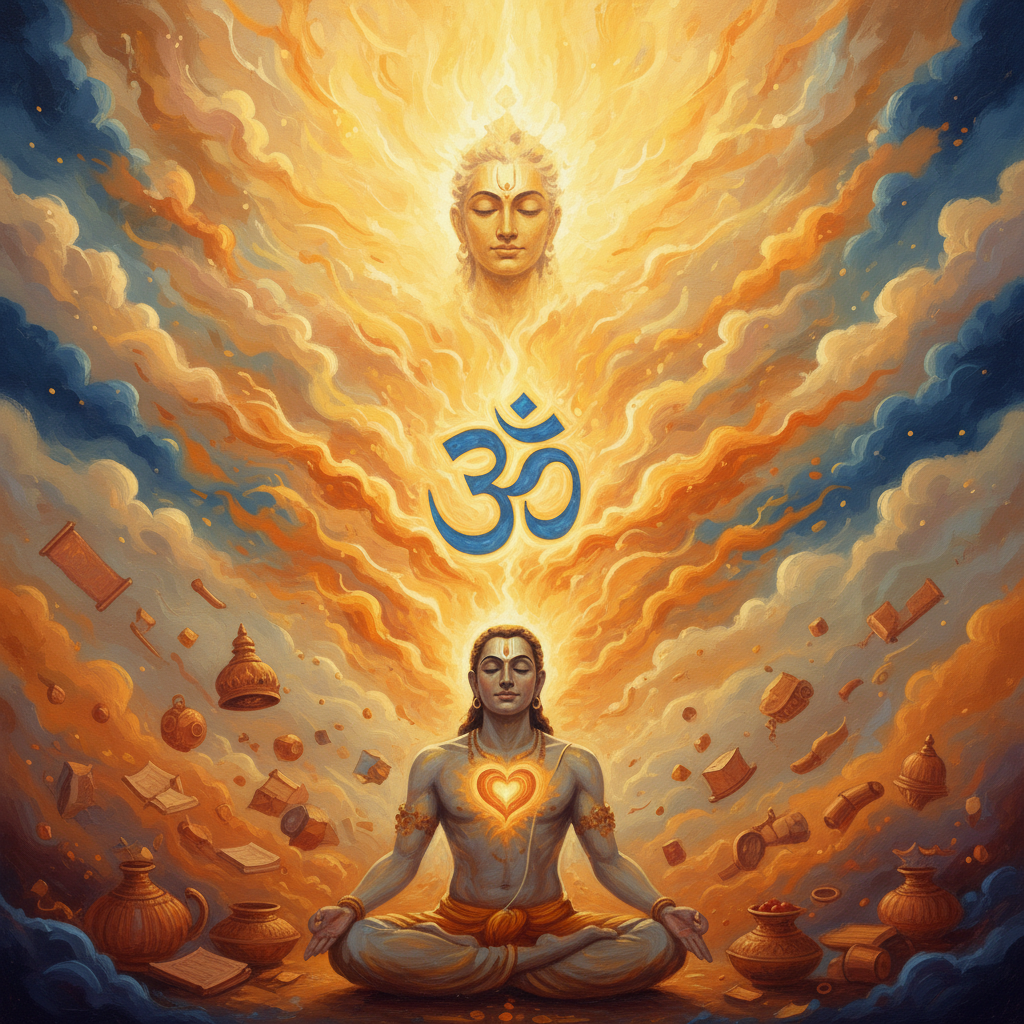
The lecture culminates in a detailed explanation of Aum Upasana — the meditation on the sacred syllable Om. The source of all mantras is Aum, which contains all sounds from the throat to the lips. Chanting Aum creates a resonance in the spinal column and has a powerful effect on the nervous system.
Aum has four aspects: A, U, M, and the silence that follows.
A (Navel Center — Manipur Chakra): The ‘A’ aspect relates to the navel center, where body identity is secure. This is Kriya Shakti, the power of action. Visualizing a lotus at the navel, the aspirant begins with the awareness of the body — “I am the body — and since I am the body, I am the entire universe.” This expands the limited body-consciousness (Vishwa) into cosmic consciousness (Virat).
U (Heart Center): The ‘U’ aspect emphasizes the mind. The body idea is mind, not physical body. All experiences are mental projections. The individual mind (Taizas) relates to the cosmic mind (Hiranyagarbha) — the mind that has projected the entire universe. Your mind is a wave in that ocean. “Wave goodbye to your limited mind and dive into the ocean of mind.”
M (Causal — Consciousness): In the third stage, the aspirant becomes identified with the causal body, the unconscious. That unconscious is the profound reality behind the mind. The cosmic causal body is God Himself — Brahman stepping through the veil of Maya. The first stage of Brahman is Ishvara. That Ishvara is “I am.”
The Silence Beyond: Having transcended the three states of waking, dream, and deep sleep, the aspirant passes into Turiya — the transcendental state. This is what King Bali achieved.
King Bali’s Attainment
As a result of this meditation, King Bali became immersed in Samadhi. He was no longer caught in the maze of the mind, no longer dependent on the world, no longer conditioned by the triad of seer, scene, and sight. He transcended even the ego thought and became like a painted picture or like a flame that burns steadily in a windless place. That is the state of absolute revelation and realization.
Scholar’s Corner
Text: Yoga Vasistha
Section: Upashama Prakarana (On Quietude), Section 27
Lesson: 167
Context: King Bali, having attained rulership of the three worlds, realizes the limits of worldly fulfillment and turns inward. Guided by his guru Shukracharya, he practices Vichar (self-inquiry) and Nishcaya (affirmation), culminating in Aum Upasana — the threefold meditation on Om that carries the aspirant through the three states of consciousness into Turiya, the transcendental fourth state.
Glossary
- Vichar: Self-inquiry; the practice of reflecting on the nature of the Self
- Nishcaya: Firm conviction or certainty born of deep affirmation and meditation
- Aum Upasana: The practice of meditating on the sacred syllable Om as a means of spiritual ascent
- Turiya: The fourth state of consciousness, transcending waking, dream, and deep sleep
- Aham: “I am” — the sense of individual selfhood that, when purified, reveals Brahman
- Vishwa: The individual self identified with the physical body
- Virat: The cosmic self manifest as the entire universe
- Taizas: The individual self identified with the mind
- Hiranyagarbha: The cosmic mind; the golden womb of all creation
- Manipur Chakra: The navel center associated with the fire element and Kriya Shakti
- Kriya Shakti: The power of action in spiritual practice
- Satchitananda: Sat (existence), Chit (consciousness), Ananda (bliss) — the nature of Brahman
- Brahma Satyam Jagat Mithya: Brahman alone is real; the world is illusory
- Atmanastu kamaya sarvam priyam bhavati: For the sake of the Self, all things become dear (Brihadaranyaka Upanishad)
Explore Further
📺 Watch the full lecture: https://youtu.be/ohoJR7CIHDM
🕉️ Join the Digital Sangha for the full archive of Sri Swami Jyotirmayananda’s teachings.
📚 Full Yoga Vasistha Playlist: https://www.youtube.com/playlist?list=PLu4qbbM6vDP37–8UBT4vK7Z6sNU4jvHz
This study guide is drawn from the archived teachings of Sri Swami Jyotirmayananda.