
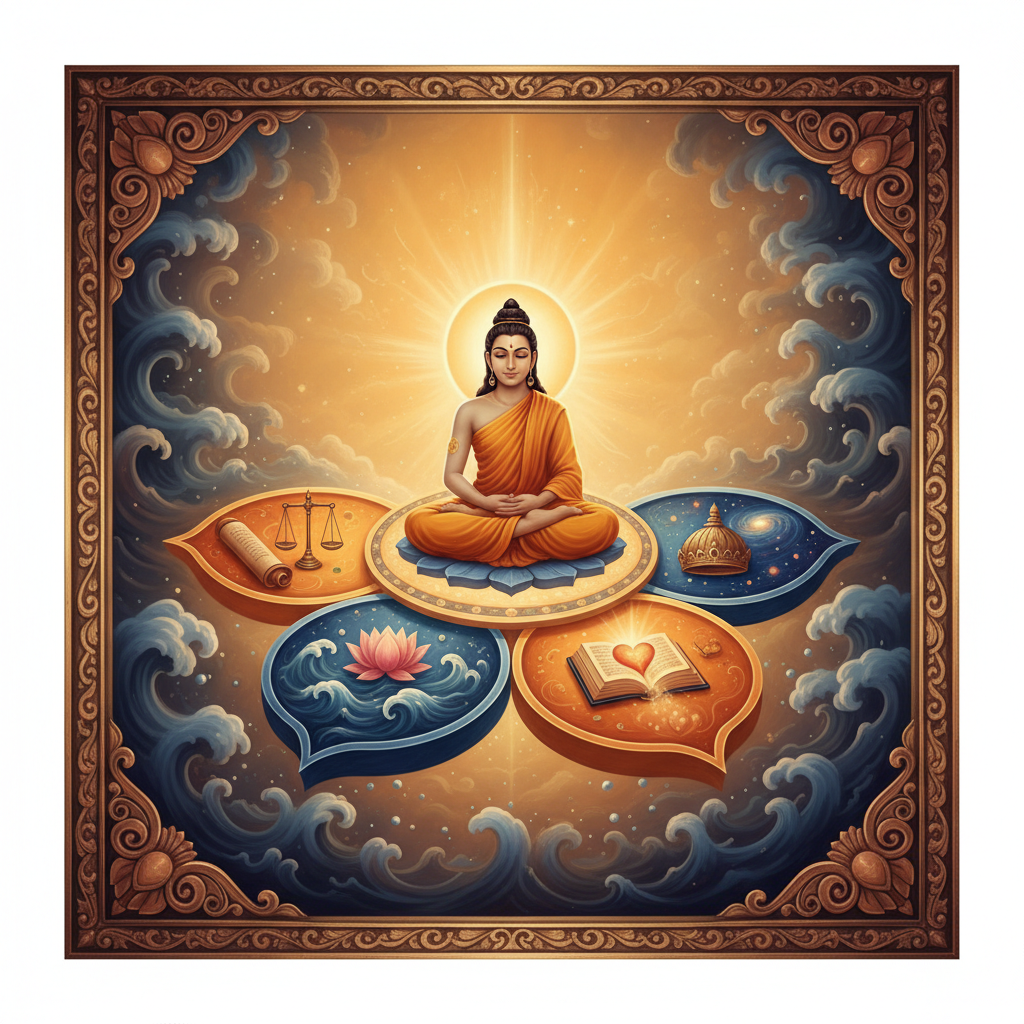
What does it take to stop being controlled by your own mind?
Patanjali’s Yoga Sutras begin with a declaration: Atha Yoga Anushasanam — now we commence the discipline of yoga. Sutra 2 defines yoga itself: Yogas Chittavritti Nirodhah — yoga is the control of the mind’s thought waves.
But knowing the definition is only the beginning. Sutras 3 and 4 reveal the practical path — Abhyasa (practice) and Vairagya (detachment). In this profound teaching, Sri Swami Jyotirmayananda brings these ancient sutras to life through the four pillars that every sadhaka must develop.
Three Instruments of Purification
Patanjali gave the world three scriptures for three levels of human existence. The Yoga Sutras purify the chitta — the mind-stuff. The Ayurvedic texts purify the body. And the grammar scripture purifies speech. Body, tongue, and mind — all three must be refined for the seeker to progress. None can be neglected.
Vasanas: The Architect of Your Destiny
The mind is not a simple entity. It operates on three levels — conscious, subconscious, and unconscious. The subconscious layer, closest to our waking awareness, is where vasanas reside. Vasanas are subtle desires, subtle inclinations. They are not the gross wants we consciously pursue — they are the deeper currents that shape our character, our choices, and our destiny.
Every action you take creates an impression. Those impressions become vasanas. Those vasanas architect your destiny. They determine whether you move with gain or through this world.
The crucial insight: You are not a slave to those vasanas. You have a choice.
The Three Gunas: Sattva, Rajas, Tamas
The mind moves under the influence of three qualities:
Sattva — When sattva predominates, the mind is serene and peaceful. All goodness within you begins to express. Clarity, compassion, and devotion flow naturally.
Rajas — Rajas is the flamboyant quality. It likes to show off, to create drama, to seek stimulation. Rajasic vasanas flourish through crowds, parties, social media — any environment of constant excitement and display.
Tamas — Tamas is the negative quality. It finds entertainment in darkness, in cruelty, in sensationalism. Allowing rajasic and tamasic vasanas to flourish degrades you. You lose the inner sense of freedom.
Critical insight: The goal is not temporary sattva — it is transcendence of all three gunas. When sattva is not yet well developed, even its gentle influence can be swallowed by rajas and tamas.
The Five States of the Mind (Avasthas)
Patanjali describes five states the mind can occupy:
1. Mudha (Dull) — The mind is burdened by impressions of fear, illusion, and delusion. Like rust on a mirror that can no longer reflect. People in this state live their entire lives with only rare moments of genuine happiness. They sit with stories of misery and relish negative narratives. This is not a temporary mood — it is their rooted state.
2. Kshipta (Distracted) — The mind is clearer but constantly shaking. There is no focus on “who am I” — only focus on “what I desire.” Desires multiply across lifetimes. Trishna (craving) never ages. The kshipta person builds enemies, frustrations, and endless karmas.
3. Vikshipta (Sattvic but Unstable) — The person is predominantly good — generous, ethical, peaceful. But during provocation, the old patterns resurface. The seeds of anger and hate have not been removed. They are wonderful people, but they are not ready for enlightenment because the subtle causes remain.
4. Ekagrata (One-Pointed) — The mind has become so purified through profound meditation that the seer in you sees with absolute clarity: “I am That.” This is the advanced yogi. The mind no longer creates bondage.
5. Niruddha (Transcended) — The final state. Mind has absolutely no influence on you. It does not limit you in any way. Like a cloud drenched with light — there is only one direction to go: dissolve. Gone. Gone. Gone. This is absolute liberation. Nothing remains to draw you back.
Avastha vs. Sthiti: The Critical Distinction
One of the most important distinctions in the Yoga Sutras: the difference between avastha (passing mood) and sthiti (your rooted state).
A person whose rooted state is dull may occasionally rise to sattvic levels — wearing the dress of monks, displaying spiritual knowledge. But they are not comfortable there. They are acting. A person whose rooted state is sattvic may occasionally display rajasic or tamasic moods — irritability, distraction, negativity. But this is transient. This is not what they are.
“Do not judge yourself by passing moods. Do not define yourself by the dreams and thoughts that arise in the mind.”
Your goal is to be rooted in the highest level — what the Bhagavad Gita calls Sthitaprajna — rooted in intuitional revelation.
“I am That. The seer in me has moved away from ego, mind, intellect. I am no longer resting in the waters of illusion.”
Clouds do not limit the sky.
The Four Pillars Every Sadhaka Must Develop
Swamiji teaches that four qualities must be developed by every sincere seeker:
1. Dharma — Living by Ethical Values
Do good. Be good. Follow the path of righteousness. Be sincere. Be truthful. Without dharma as the foundation, the mind becomes dull. Lying requires enormous mental energy — maintaining the story, remembering the falsehoods. Truthfulness simplifies everything.
2. Vairagya — True Detachment
Not cold indifference. Not running away from the world. Vairagya is the strength of a skilled swimmer. When someone is drowning in a pool, the compassionate but unskilled person jumps in — and both drown. The skilled swimmer stays strong, stays above water, and pulls the drowning person to safety.
Vairagya means you can move through the world without being pulled under by it. You remain unaffected. This is not indifference — it is the highest form of strength and compassion.
3. Jnana & Bhakti — Light and Love
Jnana is knowledge — figuratively, light. Its companion is Bhakti — devotion, love. These are two wings of the same bird. Knowledge without love is dry. Love without knowledge is blind. Together, they lift the seeker.
4. Aishwarya — The Sense of Divine Majesty
Not arrogance. The understanding that you are behind all the majesty of the world. If you are a wave, you have no majesty — you are tossed about by every other wave. But if you realize “I am the ocean” — immense, majestic, unshakeable. You are the sun, not the reflected sun. You are the sky, not the cloud. This sense of divine majesty grows as you ascend until you realize: you are Ishwara. You are the controller of all.
The Cinema of the Mind
Swamiji offers a beautiful analogy for understanding the entire teaching. The whole world — your experience of your body, your senses, the entire universe before you — is like a picture show on a blank screen. The continuity of images creates a compelling story. Suspenseful. Tear-jerking. Laughter-provoking. But between each frame, the continuous screen alone is there, looking at you.
You are that screen. You are the eternal seer, the absolute knower, the absolute experiencer.
Deep down, you are free of all process. There is no world, no time, no space, no sense of duality. Like the sun — there is no space for darkness in the sun.
But your thought waves create the illusion. Frame after frame. Experience after experience. And you lose yourself in the show.
Yoga is learning to be the screen again. To see the frames for what they are. To know: I am not the movie. I am not even the projector. I am the light itself.
Om. Shanti. Shanti. Shanti.
Watch the full lecture: Raja Yoga Sutras #3 — Four Pillars That Set You Free
From a lecture by Sri Swami Jyotirmayananda, a direct disciple of Swami Sivananda.
This study guide is drawn from the archived teachings of Sri Swami Jyotirmayananda.