
Introduction
From a lecture by Sri Swami Jyotirmayananda, a direct disciple of Swami Sivananda. This teaching comes from the Yoga Vasistha, Upasham Prakarana, Sections 28-29. The story of King Bali’s enlightenment is one of the most profound allegories in all of Vedantic literature.
The Story of King Bali
Every soul is Bali. Bali dominates the three lokas: the physical world, the world of feelings, and the world of understanding. In the storyline, Bali is a powerful demon king. The demon aspect highlights that no matter how demoniac the soul appears, enlightenment is completely free of the word “demon.” It is even free of the word “divine.” Going beyond both.
Bali was a righteous king who, due to virtuous karmas, developed deep spiritual aspiration. He remembered the teachings he received from his father, King Virochana. Those good samskaras, hidden in the mind, surfaced and began to lead him inward.
Vichar: The Subtle Inquiry
Bali practiced vichar. Vichar is subtle inquiry. It is a process of affirmation. We allow the mind to work calmly. And through the mind, you begin to figure out: Who am I?
The ordinary mind goes on creating its nishchay: this food is tasty, that food is not. But now that process of nishchay is applied towards a mystical search. Figuring out your own identity. Led by scriptural teachings.
He began to work upon the great affirmation: I am not the body. I am not the mind. I am not the intellect. I am not the ego. I am Sachidananda.
Deep Samadhi
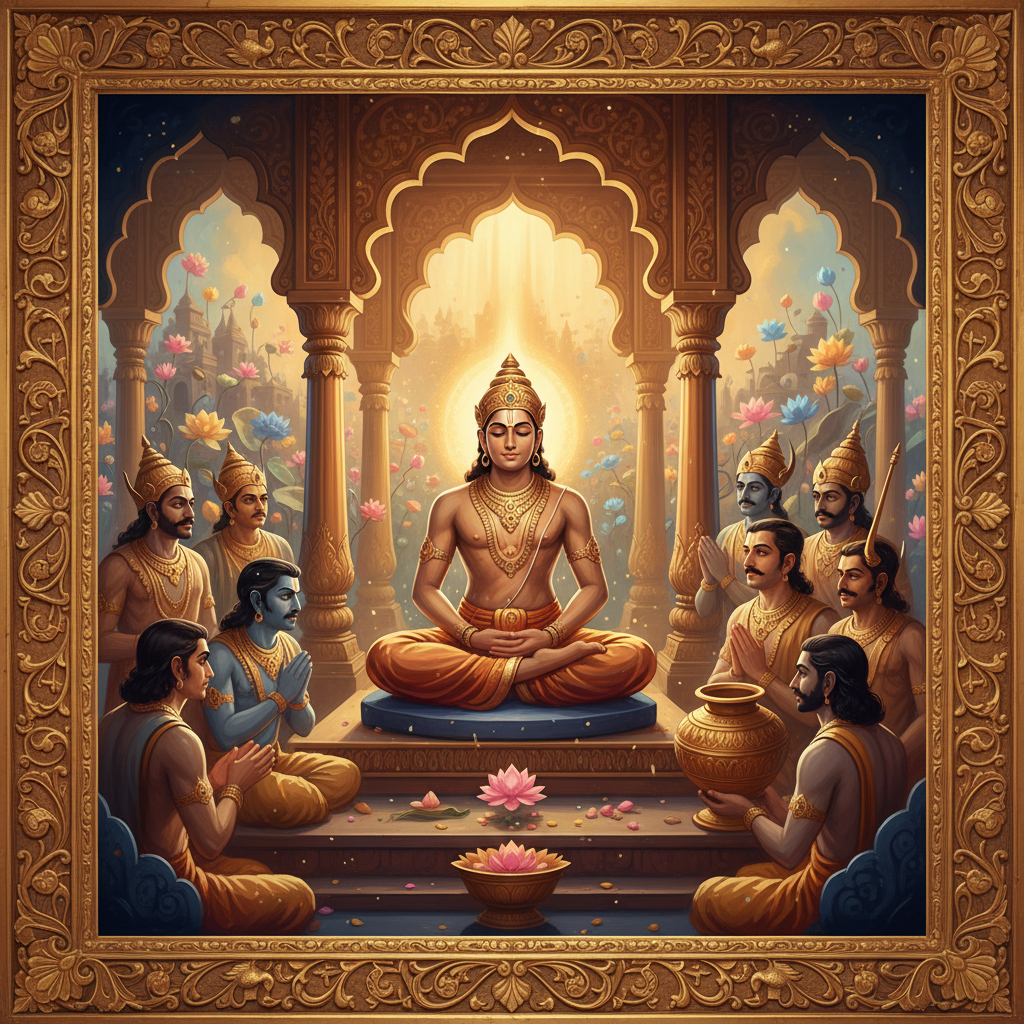
Bali entered into deep samadhi led by his vichar movement. In that stage, the attendants of the king became concerned. They hastily ascended to the uppermost story of the palace. Among them were generals of the demon army, as well as gods such as Kubera, Yama, and Indra.
Your personality is the palace. A palace that has gods. When you practice dharma, control of mind and senses, you allow God’s aspect in you to become glorious. You allow the godly aspect to win. By acts of charity, you allow human value to flourish. By controlling cruelty and transforming it into compassion, the demons become passive.
They all come towards Bali, missing him. Gods and demons alike. All the celestial apsaras, all sentiments involved in the three planes. They all arrive and find Bali in a state of profound meditation. Seated like a painted picture. Statue-like stillness. They were overcome with amazement and grief.

The Guru’s Diagnosis
Shukracharya, the preceptor, appeared before them. Being the all-pervading Atman, he appeared. Like a doctor examining a patient, he observed Bali. He concluded that Bali had attained Samadhi.
As a result of his vichar practice and Vedantic meditation, the king had passed into the blessed state of Samadhi. The mist of ignorance had dissolved from the firmament of his heart. Bhavana shuddhi. All feelings become purified. That results in vasana kshaya. All the subtle desires that obstruct enlightenment melt away or become sublimated.
He had been awakened from the long dream of the world process. Realization is awakening.
Awakening Is Not an Attainment
You don’t create anything new by your sadhana. All your sadhana only leads you to the state of awakening. You have been sleeping and experiencing dreams. You are very proud of achieving wonderful things in your dream world. But all this time, you have been sleeping.
All your karmas do not produce liberation. Liberation is your ultimate bed. The profound one is the bed of eternity. All karmas cannot produce what is already there.
The Spontaneous Awakening
There should be no effort involved in awakening from Samadhi. It must be spontaneous. A flower has blossomed. All the fragrance is sleeping within. Nothing you need to do. Wait. In the silence of the night, the fragrance simply begins to spread.
This is the sahaja movement. Spontaneity. In all worldly gains, that sahaja state is not there. You gain something, you must struggle to maintain it. But the enlightened one wakes spontaneously.
Prarabdha Karma and the Enlightened Sage
Even after enlightenment, prarabdha karma operates. Prarabdha is the fructifying karma for that particular embodiment. It must run its course. Three types operate:
Sveccha prarabdha: according to the sage’s own choice. Pareksha prarabdha: disciples or friends arrive, planning events. The sage goes into it. Aniccha prarabdha: things you didn’t plan. Hurricanes. Terrible rains. Aging.
While unenlightened masses go through prarabdha creating new karmas for another embodiment, for the sage this is the last time. But the picture is the same. Prarabdha operates exactly the same way. The sage’s nose will be exactly the same after exaltation. Nothing changes physically.
The enlightened one, though one with Brahman and having no need to work with the world, continues. The world is now viewed as a dream. As leela. No matter how things happen, it is praise of God. Jesus on the cross turned to God: “Forgive them, for they know not.”
Every enlightened person, though in communion with God, goes on dealing with the world. All actions become inspiring. The world receives tremendous inspiration from the enlightened personality.
1000 Celestial Years
King Bali continued in Samadhi for 1000 celestial years. After which he was awakened by the beating of heavenly drums by the gods. They had been beating all the time but he remained in Samadhi.
Every attainment has a time implied behind it. Samadhi transcends time. So if you try to describe it in terms of time, thousands of years become few moments of Samadhi. The happiness you could collect in thousand years, he collected within moments of his samadhi. As if he passed through 1000 years.
His city, which had become like a withering lotus in his absence, now bloomed with delight. Much as the lotus does with the rising of the sun.
Sahaj Samadhi
Having recovered normal consciousness, Bali entered the state of Sahaj Samadhi. That state where both have become blended. Internally, nothing exists. Externally, all is.
“Bondage Is Illusory”
King Bali reflected: “Oh, how wonderful is this state of bliss which I have enjoyed. Immersed in bliss, I passed through such a long duration of time as if it were only a moment.”
“Let me again enter into this same state of super consciousness. What have I to do with the transient prosperities of the world?”
“I have no need to desire for liberation because I have discovered the fact that bondage is illusory.”
Sadame samatvam na muktirna bandha. Shankaracharya’s statement: I am always the same. There is neither bondage nor relief for me.
The Sun and Cloud Metaphor
Where there is no bondage, how can there be liberation? Bondage and liberation are for the ignorant alone. I am illumined by knowledge.
The sun doesn’t desire to be liberated. Already full of light. When you discover who you are intuitively, not the ego I am but the real I am, the question of liberation doesn’t arise. Because liberation is not an attainment led by karma. Liberation is revelation. The sun is already there.
I am that. That I am is like the sun. Absolute reality. The clouds created by your mind’s illusion obscure and create a fictitious identity. That identity goes on changing. In every embodiment you have a different name. Different personality. Even in a single embodiment, different stages.
Nothing really affects you. You abide in the Self wherein your vision is ever balanced. Samatva Buddhi. The mind is ever rooted in the awareness: I am Brahma. Brahman alone is real.
Beyond All Projections
I am neither dead nor alive. Neither gross nor subtle. Neither existent nor non-existent. All experiences of existence, non-existence, dead and alive are created by projections. Like a cinema show. Life, death, gain, loss, positive, negative. They are projections. They are not reality.
The I am is the screen behind all projection. That I am remains untouched. No matter what type of projection the screen displays. The screen has no trace.
The Saintly Vision
The state of the enlightened mind is like the sky. The sky has no concern for whether clouds should be noisy or soft. No matter how they are, the sky welcomes them all.
People suffering from mortality, dying. In a higher point of view, souls are throwing off old clothes. Trying on a new dress. All adverse situations have their purpose. When it passes away, you will discover yourself in a higher level.
Three Stages of Relationship with the Divine
In easy movement, you go through three stages:
- First: I am in the hands of God. All your work goes on serving God. Bring a sacred attitude toward your activities. Otherwise, day by day you create impressions of boredom. No. You are in the hands of God. Use all your energy, all your intelligence. Do your self-effort in all detail. But what you cannot do, leave it in God’s hands.
- Second: I am a ray and You are the Sun. God is like the sun and you are a ray of the sun. Now you are matching up with God. Become godly.
- Third: Nothing but God. I am That.
Bringing these three in your personality is the great ideal of all religions of the world.
The Liberated Sage Enriches the World
Having renounced the subtle desires of the mind, Bali continued to rule his kingdom in the most elegant manner possible. Under his rule, the kingdom became increasingly prosperous. Ram Rajya.
The liberated sage, having attained liberation, now enriches the world around him by his spiritual presence. Vibrations touching different souls. Because he is a channel of the divine source.
Scholar’s Corner
Key scriptural references from this lecture:
- Yoga Vasistha, Upasham Prakarana, Sections 28-29: The story of King Bali’s samadhi and liberation
- Sadame samatvam na muktirna bandha: From Shankaracharya. “I am always the same. There is neither bondage nor relief for me.”
- The three types of prarabdha: sveccha (own choice), pareksha (others’ wishes), aniccha (not in anyone’s control)
- Om purnamadah purnamidam: The invocation at the start of the lecture. “That is full. This is full. From the full, the full arises. Taking the full from the full, the full alone remains.”
Glossary of Sanskrit Terms
- Samadhi
- Deep meditative absorption. A state of complete stillness where the meditator and the object of meditation become one.
- Sahaj Samadhi
- The natural state of samadhi. Where internal stillness and external activity blend together spontaneously.
- Vichar
- Self-inquiry. The subtle investigation into the nature of the Self. “Who am I?”
- Nishchay
- Firm conviction. A settled conclusion of the mind.
- Samskara
- Mental impression. Subtle tendencies stored in the mind from past actions and experiences.
- Vasana
- Subtle desire. A latent tendency that obstructs enlightenment.
- Vasana Kshaya
- The destruction or sublimation of subtle desires.
- Bhavana Shuddhi
- Purification of feelings.
- Prarabdha Karma
- The portion of karma that has begun to fructify in this embodiment.
- Sveccha Prarabdha
- Prarabdha according to one’s own choice.
- Pareksha Prarabdha
- Prarabdha caused by the wishes of others.
- Aniccha Prarabdha
- Prarabdha not in anyone’s control.
- Sachidananda
- Existence-Consciousness-Bliss. The nature of the Supreme Self.
- Samatva
- Evenness of mind. Balance in all conditions.
- Brahman
- The Absolute Reality. The one without a second.
- Leela
- Divine play. The world as the spontaneous expression of the Divine.
This study guide is drawn from the archived teachings of Sri Swami Jyotirmayananda.