
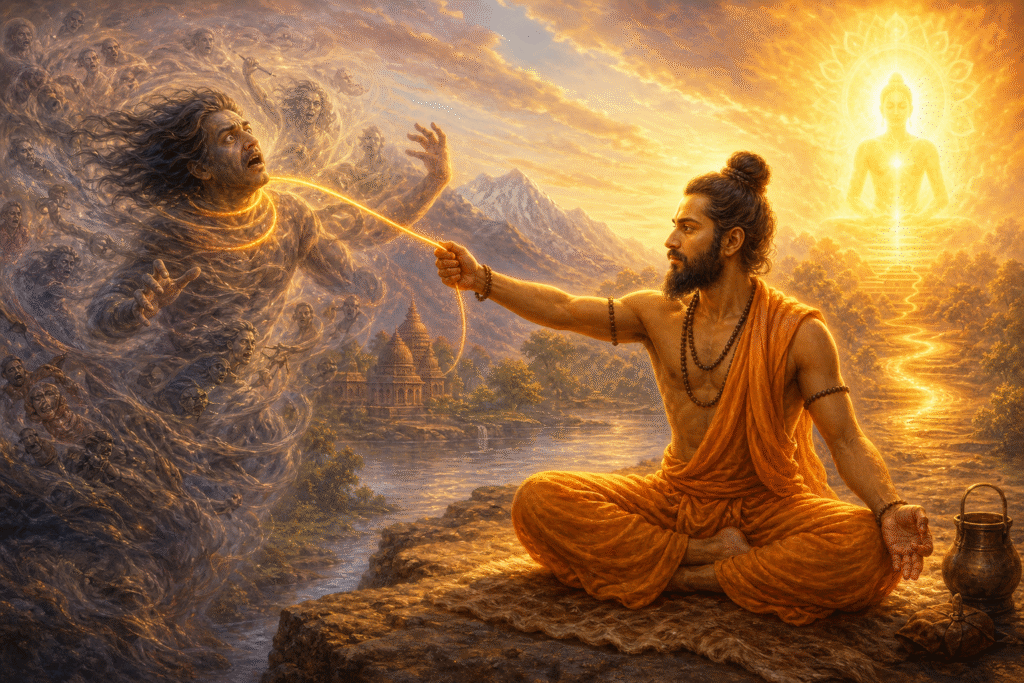
Are you finding it difficult to maintain inner peace in a world that constantly pulls your attention outward? We all possess a profound treasure of divine knowledge within, waiting to be awakened. In this profound teaching, Sri Swami Jyotirmayananda, a direct disciple of Swami Sivananda, offers a gentle, compassionate method for realizing that inner stillness. He reminds us that we are not meant to struggle harshly against our minds, but rather to awaken to the divine reality that already exists within us. By understanding the nature of the mind and applying the ancient wisdom of Adhyatma Yoga, we can guide our restless thoughts back to the tranquility of the Self.
The Two Worlds and the Wall of Delusion
According to the teachings of Sri Swami Jyotirmayananda, we experience two aspects of reality: the internal world and the external world. The internal world is vast, encompassing our thoughts, feelings, imaginations, dreams, and subtle desires, which are known as vasanas. The external world consists of practical reality, our relationships, political conditions, and the threefold troubles of life.
However, the great truth is that Brahman, the Supreme Self, is the sole reality both internally and externally. What separates us from experiencing this truth is a wall of delusion, or bhrama, which acts as a form of ignorance that distorts our perception. When this ignorance is broken, opening our eyes brings a thrill of joy in the world, and closing our eyes brings the profound thrill of the Self. The goal of all spiritual traditions is to remove this delusion.
Cultivating the Ten Characteristics of Dharma
To overcome the darkness of ignorance, we must cultivate Dharma. Sri Swami Jyotirmayananda outlines the ten great characteristics of a truly religious person, a framework designed to enrich our internal life:
- Dhriti (Firmness): A progressive inner firmness based on faith.
- Kshama (Forgiveness): A mind that does not hold onto grudges. Holding a grudge is described as a headache and an unhealthy, abnormal state.
- Dama (Control): The ability to control the mind and senses, viewing the personality as a chariot where the senses obey the mind, and the mind bows to the intellect.
- Asteyam (Non-stealing): The negation of greed, meaning we do not manipulate situations to deprive others for our own comfort.
- Shaucham (Purity): Calming the mind so that the “mud” of gross impurities like anger and hate can settle. When a glass of water is muddy, shaking it only keeps the mud suspended. Similarly, constantly analyzing our anger shakes the mind; by surrendering to God, the mind relaxes and the mud simply settles down.
- Indriya Nigraha: Specific control over the senses.
- Dhi (Purity of Intellect): Achieving a pure understanding and illumined intellect.
- Vidya (Knowledge): The divine knowledge that opposes trouble-causing ignorance (Avidya).
- Satyam (Truth): Beginning with sincerity and expanding into a life where we take responsibility instead of pointing fingers at others.
- Akrodha (Absence of Anger): Refusing to let anger spoil our reasoning.

Seeing Through the Illusion of Objects
All objects in the world are illusory, much like a snake seen on a rope. Sri Swami Jyotirmayananda uses the Vedantic example of clay: many different pots can be made of clay, possessing different shapes and stories, yet they are all fundamentally just clay. In the same manner, all our worldly experiences are merely reflections in consciousness. When these reflections come and go, nothing truly happens to the underlying reality of the Self. Understanding this allows us to interact with the world without building raga (attachment) and dwesha (hatred), which are the two fingers of the ego that choke the intellect.
Overcoming Anger Through Sattvic Firmness
Anger is a common challenge, but it does not belong to our true nature. Sri Swami Jyotirmayananda explains that when we become upset, we are merely beating our own nerves. Instead of obsessing over why we are angry or who caused it, we should affirm that we are made in the image of God and that anger is foreign to us.
When anger appears like a ghost on your shoulders, the most effective technique is to use the 3S method: Suppress, Substitute, and Sublimate. Close the door to the anger without recognizing its identity, and substitute it with divine affirmation. This practice relies on Sattvic Dhriti—a spiritual firmness that allows us to cross over turmoil. Each time we overcome such adversity, we grow much stronger and richer in spirit. In God’s plan, these challenges exist for the profound growth of the soul.
The Supreme Bliss of the Divine Touch
By practicing these virtues and bringing the restless mind under the control of the purified intellect, the yogi maintains their mind in Samadhi. This allows one to rise beyond the evils of the world and experience the infinite bliss of contact with the Divine—known as “Brahma Sansparsha.”
While physical touch in the material world leaves objects feeling separate from us, touching Brahman means intuitively awakening to our essential nature. You become what you touch; as the Swami beautifully illustrates, a river cannot shake hands with the ocean. Once touched by Brahman, we experience atyanta sukham (boundless bliss) that surpasses the transient happiness of the material world.
Scholar’s Corner
- Bhagavad Gita, Chapter 6, Verse 26: “Yato yato nishcharati manah chanchalam asthiram tatah tato niyamyaitat atmaneva vasham nayet.” (If the mind becomes restless or distracted for whatever reason, let the Yogi restrain it and bring it back under the control of the purified intellect).
- Bhagavad Gita, Chapter 6, Verse 27: “Prashanta manasam hyenam yoginam sukham uttamam…” (The Yogi who is sinless and has identified himself with Brahman enjoys supreme bliss).
- Bhagavad Gita, Chapter 6, Verse 28: “Yunjannevaṁ sadātmanam yogī vigata-kalmaṣaḥ…” (The Yogi experiences the infinite bliss of contact with Brahman—Brahma Sansparsha).
- Gayatri Mantra: “Dhiyo yonah prachodayat” (Let our intellects be illumined).
Glossary of Vedantic Terms
- Adhyatma Yoga: The practice of meditation and connecting with the Supreme Self.
- Bhrama: Delusion or illusion that distorts our perception of reality.
- Dhriti: Inner firmness, patience, and resolve based on faith.
- Raga and Dwesha: Attachment (likes) and Hatred (dislikes).
- Satchidananda: The Absolute Reality; existence, knowledge, and bliss that sustains all objects.
- Vasanas: Subtle desires residing in the inner world.
Watch the Full Lecture
Watch the full lecture on YouTube.
Join the community for daily inspiration.
This study guide is drawn from the archived teachings of Sri Swami Jyotirmayananda.