
Sri Swami Jyotirmayananda, a direct disciple of Swami Sivananda, continues his exposition of the Tulsi Ramayana with one of the most structurally rich passages in the Balakanda: the gods’ prayer to Lord Vishnu, his vow to incarnate as the four sons of King Dasharatha, and the sacred fire ritual through which that vow takes root in the world.
The Gods’ Prayer and Vishnu’s Vow
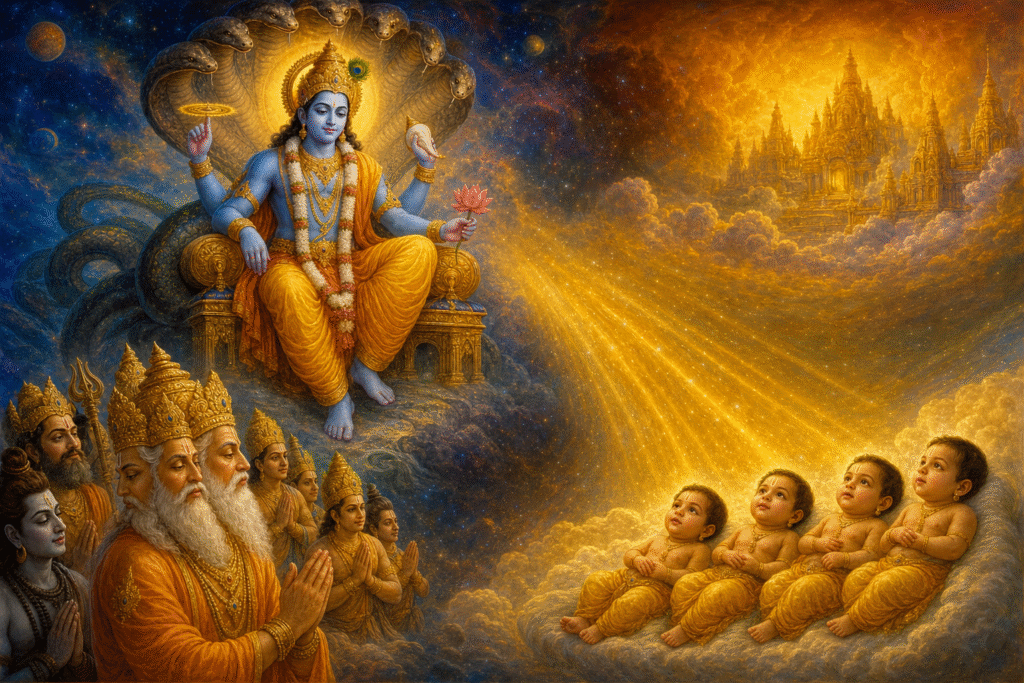
The class opens with the gods, led by Brahma the creator, approaching Lord Vishnu in distress, oppressed by the growing power of demoniac forces on earth. Swamiji pauses on their opening declaration — Hari Vyapak Sarvatra Samana — God pervades the universe equally. Not ninety percent present in one place and ten in another, he notes, but wholly and equally everywhere, and most intimately, in the heart.
In response to their prayer, a voice descends from the heavenly sky, and Vishnu makes his vow: Janidar Pahu Muni Siddha Suresha, Tumahi Lagi Dhari Houn Nar Besa — for the sake of the sages, the siddhas, and the gods, he will take a human form. He will incarnate, he says, along with his aspects — not as one avatar, but as four.
Four Brothers, Four Yogas
Vishnu’s vow names four personalities: Rama, Lakshmana, Bharata, and Shatrughna, born into the solar dynasty. Swamiji maps each brother to one of the four yogas of Integral Yoga. Rama, whose name relates to jnana, knowledge. Lakshmana, the embodiment of dhyana yoga, meditation and unshaken will. Bharata, the embodiment of bhakti, devotion. Shatrughna — literally, “one who destroys the enemy” — the embodiment of karma yoga, the yoga that removes impurity, anger, and greed.
The solar dynasty itself is read allegorically through a verse from the Bhagavad Gita — Agni Jyotir Shukla Shanmasha Uttarayanam — describing the soul’s ascent through four stages: Agni, the fire of dispassion (vairagya) that no longer chases objects without discernment; Jyoti, the light of pure insight that enriches each day with a sense of divine purpose; the waxing moon of pure feeling, Bhavana Shuddhi; and finally Uttarayana, the northern path, where the soul reaches its climax and realizes, without return, “I am That.”
Names That Are Yogas: Kaushalya, Sumitra, Kaikeyi
Before the story reaches Dasharatha’s queens, Swamiji draws out the etymology hidden in each of their names. Kaushalya, from kaushal, skill — not worldly cleverness, but the mystic skill of doing any action with a focused, good-hearted attitude, so that “your activity is not saturated by your perspiration, but thrilled by inspiration.” Sumitra, the source of a universal friendliness that leaves no room in the heart for animosity toward anyone. And Kaikeyi — a name Swamiji reads as a doubled question, “Kai? Kai?” — the path of inquiry itself, the demand of Who am I?, which requires its own austerity.
Dasharatha’s own name receives the same treatment: a chariot yoked to ten — the ten indriyas, the senses — and his city, Ayodhya, “where all battles end.”
The Putrakama Yagya and the Mystic Pudding
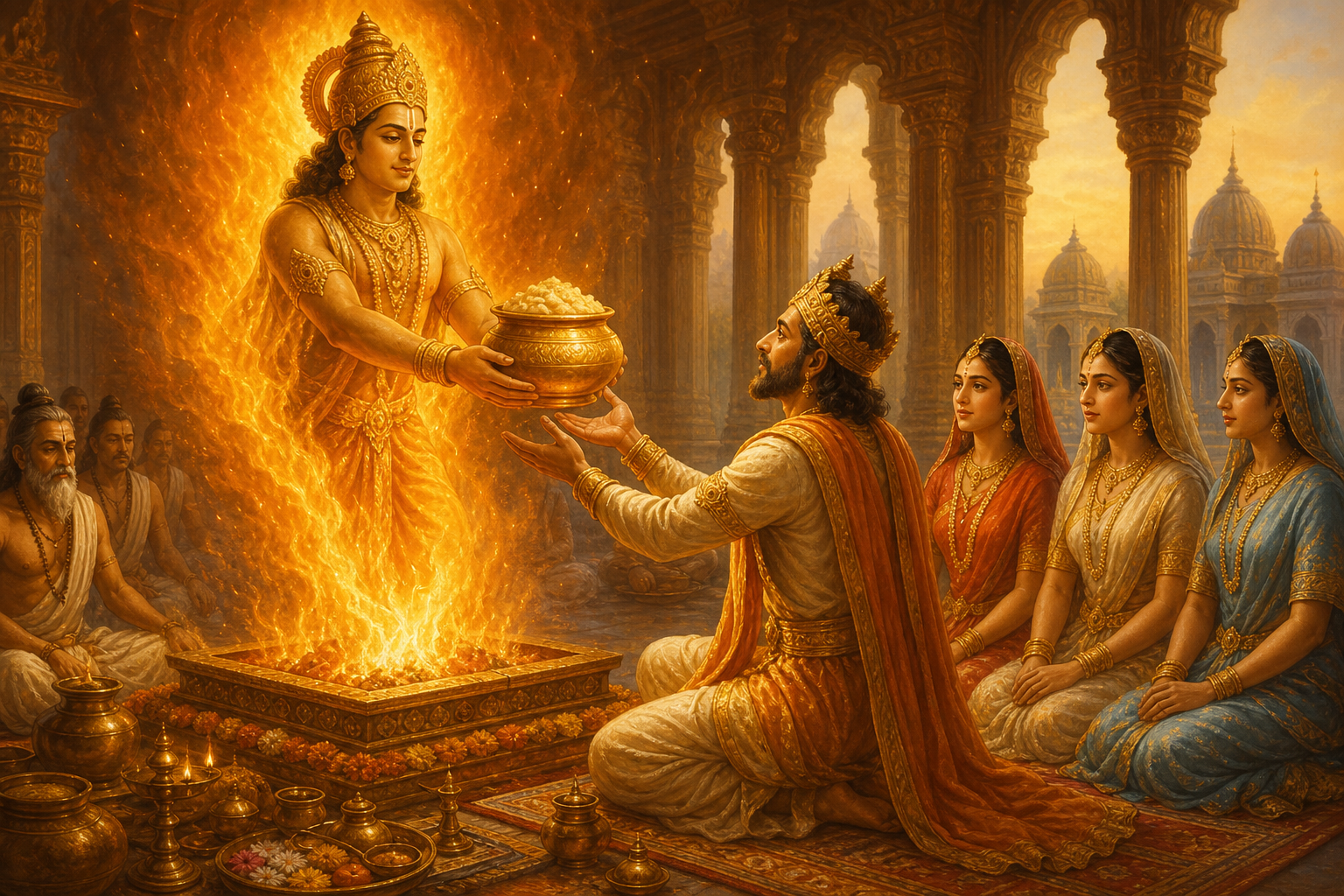
Grieving that he has no heir, King Dasharatha turns to his guru, Sage Vashistha, who assures him of four sons and calls for the sage Shringi Rishi to perform the Putrakama Yagya — the fire ritual undertaken for the boon of children. As oblations are poured into the fire, the fire god himself emerges in human form, holding a vessel of mystic pudding (havishyanna), and tells the king his aspiration is fulfilled.
Dasharatha divides the pudding among his three queens: half to Kaushalya, and the remaining half divided again — a quarter to Kaikeyi, and the last quarter split once more between Kaushalya and Kaikeyi, with the final two small portions going to Sumitra.
Tulsidas’s Mathematics of Integral Yoga
Swamiji reads this division as a precise, if playful, mathematics. Kaushalya’s share — representing Rama, jnana — is one-half, the highest. Kaikeyi’s share — Bharata, bhakti — one-quarter. Sumitra’s two small portions — Lakshmana and Shatrughna, dhyana and karma yoga — one-eighth each. Four fractions, unequal in proportion yet, as Swamiji puts it, “all together” — four fingers of one hand, none dispensable, combining into the single whole of real yoga: action, emotion, will, and reason, integrated.
The class closes as all three queens conceive, and the astrological alignment for Rama’s incarnation draws near — the story to be continued in the next class.
Scholar’s Corner
This class covers the Ramcharitmanas of Goswami Tulsidas, Balakanda, Doha 186 and its surrounding chaupais, including the verses Hari Vyapak Sarvatra Samana, Janidar Pahu Muni Siddha Suresha, Tin Ke Grih Avatari Hau Jai, Kashyap Aditi Mahatap Keena, and Bhagati Sahit Muni Ahuti Dinhe. The teaching on the four stages of the soul’s ascent draws on Bhagavad Gita 8.24, Agnir Jyotir Ahah Shuklah Shanmasah Uttarayanam.
Glossary of Spiritual Terms
- Jnana: Knowledge; the yoga of discernment, associated with Rama.
- Dhyana: Meditation; the yoga of concentrated will, associated with Lakshmana.
- Bhakti: Devotion; the yoga of the heart, associated with Bharata.
- Karma Yoga: The yoga of selfless action, which removes impurity; associated with Shatrughna.
- Vairagya: Dispassion; discernment that no longer chases objects without reflection.
- Uttarayana: The “northern path” of the sun, used allegorically for the soul’s ascent toward realization.
- Putrakama Yagya: A Vedic fire ritual performed for the boon of children.
- Havishyanna: The sacred food offering produced through a yagya, distributed as prasada.
- Kaushal: Skill; the root of Queen Kaushalya’s name.
Watch the Full Lecture
Watch the full lecture on YouTube.
Join the community for daily inspiration.
This study guide is drawn from the archived teachings of Sri Swami Jyotirmayananda.