
Yoga Vasistha, Upasama Prakarana, sections 37 to 39 — lesson 180
Sri Swami Jyotirmayananda, senior-most living direct disciple of Swami Sivananda
Orientation
There is a particular fear that keeps thoughtful people from taking liberation seriously, and it is rarely said out loud: that enlightenment would cost them their life. That the price of realizing the Self is to become useless — seated, silent, indifferent to a world that still needs feeding and defending. Tonight’s lesson takes that fear directly, and its answer is not reassurance. It is a correction.
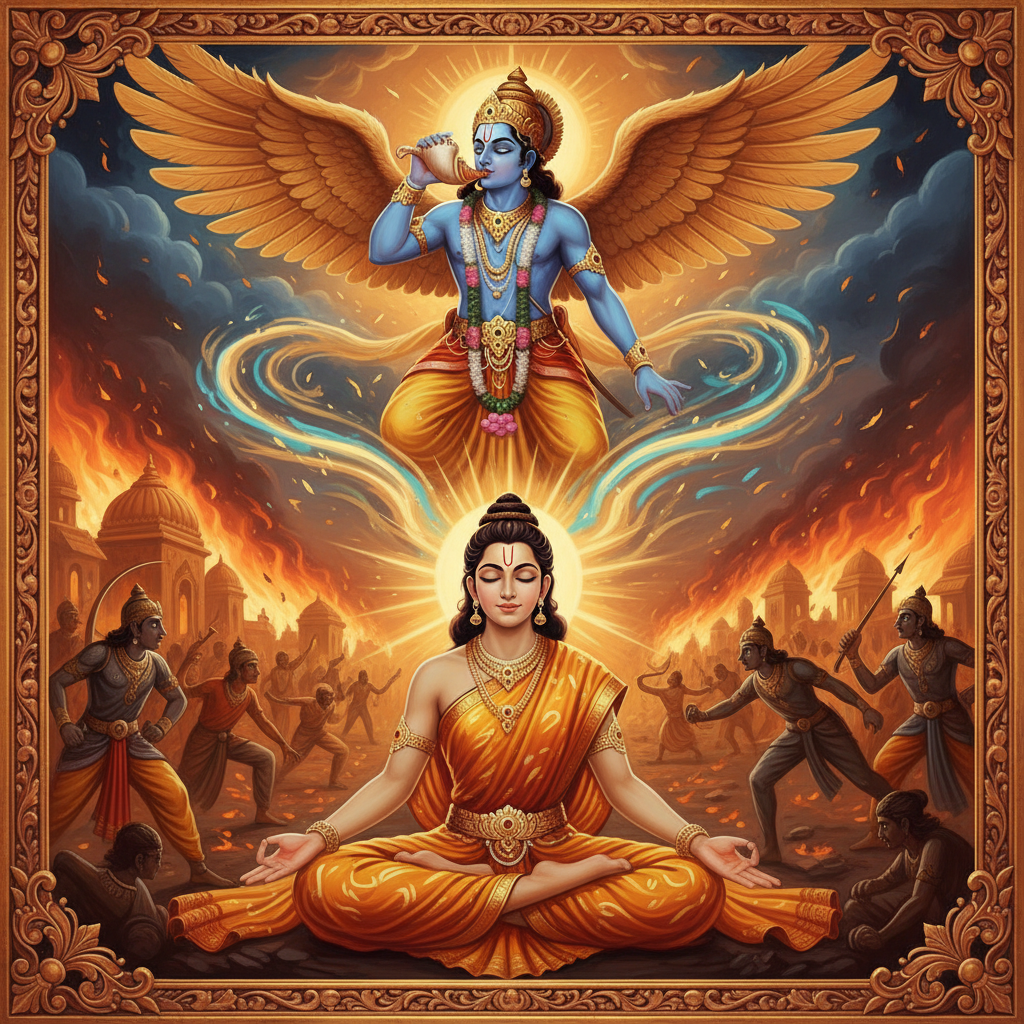
Prahlada, at this point in the story, has entered nirvikalpa-samadhi. He sits, in Swamiji’s phrase, “like a painted picture,” and his kingdom falls apart around him. The weak are oppressed by the strong. Enemies destroy the cities. Nobody is there to handle it. And the being who comes to wake him is not a critic of samadhi but Lord Vishnu himself, riding Garuda, sounding the Pancajanya conch — and his reason for the interruption is stranger than anything a modern reader expects. If Prahlada stays where he is, the demons will be destroyed. That, Vishnu says, is the loss.
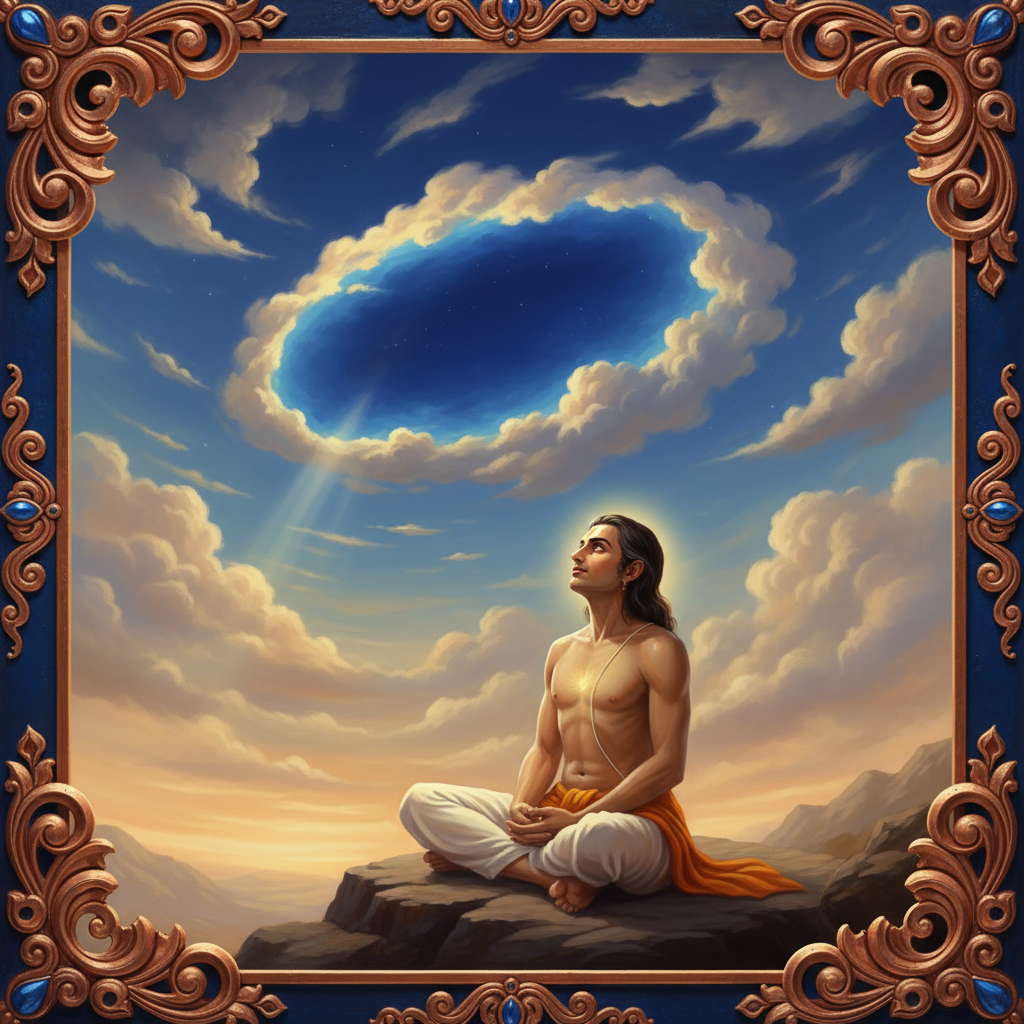
Around that reversal Swamiji builds two things a student can actually use. The first is a map: six forms of samadhi, three turned inward and three turned toward the world, so that practice stops meaning sitting and starts meaning something available in the middle of an ordinary active day. The second is an image so simple it can be carried for years. Clouds drift across the sky and appear to capture a patch of blue, and the patch travels with them, and the clouds are quite convinced they have taken possession of something. That is bondage. Enlightenment does not chase the clouds away. The clouds still race, positive and negative are all still there, and — this is the line to sit with — “Appearance has not changed.” Only the identification has. You are no longer a patch of blue. You are the sky.
The passages
|—|—|
| 00:00 | Cold open: the radiation an enlightened life sends out |
| 00:46 | Invocation and adorations to the sadguru |
| 03:52 | The patch of blue and the sky that never moved |
| 05:55 | Prahlada enters nirvikalpa samadhi and the kingdom falls |
| 07:38 | Antar samadhi: drsyanuviddha, sabdanuviddha, nirvikalpa |
| 14:13 | Bahya samadhi: the world as the glory of God |
| 18:20 | Chaos in the kingdom, and every enlightened soul as avatara |
| 24:32 | Why the demons must keep doing their duty |
| 29:14 | Vishnu wakes Prahlada with the Pancajanya conch |
| 36:33 | Fit to die: what the phrase actually means |
| 44:24 | Jnana-drsti: nothing here to love or to hate |
| 50:24 | Jivitam yasya sobhate: whose life shines |
The patch of blue
Start with the picture, because everything else in the lesson hangs from it. A cloud passes over the sky and seems to enclose a piece of it. As the cloud moves, the little circle of blue moves too, and if you watch only the cloud you will conclude that the blue belongs to it — that it is being carried. Swamiji’s application is exact: in the state of ignorance “You are like this piece of the sky being moved by your karmic process.”
What changes at enlightenment is not the weather. “Some clouds are racing, some going this way, that way. Positive, negative, all is there.” The sky was never actually captured; it was only ever appearing to be captured, and the appearance persists. So the difference between bondage and liberation turns out to be invisible from outside: “Only difference that now you are not a patch of blue, you are the infinite blue.”
This is why the lesson can be so calm about the continuing existence of difficulty. A student who expects enlightenment to clear the sky will read every remaining cloud as evidence of failure. A student who has understood this image expects the clouds, and measures progress somewhere else entirely — in whether the patch is still being dragged around.
A painted picture
Prahlada’s samadhi is presented with real sympathy and then firmly relativized. He has attained something immense; he is also, at this moment, unavailable. “And while all his kingdom suffers, nobody is there to handle it.” Swamiji pauses the narrative here to correct a common assumption about what advanced samadhi even is. It “is not staying in one pose and allowing your mind just to stay focused on a certain object.” The mind in samadhi is not parked. It has to become actively involved in the question who am I.
That correction is the hinge of the whole class. If samadhi were a posture, then the world and the practice would be genuinely in competition, and Prahlada’s collapse would be the price of his attainment. Because samadhi is an insight into identity, it can travel — into speech, into work, into a kingdom that needs governing.
The three inward movements
Swamiji then gives the map. Antar means internal, “referring to your own mind, your own thoughts, your emotions which you are subjectively you are watching.” Its first stage internalizes attention until the entire mental process becomes an object: “The whole mind has become drishya. You are the one watching and they are being watched.” This is sakshi bhavana, the witness attitude, and it is the necessary first move — you cannot investigate what you are still standing inside.
The second stage, sabdanuviddha, adds a scripturally grounded affirmation. Watching is not enough; the watcher asks what the watched is made of. Swamiji reaches for the cinema, as he often does: behind every image on the screen, “Screen is the reality.” Behind every thought, saccidananda. Behind every dream experience, your own consciousness. The affirmation is not a mood; it is a conclusion held steadily against the evidence of the senses.
He is careful about what this is not. It is not spiritual avoidance: “You are not moving away from your problems just by turning your head, but by understanding that your problems are not problems.” That distinction is worth reading twice. The relief is not produced by looking away. It is produced by seeing what the trouble is composed of — “And mental projections are not reality. Reality behind your mental projections is consciousness, Pure Awareness.”
He then supplies the analogy that makes the third stage intelligible. Consider yoga-nidra: “your body continues to have its problems. But while you are practicing it, you withdraw yourself.” Nothing about the body’s situation improves during that practice, and yet you “begin to experience special type of exhilarating relaxation.” The withdrawal is real without being an escape, because it is not achieved by denying the body’s condition but by ceasing to be located in it. Read that across to the mind, and the third stage follows: the thoughts still have their own practical reality, and you are no longer inside them.
The third stage is nirvikalpa, where the mind stops interfering with the vision. Description fails at this point; if pressed, aham brahma.
The three outward movements
Then the same three, turned outward, and this is where the lesson becomes practical for anyone with a job. In the active hours, looking at things, you hold the deeper understanding that objects are real in relation to the senses and not real in themselves. Swamiji guards the flank immediately: “Be a sensitive person, not a senseless person.” Maya is not an excuse for numbness.
Next, the same perceptions read as appearances of Brahman. Nothing you see is a senseless vision; behind every perception, God is shining through it. “And there is nowhere in the world where the Atman, the Self, is not there.” He glosses this with the Gita’s Vibhuti-yoga — the world as God’s glory spilled everywhere — and, remarkably, with the Gospels: “Try to consider the lilies of the field, how do they grow?” The instruction is to let the mind open to a world that is constantly presenting the amazing glory of God, which is also a plain description of what wonder feels like.
Then the third: that glory is the Divine Self, and that Divine Self is I Am. “Look at me, I Am. You little ego, get out. I’m the real I Am.” The sun’s shining, the moon’s cooling rays, the surging ocean, countless brahmandas sustained — all of it this. And at the end of that expansion, nothing left to say. “Mind completely relaxes.” That state, Swamiji says, becomes your real identity, and its name is jivanmukti.
Six forms, then, three internal and three external, and a saving word about pace: “And all this I have said at the highest climax. Your movement is gradual.”
Why the kingdom matters
Back to the story, and now the collapse can be read correctly. It is not scenery. “Your enlightened state creates order and encourages all souls to follow the path of dharma.” Swamiji takes Krishna’s promise — yada yada hi dharmasya glanirbhavati bharata — and refuses to confine it to the classical descents: “This incarnation is not limited to avataras. Everyone who attains enlightenment is an avatara of God.”
His example is Shankaracharya, and he uses it to correct Shankaracharya’s own followers. The world is false, the snake on the rope — and some students concluded from that: nothing to do with the world, get to sannyasa, get away. “Sankaracarya didn’t teach that. He taught people with great interest to enlighten them,” and he founded centers to keep people studying the scriptures for centuries. The teaching that the world is unreal is not a license to abandon it.
Why the demons must stay
Now the genuinely strange turn, and the part of this lesson most likely to be misremembered. Vishnu’s worry is not that evil will triumph. It is the opposite: “Demons who contribute to the balance of forces in the world will be destroyed.” And the consequence: “And if demons don’t exist doing their duties, nobody can attain enlightenment.”
Swamiji makes the logic ordinary with two illustrations. First the body: for perfect health, shall all bacteria be destroyed? “How can you live?” Second, motion: walk on a surface with absolutely no resistance at all and you will slip — you cannot get anywhere. Those who have not yet attained “need resistance before them for their progress.” Every discovery of your own strength was made against something. Challenges are presented, and in your own mind you go on discovering what is negativity and what is not.
He extends it to the gods, who in this context are the heavenly gods, not the liberated — beings whose role is bhoga, enjoyment, and whose virtue must not fall under the control of negativity. Their activity depends on opposition. “So without demons, gods become lazy.” Remove the friction and heaven sinks into its own pleasure, human offerings lose their fulfillment, and the whole circuit of exchange between earth and heaven goes slack.
Garva, guru, Garuda
Before the conch, a small philological aside that turns out to carry weight. Vishnu arrives riding Garuda, and Swamiji reads the bird as a stage of the soul’s own strength. “The first stage of Garuda is garva” — pride. And then a characteristically unsentimental concession: “You become proud of yourself. Pride again is not always bad. You are doing good things and a special pride enters.” From that garva comes Garuda, the immense power that carries the Divine. And Garuda, garva, guru all share a root: “So the same root letter is being highlighted in this context: guru, garva, Garuda.”
The point is not etymological trivia. It is that the energy which becomes spiritual strength is the same energy that shows up first as self-regard. You do not destroy it; it matures. On the practical side, Swamiji notes, Garuda is simply “a powerful bird, an eagle” — extremely powerful. The vehicle of the Lord is force, correctly directed.
The conch
So: “Let Me therefore awaken Prahlada from his samadhi.” Vishnu blows the Pancajanya, and the awakening is described in the body’s own language — the pranas pulsing at the crown like the rising Ganga, the nectar of the sahasrara sweeping over the whole personality, a withering plant revived by a shower of rain. Swamiji’s aside is bracing: what Prahlada was in “was not normal.”
There is also a promise in Vishnu’s speech that is easy to read as merely royal: Prahlada is to rule until the end of the present kalpa. Swamiji translates it inward. You are living in the body; you are ruling over the body — “ruling in the sense that body will not overpower you,” and further, “body will not handicap your power, progress, experience.” Then he adds the reason this matters to anyone who has ever learned from a teacher rather than a text: “the body of a sage becomes a powerful channel” for “Presenting to the world the essence of all scriptures, more profoundly than the scriptures themselves.” Set the teaching you find on the page beside the teaching you see expressing through the life of an enlightened sage: “Big difference.” The continuing body is not a residue left over from liberation. It is the instrument through which liberation becomes transmissible.
And the instruction Vishnu gives is the definition of the state this whole lesson is pointing at. “A jivanmukta continues to do his duty towards the world until his karma is over.” Then he becomes videhamukta. Meanwhile, “while performing his duties, he will continue to abide in the boundless Self.” Though possessing a body, he is videha, bodiless — which is why Janaka, a king with a kingdom to run, was called Videha.
Fit to die
The section closes in poetry, and the refrain needs handling because it sounds punitive in English. “Fit to die has to be understood. Fit to die means they, they need to die in order to progress.” Those who live under the control of agitated minds, pierced by the arrows of misery, never asking how misery ends; those identified with the mortal personality; those who let cravings rob them of discrimination; those who let the creeper of the mind entwine their consciousness “with attachment and hatred, which are decked with the flowers and fruits of pleasure and pain” — for them death is not a penalty but a further chance. “For death will lead to rebirth, and they will continue to reincarnate until they attain enlightenment.”
Swamiji says it plainly, and it is the warmest moment in the class: “The divine plan is loving to his soul. You’re not satisfied, didn’t learn that lesson, all right, we’ll give you another one.”
The three knots
Having named the condition, he names its mechanism, and this is the most diagnostic passage in the lesson. The fear itself has a technical name — “Abhinivesa-klesa. That means, see, death terrorizes everyone.” Beneath it sit three knots of the heart: “Basic cause is avidya, kama, karma, three granthis, knots of the heart.”
Each has its own remedy, and the symmetry is worth memorizing. Karma-granthi ties you to experience in time and space, where “all that experience is kind of a mirage, nothing is substantial”; it “is removed by Karma Yoga.” Kama-granthi is the knot of desire, and Swamiji’s picture of it is domestic and exact: some desires are active, others are “put into your box” — stored, waiting, not gone. “So as long as these arts have not found their resolution, you have to live.” That is the mechanism of rebirth stated without drama: unresolved wanting requires more time, and time requires a body. The third is avidya, ignorance, and here he is blunt about the trap of endless acquisition: as long as the mind is going after worldly knowledge, “You are going to die because the world is not finished.”
The image he leaves it with is the reflected sun. “A reflected sun in a jar of water” — break the jar, and what is lost is the jar. The reflection appears elsewhere. If you have concluded that you are the reflection, then the jar’s fate is your fate, and every crack is a mortal threat. That is identification, precisely described, and it is the only thing death has ever had hold of.
The counter-condition is jnana-drsti, the vision not refracted by attachment and hatred. Where that vision is, there is nothing here to love or to hate — “If at all, all this is Brahman Himself.” Practically, this is not indifference but composure: allowing the mind to compose itself “without the swing of like and dislike,” which opens the channel toward who am I. Yoga Vasistha named that gatekeeper at the very start of the text — sama, serenity. Its twin brother is samadhana, tranquility: do not let the mind be agitated by everything happening internally and externally.
And then the homely, unforgettable application. Tapantam na nindyat — when it becomes too hot, do not go on crying that it is hot. Calm yourself, sit in your room, and look through your window at all the trees receiving immense energy from the sun. Varsantam na nindyat — when the rain comes, keep yourself warm, but do not keep the mind focused on how miserable it is. This is allegorical for any disturbance: “Stay quiet, understand, learn lesson from it, what has caused it,” holding the deeper understanding “that every situation is an opportunity for you to discover your intelligence, your strengths.” He calls that an amazing act of grace, and goes further: “Being related to God becomes possible only through challenging circumstances.” Which is the demon teaching again, arrived at from the inside.
The final refrain answers the first. Where the earlier verses rhymed on deserve to die, these rhyme on jivitam yasya sobhate. “Living for them is glorious. Their life shines.”
Scholar’s Corner
The six-fold samadhi scheme. The three-plus-three structure Swamiji lays out — drsyanuviddha, sabdanuviddha, and nirvikalpa in both an antar and a bahya mode — belongs to the Yoga Vasistha’s own extended treatment of samadhi and its later commentarial elaboration rather than to any single verse of sections 37 to 39. Patanjali’s four-rung samprajnata scheme (vitarka, vicara, ananda, asmita) is a different taxonomy; do not blend them.
“Demons who contribute to the balance of forces.” The reading that asuric forces have a function in the cosmic order, and that their wholesale destruction would be a loss, is genuinely in this passage of the Yoga Vasistha and is not the popular understanding of avatara-as-demon-slayer. Swamiji says so explicitly, and anyone who has only met the Puranic framing should mark it.
Videha and Janaka. The identification of Janaka as Videha is traditional wordplay with real doctrinal weight: the king of Mithila, fully engaged in governance, is the standing scriptural example of embodied liberation. It is not incidental to the argument; it is the argument.
A note on the recording. This class was transcribed from audio and some passages carry transcription artifacts. Quotations here were taken only from clean passages and checked against the timed transcript. Where a phrase in the audio is ambiguous, this guide paraphrases rather than attributing wording to Swamiji.
Glossary
jivanmukti / jivanmukta — liberation while still embodied; one who is so liberated.
videhamukta — liberated at the dropping of the body, after prarabdha-karma is exhausted.
nirvikalpa-samadhi — samadhi without conceptual content or verbalization.
antar / bahya — internal and external; here, the two directions the same threefold practice can face.
drsyanuviddha — samadhi “interpenetrated by the seen”; the witness watching the mind as object.
sabdanuviddha — samadhi “interpenetrated by word”; scripturally grounded affirmation.
sakshi bhavana — the witness attitude.
drsya — the seen, the object.
saccidananda — existence, knowledge, bliss absolute.
raga / dvesa — attachment and aversion; the two arms of the mind’s swing.
jnana-drsti — the eye of wisdom; vision unrefracted by raga and dvesa.
sama — serenity; in the Yoga Vasistha, the gatekeeper at the entrance.
samadhana — tranquility, mental composure; sama’s “twin brother.”
vibhuti — divine glory or expression; the Gita’s tenth chapter.
prarabdha-karma — the portion of karma allotted to the present life.
sahasrara — the crown center.
Pancajanya — Vishnu’s conch.
Garuda — Vishnu’s eagle mount; Swamiji links guru, garva, Garuda through their shared root sound.
For reflection
- Where in your life are you still watching the cloud instead of the sky — treating a moving circumstance as though it were carrying your identity with it?
- Swamiji distinguishes turning your head from understanding that your problems are not problems. Can you name one difficulty you have been handling by the first method?
- Of the six movements, which is actually available to you today: watching the mind as object, holding the affirmation, or reading the world as God’s glory?
- What resistance in your life has taught you something no easier circumstance could have?
- When did a situation you complained about later turn out to be, in Swamiji’s phrase, an amazing act of grace?
- If appearance does not change at liberation, what would you look for in yourself as evidence of progress?
This study guide is drawn from the archived teachings of Sri Swami Jyotirmayananda.