
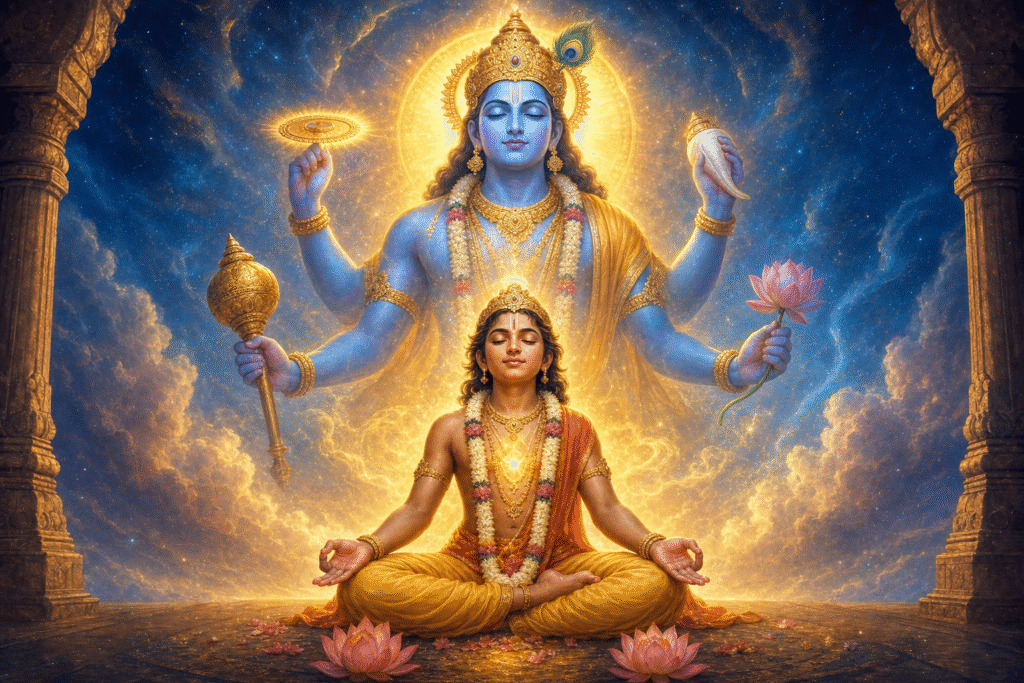
From a lecture by Sri Swami Jyotirmayananda, a direct disciple of Swami Sivananda, we receive a profound examination of the Upasham Prakarana from the Yoga Vasistha. When daily stress and inner doubts arise, the ancient scriptures provide a lasting cure through devout meditation and an understanding of divine grace. In section 32, Sage Vashistha recounts the transformative story of King Prahlad to Lord Rama, revealing the secrets of spiritual evolution.
Prenatal Education & The Story of Prahlad
Prahlad, a great devotee of Lord Vishnu, attained his profound spiritual foundation even before birth. While his father, the demon Hiranyakashipu, practiced austerities, Prahlad’s pregnant mother resided in the ashram of Sage Narada. Under Narada’s influence, the baby in the womb was awakened to devotion. Swamiji teaches that prenatal education is a “super science,” suggesting that parents who want spiritually strong children should align their own lives with the Divine.
Ahamgraha Upasana: The Buffalo Metaphor
After the destruction of Hiranyakashipu by Narasimha (the man-lion incarnation of Vishnu), Prahlad took up a specific meditation practice known as Ahamgraha Upasana. Swamiji explains that while normal upasana involves viewing God externally, Ahamgraha Upasana requires the aspirant to blend completely with God, asserting “I am that”. Swamiji humorously illustrates this with a story of a disciple who meditated so intensely on being a buffalo that he felt he could not fit through the cave door to eat, reminding us that while this deep identification is a powerful practice, one must not remain stuck in the metaphor.
The Meaning of Lord Vishnu’s Attributes
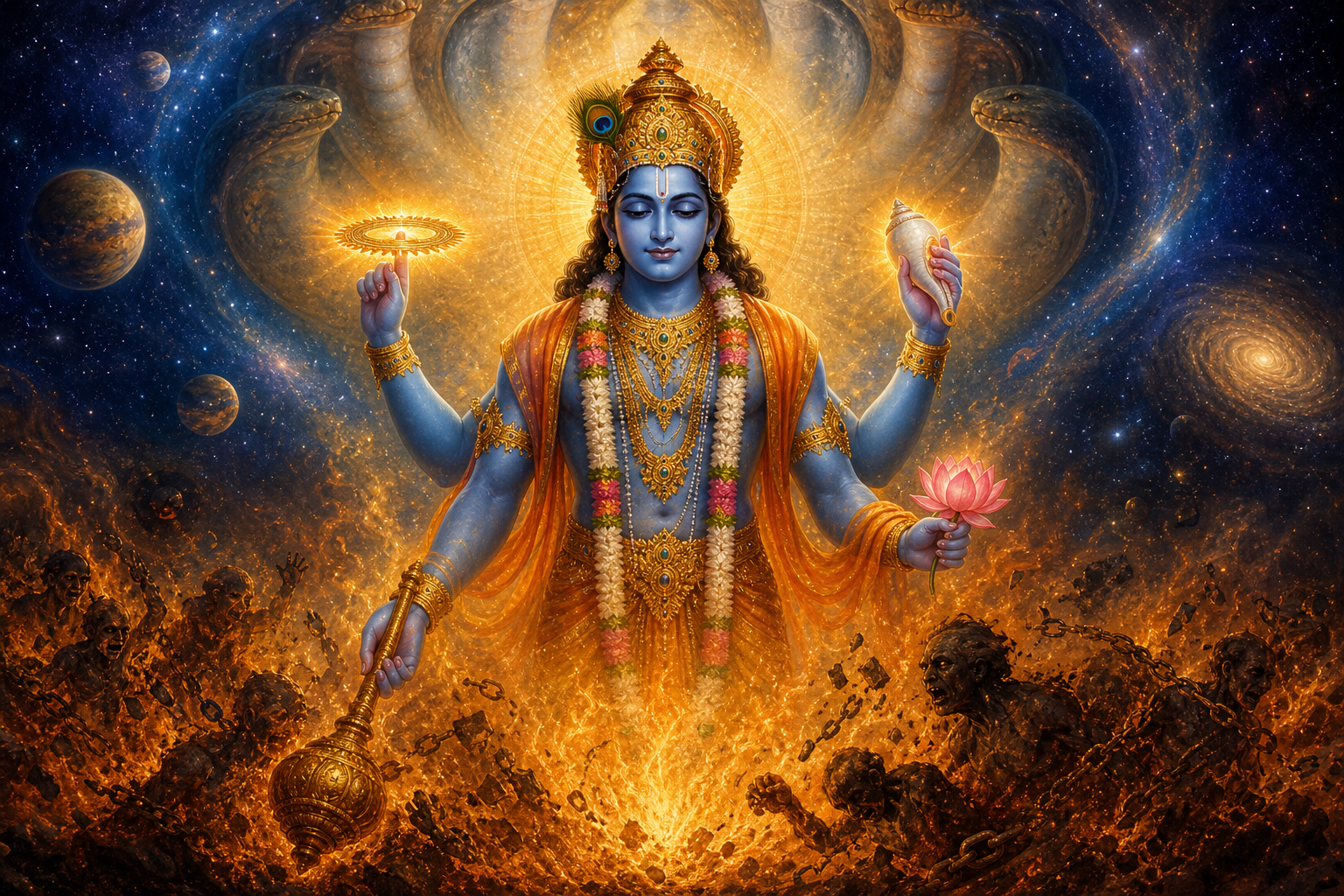
During his meditation, Prahlad reflected on the attributes of Lord Vishnu. Swamiji clarifies the symbolism: the blue complexion represents the infinite expanse of space, transitioning the practitioner from physical space to an expanded mental space. The four arms symbolize divine permeation of the universe, and the objects held represent awakening (conch), karmic movement blended with grace (discus), breaking down difficulties (mace), and divine virtues (lotus).
Burning Karma Through Devotion
Prahlad’s internal worship ultimately purified his mind and positively influenced his demoniac subjects, turning them away from cruelty. When the heavenly gods expressed concern to Vishnu about this change, the Lord reassured them that an ascending spiritual movement (uttan) is a cause for rejoicing, not fear. Vishnu explained that Prahlad’s karmas were burnt up by the fire of devotion, ending his cycle of birth and death.
The Eight Great Virtues of the Soul
As Prahlad progressed, his natural divine qualities bloomed. Swamiji outlines the eight great virtues (Shisht) inherent to the soul: daya (compassion), shanti (forgiving peace), anasuya (absence of fault-finding), shauch (spontaneous purity), anayas (effortless action), mangal (auspiciousness), akarpanya (absence of miserliness), and aspreya (freedom from greed). When an aspirant aligns with the Divine, these virtues develop naturally without forceful tension.
The Four Types of Grace
Swamiji concludes by emphasizing that spiritual success relies on grace (Kripa). There are four types: Ishwar Kripa (God’s fundamental grace), Atma Kripa (the inner hunger for truth), Guru Kripa (authentic guidance from a preceptor), and Shastra Kripa (the living inspiration drawn from scriptures). Without grace, studying texts leads only to a “swollen head,” but with grace, the scriptures reveal hidden jewels of wisdom.
Scholar’s Corner
- The text references section 32 of the Upasham Prakarana within the Yoga Vasistha.
- The story of Prahlad demonstrates the shift from ordinary destiny to Vidy Vidhan, the divine plan for enlightenment.
- The movement of devotion requires blending Purushartha (human effort) with divine grace.
Glossary of Spiritual Terms
- Ahamgraha Upasana: Devout meditation where the practitioner identifies entirely with the object of worship.
- Kripa: Divine grace that speeds up the spiritual process.
- Purushartha: Personal effort or exertion.
- Shisht: The eight great, natural virtues of the soul.
- Vidy Vidhan: The divine plan for the soul’s enlightenment.
Watch the Full Lecture
Watch the full lecture on YouTube.
Join the community for daily inspiration.
This study guide is drawn from the archived teachings of Sri Swami Jyotirmayananda.