
Sri Swami Jyotirmayananda continues the Yoga Vasistha, Upasama Prakarana, Section 35, with Prahlada’s own reflection on the glories of the Atman. This is not abstract philosophy. It is a direct answer to a very ordinary fear: that we have to earn our way back to God, or that we have drifted too far to be welcomed home.
The Three Fires of Duality
Every soul, Swamiji explains, meets three kinds of fire. The subjective fire is the misery we create in our own mind, our reactions, our fears, our restlessness. The objective fire is the trouble that comes from the outside world, people, circumstances, loss. The third is what Swamiji calls the act of God, the sudden turn of events, the storm that breaks and then clears.
All three fires belong to the realm of duality, the world of multiplicity we live inside every day. The one who has seen through them, who recognizes their ceaseless rising and falling, is the one the Vasistha calls successful in life.
AUM and the Four States of the Self
Swamiji walks through the classical map of the syllable AUM to show how ordinary identity is built in layers. First comes Vishwa, the identification with the physical body and the physical cosmos, Virat. Then Tejas, identification with the subtle body, the cosmic mind. Then the causal stage, the unconscious ground Swamiji names Tagnya, which corresponds to Ishvara, God, on the cosmic scale.
Each of these, mind, subtle body, causal body, is a wave. Behind every wave is the ocean. The physical, subtle, causal, and transcendent states all point back to one reality. That reality is Turiya, the fourth state, Brahman, the absolute.
Where Is God? The Butter Hidden in the Milk
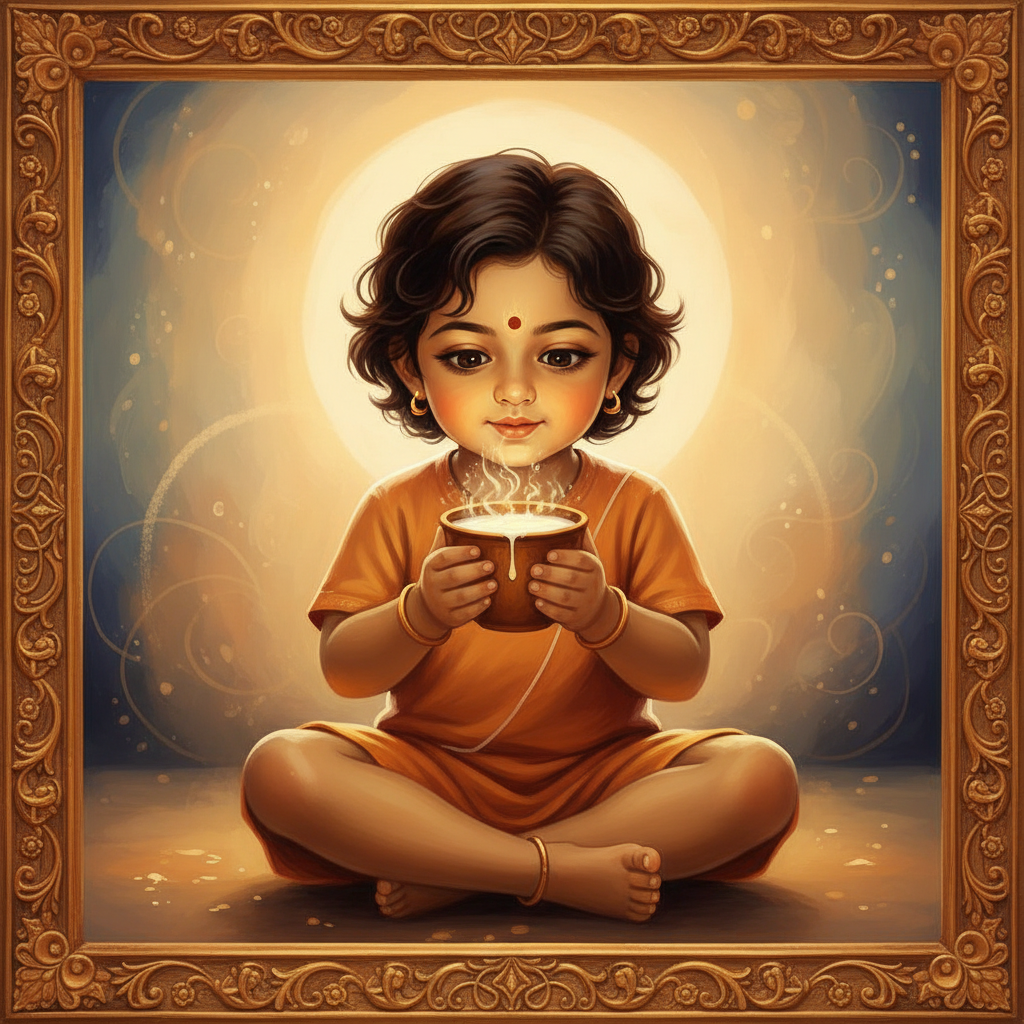
To make this concrete, Swamiji offers a simple illustration. Give a child a cup of milk and ask him to find the butter in it. He will not see it anywhere, and yet it is everywhere in the milk. This, Swamiji says, is exactly how God is present in the world we see. Not visible as a separate object, yet the very substance of everything.
The instruction that follows is direct: stop searching for God as if He were a place, a temple, or a distant address. Turn instead toward awareness itself, the bare fact of experiencing, untouched by whatever pleasure or pain happens to be passing through it.
Your Glory, Not Your Terror
When fire burns, Swamiji says, do not think of it only as something destructive. Think of the power behind it. That power is not the fire’s own; it is glory, and that glory belongs to the Self shining through every element, every object, every experience of pleasure and pain alike.
This is the deeper meaning of the ananda hidden in the cave of the heart, satchidananda, existence, consciousness, and bliss, seated quietly at the center of a life that often feels anything but blissful.
The Friend You Recognize Again
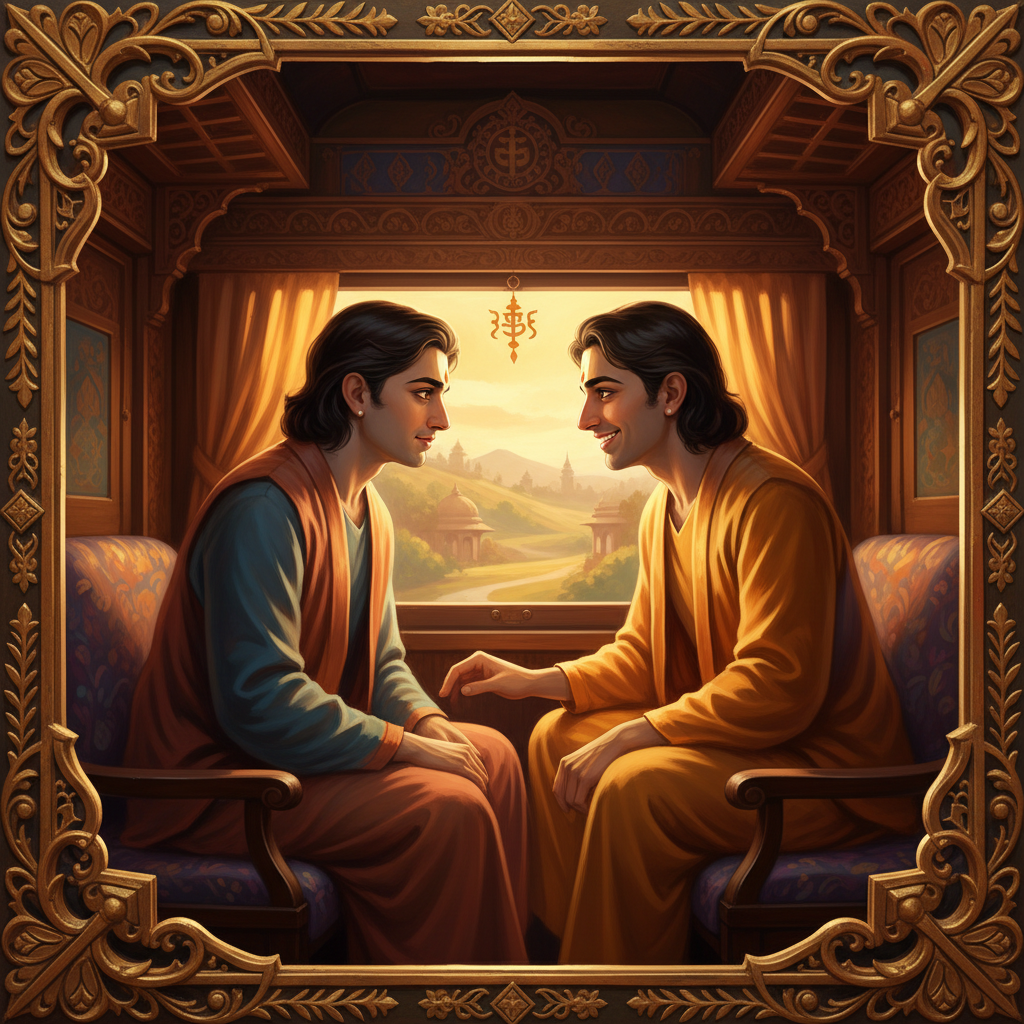
Prahlada’s reflection turns, in its most tender passage, to a small story. A man travels alone on a train, feeling miserable, until the stranger seated beside him turns out, after a little conversation, to be a childhood friend he failed to recognize. Years and height and distance had covered over what was always there.
Self realization, Swamiji says, is exactly this kind of recovery. Not the discovery of something new, but the recognition of a friend who was never actually a stranger. God has been the nearest reality all along. What was missing was not His presence but our attention.
God Cannot Reject You
Among the glories of the Atman that Prahlada lists, one stands out as an outright promise. God is omnipotent, and yet Swamiji names a single exception to that omnipotence: God cannot reject you. He cannot abandon a single soul, because every soul is His own reflection. Rejection is simply not within His power.
This is worth sitting with. Whatever a person believes has disqualified them, however far they feel they have wandered, the text does not leave room for that fear. Fear of rejection is answered directly, not with reassurance alone but with a statement about what God can and cannot do.
Humility Is Not a Word, It Is a Blossoming
Two virtues anchor the practical side of this lecture. The first is fearlessness, refusing to let fear rule the heart. The second is humility, and Swamiji is precise about what humility is not. Announcing “I am very humble” only highlights the ego doing the announcing. Real humility cannot be spoken into being any more than a tree can announce its own blossoming.
Humility grows the way a tree blossoms, through the quiet maturing of practice, not through a decision made one morning and declared the next.
The Joy That Needs No Object
The lecture closes on the self as the taster of every experience, the black bee drawn to the honey seated in the lotus of the heart. Whatever joy arrives in a life, its source is the Self, not the object that seemed to carry it. Discovering this, even in small measure, does something practical: it stops the mind from chasing the same worldly objects with the same old hunger, not by force, but because a taste of real ananda quietly outweighs them.
Scholar’s Corner
This lecture continues Prahlada’s reflection from the Upasama Prakarana of the Yoga Vasistha, Section 35, on the glories of the Atman, following his earlier declaration in Section 34 that liberation admits no differences between one seeker and another. The image of the self as the taster of honey in the lotus of the heart, and the description of the Atman assuming the form of time and space, both belong to this same sustained meditation on the qualities of the Self as recounted by Prahlada.
Glossary
- Atman
- The Self, the innermost reality of a person, distinct from body, mind, and ego.
- Brahman
- The Absolute Reality, the one truth behind all names and forms.
- Ishvara
- God as the cosmic ruler, the causal-level counterpart to the individual’s unconscious.
- Turiya
- The fourth state of consciousness, beyond waking, dream, and deep sleep, identified with Brahman.
- Maya
- The creative power through which the one Self appears as the many, likened to a potter’s wheel shaping countless forms from a single clay.
- Ananda
- Bliss, the third aspect of the Self alongside existence and consciousness.
- Satchidananda
- Existence, Consciousness, and Bliss, the threefold nature of Brahman.
- Vishwa
- Identification of the self with the physical body and the physical cosmos.
- Bhavasagar
- The ocean of the world process, the entanglement of time, space, and causation that one crosses by realizing Brahman.
Watch the Full Lecture
From a lecture by Sri Swami Jyotirmayananda. Watch the full Yoga Vasistha series on our channel, and join us for the nightly premiere.
This study guide is drawn from the archived teachings of Sri Swami Jyotirmayananda.