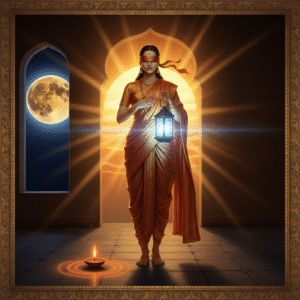
Why the Absolute Bends Down to a Child
Swamiji opens this class with a sentence he returns to almost fifty minutes later, in the same words: “He is closer to you than your physical heart.”

Swamiji opens this class with a sentence he returns to almost fifty minutes later, in the same words: “He is closer to you than your physical heart.”
A study guide to Yoga Vāsiṣṭha, Lecture 185 — Upaśama Prakaraṇa, Sections 45 and 46, with Swami Jyotirmayananda

Tonight’s class takes up a question that arrives sounding like an objection. The story of Prahlada has just closed, and in it Lord Vishnu appears and grants the boon of supreme devotion, which opens the door to liberation. Rama notices the problem immediately. If the Lord can simply hand over Self-r
Patañjali spends one sūtra on the people who arrive already awake, and then he turns to everybody else. Lesson 11 of Swami Jyotirmayananda’s Raja Yoga Sutras series takes up Samādhi Pāda 1.20 and 1.21, and the shift between them is the whole reason this lecture is worth an hour of your attention. Th
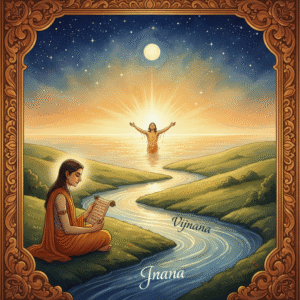
Swami Jyotirmayananda opens the seventh chapter of the Bhagavad Gita by doing something the chapter's own title invites and most readers skip. The chapter is called Jnana-Vijnana-Yoga, the yoga of knowledge and realization, and almost everyone treats those two words as a pair of synonyms stacke
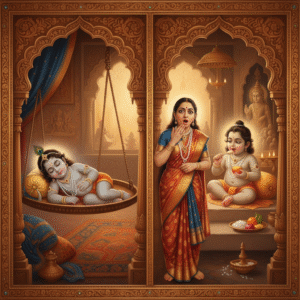
Kausalya has just finished dressing her infant in his ornaments. She lays him down, performs her worship, offers food to the deity, and steps away to the kitchen. When she comes back, Rama is eating the offering. She runs to where she left the child and finds him asleep, exactly as she put him down.

This lecture closes the story of Prahlada and then does something the story could not do on its own. It takes the finished picture apart and names the parts. Sage Vasistha has spent several sessions on a boy-devotee who reached the highest goal; here, in section 42 of the Upasama Prakarana, he stops
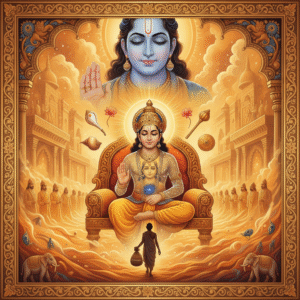
Prahlada, the demon king who became one of the great devotees, has gone into samadhi and not come out. Sage Vasistha has been telling Rama this story for several sections now, and at Section 41 of the Upashama Prakarana it reaches an odd resolution: Lord Vishnu arrives, wakes him, and tells him to g

Raja Yoga Sutras, Lecture 10. Samadhi Pada, sutras 1.19 and 1.20.
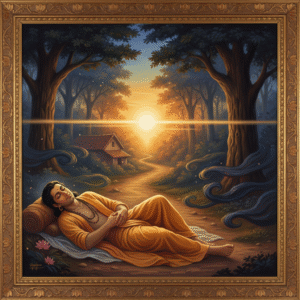
Arjuna has asked the question that every honest practitioner eventually asks. What happens to the person who takes up the spiritual path, works at it for years, and dies without arriving? Not the person who never tried. The one who tried and fell short.
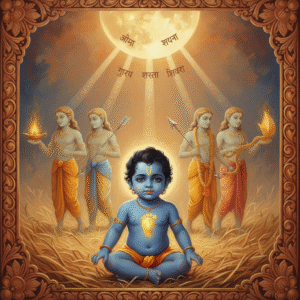
Tulsidas spends most of this section of the Ramcharitmanas describing a baby. The four sons of Dasharatha have been born, Sage Vasishtha has come to name them, and from Doha 197 through Doha 200 the poem does very little except look at the child Rama: his complexion, the moon of grace in his heart,
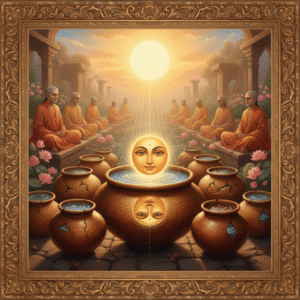
Two verses open this lecture, and both of them sound, at first hearing, like something a scripture should not say. One declares that a certain kind of person deserves to die. The other declares that a certain kind of person will never really die at all. Swami Jyotirmayananda spends the first six min