The Sky, the Clouds, and the Life That Shines
Yoga Vasistha, Upasama Prakarana, sections 37 to 39 — lesson 180

Yoga Vasistha, Upasama Prakarana, sections 37 to 39 — lesson 180
Patanjali spends three chapters elaborating what he states once, briefly, in the first. Sutras 1.17 and 1.18 are that statement about samadhi itself, and Sri Swami Jyotirmayananda returns to 1.17 in this ninth lesson deliberately rather than by accident. “Seventeenth Sutra, I have already talked abo

There is a fear that sits underneath any long practice, and in the closing verses of the sixth chapter Arjuna finally says it out loud. He does not ask about the person who never began, or the person who abandoned the path. He asks about the one who tried. Someone with faith, someone sincere, whose…
This lecture takes up Balkanda from Doha 196, in the stretch just after Rama’s birth, and it turns on a distinction most readings of the passage skip. On the surface the verses record a royal celebration: King Dasharatha opens his treasury and gives away elephants, chariots, horses, gold, cows and d

“In the name of wisdom, if your personality begins to lose softness of the heart, goodness of the heart, generosity, charity, joyousness—if your heart loses these, you are not going to be really liberated.” Swamiji states the warning before a single mantra is chanted. A moment later, the diagnosis:

The lecture opens without preamble, on a chain of questions borrowed from the Upaniṣads. What gives light to the senses? The mind. What gives light to the mind? The intellect. What gives light to the intellect?

“It seems it’s not important to ask the question, Who am I? I already know it — my picture is there in the passport.”

Sri Swami Jyotirmayananda continues the Srimad Bhagavad Gita in Chapter 6, Atma Samyama Yoga — the yoga of self-control — at verses 35 and 36. Arjuna has just heard the whole teaching and reached an honest conclusion: it cannot be done. The mind, he says, is like wind, and no one controls wind. Sinc
Sri Swami Jyotirmayananda continues the Tulsi Ramayana — Balkanda, from Doha 196 — through the great charity of King Dasharatha after Rama’s birth and the naming ceremony in which Sage Vasishtha reveals the meaning hidden in the four brothers’ names. As always, Swamiji is not interested in the histo
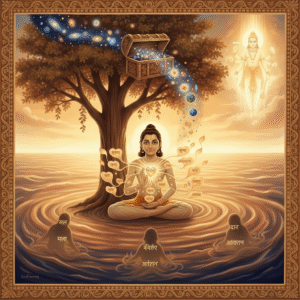
Sri Swami Jyotirmayananda continues the Yoga Vasistha, Upasama Prakarana, Section 35, where Sage Vasishtha tells Rama how Prahlada, through profound reflection (vicara), came practically to the state of enlightenment. Because he arrived there, whatever he practiced along the way is important for eve

Sri Swami Jyotirmayananda continues the Yoga Vasistha, Upasama Prakarana, Section 35, where Prahlada gives spiritual aspirants a practice of affirmation for enlightenment. The section opens on a single, startling claim: when the Self is known, all is known.

Sri Swami Jyotirmayananda, a direct disciple of Swami Sivananda, opens sutras fifteen through eighteen of Patanjali’s Samadhi Pada with a single disarming image. The mind, he says, is like an umbrella. You carry it into the rain, you use it, and when you come home you set it down at th